
About Harness Racing: the Farrier
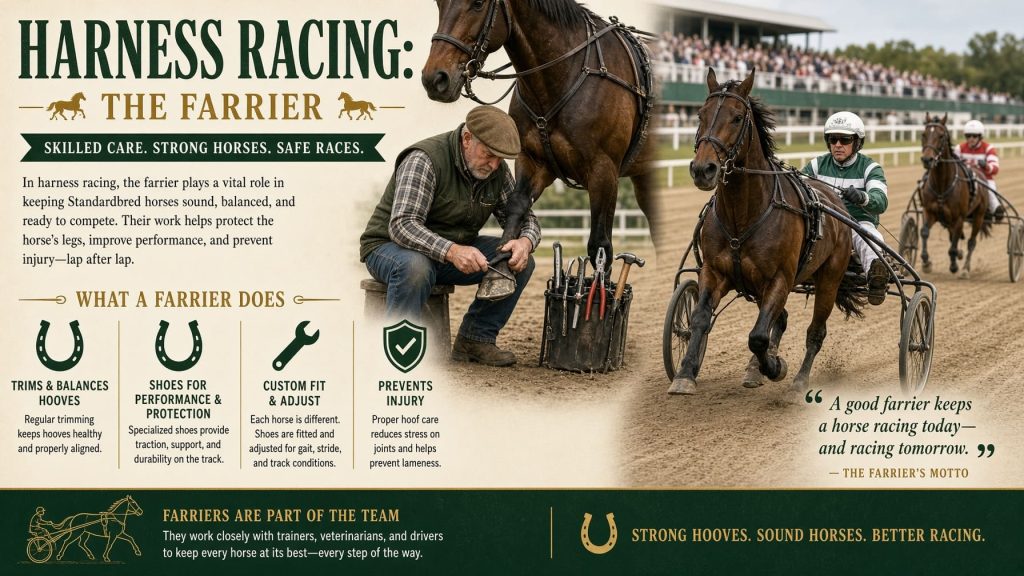
In North American harness racing, farriers work primarily with Standardbreds, which race as trotters or pacers. A farrier trims and balances the hooves, fits or modifies shoes when needed, and works with the trainer—and, when pain or lameness is involved, the veterinarian—to support comfortable and mechanically sound movement.
Farriery involves much more than attaching a horseshoe. The work starts with the foot itself: hoof shape, wall quality, sole and heel condition, wear patterns and the way the horse uses each limb.
In North American racing, the word blacksmith is still sometimes used informally for a farrier. The terms are not technically identical: blacksmithing is metalwork, while farriery includes specialized hoof care, trimming, balancing and shoe fitting.
What a Farrier Looks At
Hoof care is individualized. The trim or shoeing setup may change as the hoof grows, the horse's workload changes or a mechanical problem becomes apparent.
- Hoof balance: the shape of the foot and how it meets the ground.
- Hoof growth and wear: uneven wear can provide information about how the horse is loading the foot.
- Heel and sole condition: whether the foot has adequate support and protection.
- Breakover: how the foot rotates forward and leaves the surface at the end of the stance phase.
- Interference: whether one limb is brushing or striking another.
- Hoof–surface interaction: how the hoof and shoe interact with the racing surface.
The aim is functional balance and comfortable movement rather than reproducing a particular hoof angle, toe length or shoe design simply because it works for another horse.
Why Farriery Matters to a Trotter or Pacer
Harness racing uses two principal gaits. A trotter moves its legs in diagonal pairs, while a pacer moves the legs on the same side together. Most pacers race in hopples, although some compete free-legged.
Hoof balance and shoe characteristics can influence aspects of limb motion, loading and how the foot leaves the ground. The effect varies between horses and shoeing configurations.
Breakover: the phase from heel lift until the toe leaves the ground. Trimming and shoe placement can alter breakover, but any adjustment has to be considered together with the rest of the hoof and limb.
How a Farrier Adapts Hoof Care to the Horse
Farriers may adjust the trim, shoe shape, shoe placement or other features to suit the individual horse's feet and movement. Track conditions can also matter because the hoof and shoe interact differently with firmer, softer, wetter or looser surfaces.
More traction is not necessarily better. The most appropriate hoof–surface interaction depends on the horse, the shoe and the racing surface.
Shoe material, weight, toe length and hoof angle are considered as parts of a complete setup rather than as isolated performance variables. There is no single configuration that is appropriate for every trotter or pacer.
Farrier, Trainer and Veterinarian
The trainer provides day-to-day information about how the horse feels and moves during training and racing. The farrier evaluates hoof growth, balance, wear and shoe fit. When pain, lameness or injury is suspected, veterinary assessment is appropriate, with the veterinarian and farrier often working together when the foot is involved.
When clinically appropriate, radiographs can help evaluate internal structures and guide therapeutic trimming or shoeing. Imaging is a diagnostic tool for selected cases, not a routine requirement for every harness horse.
Can Farriery Help a Horse That Goes Off Stride?
Sometimes. A trimming or shoeing adjustment may help when hoof balance, shoe fit or interference contributes to a gait problem.
But a break in gait does not identify the cause. Soreness, fatigue, conformation, equipment, racing speed and track conditions can also contribute. If pain or lameness is suspected, the horse should be assessed by a veterinarian rather than relying on repeated shoeing changes alone.
What Farriery Can Tell a Race Analyst
A publicly reported shoeing change can be relevant, but the fact that a change was made does not indicate whether the horse will improve. The reason for the adjustment is more useful than the adjustment by itself.
- Has the horse recently shown a gait or interference problem?
- Is the change connected to unusual track conditions?
- Has a hoof-related issue recently been reported?
- Does the horse appear comfortable and even in the warm-up?
- Has it previously made breaks under similar conditions?
Without that context, farriery information should be treated as one part of the overall race assessment rather than as a direct predictor of the result.
Common Misconceptions About Harness-Racing Farriers
“A farrier just nails on horseshoes.”
Trimming and balancing the foot are fundamental parts of farriery. When a shoe is used, it is selected and fitted in relation to the prepared hoof and the horse's individual needs.
“Lighter shoes always make a horse faster.”
Shoe weight is only one variable. Movement can also be affected by shoe shape and placement, hoof balance, traction, gait mechanics and the racing surface.
FAQ About Farriers in Harness Racing
What does a farrier do in harness racing?
A farrier trims and balances hooves, fits or modifies shoes when needed, monitors hoof condition and wear, and works with trainers and veterinarians to support comfortable, mechanically sound movement.
Why does hoof balance matter to a Standardbred?
Hoof balance affects how the foot meets and leaves the ground. Because trotters and pacers must maintain a defined gait at speed, foot-related mechanical problems can contribute to interference or inconsistent movement.
Can different shoes change the way a horse moves?
Yes. Shoe characteristics can alter aspects of limb motion, breakover, loading and hoof–surface interaction, but the effect varies between horses and shoeing configurations.
Is a shoeing change a strong handicapping signal?
Not by itself. It is more informative when the reason is known, such as interference, a hoof-related issue, a gait problem or a significant change in racing-surface conditions.
Sources
- U.S. Trotting Association — Who's Who in Harness Racing
- Standardbred Canada — Standardbred & Harness Racing Glossary
- Aoun R, Takawira C, Lopez MJ — Horseshoe Effects on Equine Gait—A Systematic Scoping Review