
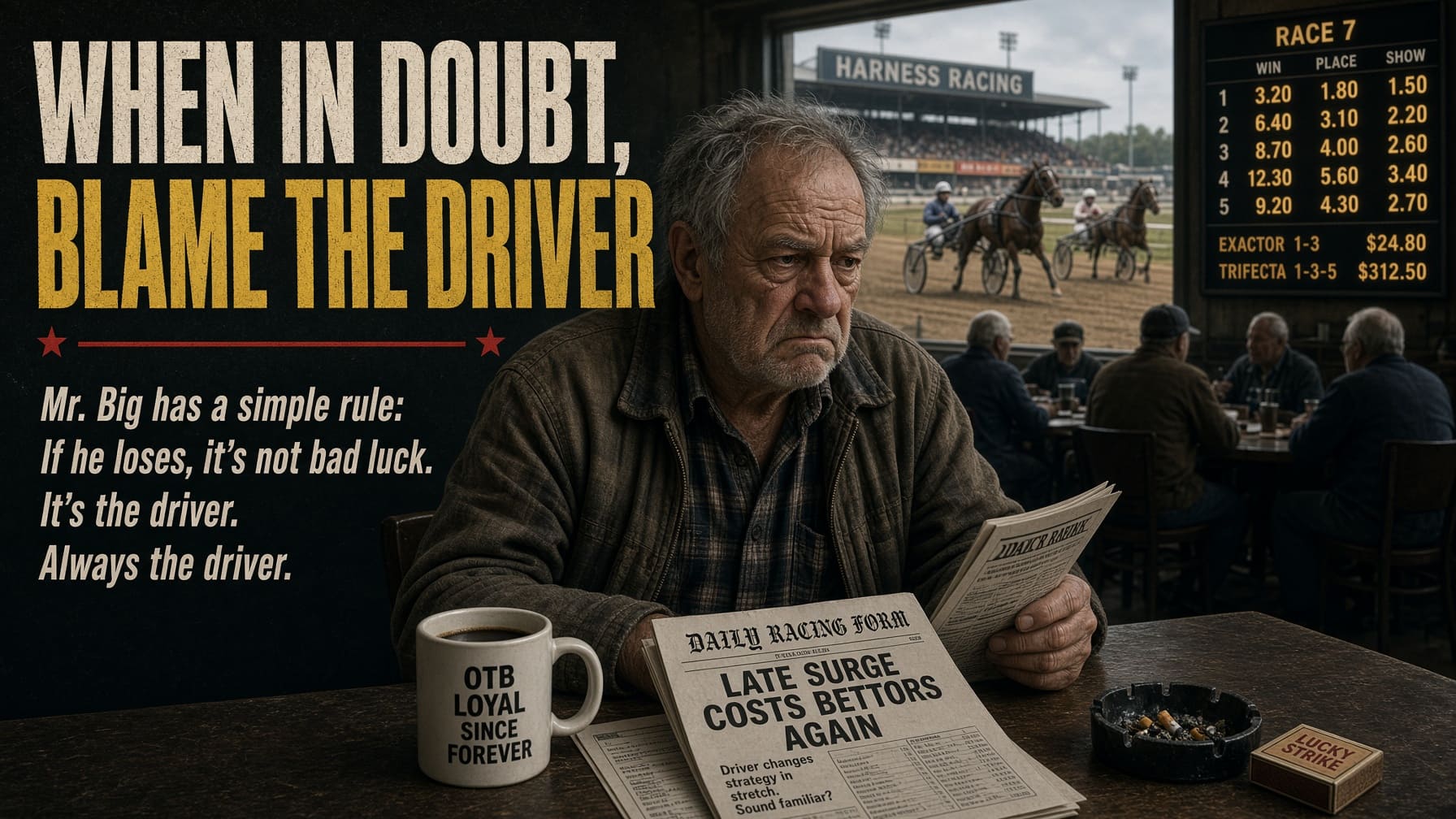
When In Doubt, Blame The Driver
In harness racing, the driver can materially affect a horse's trip through early position, pace, cover and timing, but the driver is only one part of the result. Horse ability, class, post position, race shape and traffic should be evaluated separately before a losing performance is blamed on the drive.
Contents
A skilled driver can help a horse use its ability efficiently, but cannot create ability that is not there. For readers unfamiliar with the discipline, see what harness racing is and how it works .
How Much Does the Driver Matter in Harness Racing?
For handicapping purposes, much of a driver's influence can be evaluated through the quality of the trip. Decisions made at the start, through the middle stages and approaching the finish can determine whether a horse saves ground, receives cover, spends too much energy early or becomes trapped behind rivals.
- Early position: whether to leave, settle or take back.
- Trip efficiency: saving ground and avoiding unnecessary wide racing.
- Cover: whether to follow another horse or race exposed.
- Timing: when to ask the horse to improve position.
- Pace response: adapting when the race develops faster or slower than expected.
- Racing room: maintaining a realistic route through late in the race.
A well-driven horse can still lose because trip efficiency cannot compensate for insufficient ability or a stronger opponent.
What the Driver Can and Cannot Control
The driver can influence
- how aggressively the horse is used at the start;
- whether ground is saved or additional distance is covered;
- whether the horse receives useful cover;
- when a move is initiated;
- how the horse is positioned relative to the pace;
- whether the tactics suit the horse's demonstrated racing style.
The driver cannot fully control
- the horse's physical condition and underlying ability;
- the strength of the opposition;
- the assigned post position;
- unexpected moves by other drivers;
- a rival slowing directly in front;
- interference and changing traffic patterns;
- a horse breaking stride;
- unexpected changes in how the race develops.
Once a post position has been assigned, the driver's task is to adapt the trip to it. Post position and driver decision-making should therefore be analysed as related but separate factors.
What Makes a Bad Drive?
A bad drive is a tactical decision that unnecessarily reduces a horse's chance when a realistic better option was available at the time. A poor finishing position by itself does not prove poor driving.
Examples can include:
- using excessive early speed when a less costly position was available;
- remaining behind a weakening rival despite having a clear opportunity to move;
- making an unnecessarily long uncovered move;
- failing to react to a slow pace until the leaders have gained a major positional advantage;
- repeatedly using tactics that conflict with the horse's demonstrated strengths.
Five Driver Decisions Worth Studying
1. The Start
The opening stage can determine the entire trip. From an inside position, a driver may be able to protect ground without using the horse aggressively. From a wider position, the choice can be harder: leave for position and spend energy, or take back and risk beginning the main part of the race too far behind.
Judge the decision by what it cost the horse, not only by where the horse was positioned after the start.
2. Securing Position Efficiently
A horse racing outside another horse for an extended period may cover additional ground and work harder than a rival receiving an economical trip. Finishing position alone can therefore hide the quality of the performance: a horse finishing fifth after a demanding trip may have run better than a horse finishing third after saving ground throughout.
3. Reading the Pace
Pace changes the value of positional decisions. If several horses contest the lead aggressively, joining that battle may require unnecessary early effort. If the leaders travel comfortably, horses positioned well behind them may face rivals that have conserved more energy for the closing stages.
Before deciding that a driver moved too early or too late, consider the pace, the horse's usual racing style, the position of the main rivals, available cover, work already done and how far remained when the move began.
4. Cover Versus an Uncovered Move
Following an advancing rival can provide cover and allow a horse to improve position without doing all the work itself. The risk is that the horse providing cover may stop advancing, leaving the following horse trapped or forcing it wider.
Moving without cover removes that dependency but can require a longer sustained effort and additional ground. The United States Trotting Association racetrack guide describes the pocket as an economical position behind the leader that can also create the risk of being boxed in, while a first-over horse races outside without cover and generally faces a more demanding trip.
5. Racing Room Late in the Race
A horse that appears to finish with energy remaining will often attract criticism of the driver, especially when no clear opening appeared in the stretch.
Sometimes the driver created the problem by accepting a position with too few realistic escape routes. In other cases, a rival may have stopped unexpectedly, maintained position longer than anticipated or closed a lane that previously appeared available.
When reviewing a blocked horse, look further back than the final stretch and ask how the horse reached that position.
Why Post Position Changes Driver Strategy
Post position affects the tactical choices available to a driver. An inside position can help a horse save ground, although some race shapes may increase the risk of becoming trapped behind slower traffic. A wide post may provide more freedom to choose a route, but securing an early forward position can require substantially more effort.
Raw driver win percentages should not be interpreted without context. Results can be influenced by the quality of horses driven, trainers, post positions, competition level and the circuits on which the driver competes.
Does a Driver Change Matter?
A driver change can matter, but it should not automatically be treated as an upgrade or downgrade.
A change becomes more relevant when:
- the previous trip contained a clear tactical problem;
- the new driver has previous experience with the horse;
- the horse requires a particular type of trip to perform well;
- the new driver may approach the expected pace or post-position problem differently.
A change of driver cannot compensate for a major disadvantage in ability or class. Evaluate the horse, opposition, post and likely race shape first.
Current driver and trainer statistics are available through official harness-racing resources such as USTA Racing, but those statistics still require context.
Do Not Confuse the Result With the Decision
A horse can lose after receiving a sound drive and win despite an inefficient one. Suppose a driver declines to join an expensive early battle for the lead and settles behind the leaders. If the expected pressure never develops and the leader keeps going, the horse may lose even though the original decision was defensible.
The reverse can also happen: an aggressive move may succeed because the horse is simply better than the opposition. Post-race analysis should judge the decision using the information and realistic options available when it was made, not only the finishing position.
How to Review a Driver From the Replay
At the start
- Did the horse show usable early speed?
- How much effort was required to obtain position?
- Was taking back reasonable from that post?
During the middle stages
- Was the horse saving ground or racing exposed?
- Was useful cover available?
- Did the pace become unusually fast or slow?
- Was there a realistic opportunity to improve position?
On the final turn and in the stretch
- Was the horse travelling strongly before being asked?
- Did a weakening rival create the traffic problem?
- Was there a realistic route outside or inside?
- Did the horse respond when clear racing room appeared?
- Did it finish with momentum or simply fail to improve?
When a Difficult Trip Matters for the Next Race
Replay analysis becomes useful when it changes how a horse should be assessed next time. A horse may deserve closer attention if it used substantial energy to obtain early position, raced without cover for a significant part of the race, was repeatedly denied clear racing room, followed a tiring rival at a crucial stage or was forced into a trip that did not suit its established racing style.
Avoid recording the trip simply as unlucky. Identify the specific problem and decide whether it is likely to recur. A horse blocked once behind a tiring rival presents a different situation from a horse that repeatedly encounters traffic because it lacks enough early speed to secure position.
When Blaming the Driver Is Usually Wrong
Driver criticism is much weaker when the horse:
- was simply slower than the principal rivals;
- was facing significantly stronger competition;
- received a reasonable trip but failed to accelerate;
- had to overcome both a difficult post and an unfavourable race shape;
- encountered traffic that was difficult to anticipate;
- broke stride or otherwise failed to perform normally.
In these situations, the more useful conclusion may be that the original assessment of the horse was wrong rather than that the driver caused the defeat.
How to Use the Driver in Handicapping
- Assess the horse. Is its demonstrated ability competitive with this field?
- Check class. Is the horse facing stronger, weaker or similar opposition?
- Review the post position. What opportunities or tactical problems does it create?
- Estimate the likely race shape. Which horses are likely to seek early position?
- Identify the preferred trip. Does this horse usually perform better near the lead, behind cover or from off the pace?
- Evaluate the driver. Is the driver likely to help the horse obtain an efficient version of that trip?
What to Carry Into the Next Race
Drivers matter in harness racing because they influence position, pace response, cover, timing and racing room. Those decisions can improve or reduce trip efficiency, but "blame the driver" is not a complete handicapping explanation.
Separate the horse's ability from the trip it received, review tactical decisions in context and identify which parts of the result the driver could realistically influence. A replay is useful when it changes the next assessment. It should not become an excuse for the previous result.