
Correct Score Odds to Probability Explained
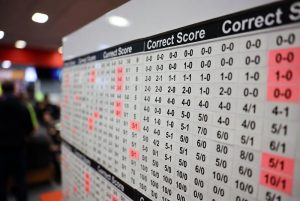
How Correct Score odds become probabilities
Convert decimal Correct Score odds into raw implied probabilities, calculate the total market percentage, and apply proportional normalization to compare scorelines on the same basis. This method describes how prices are distributed across the market; it does not reveal the tactical reasons behind those prices or guarantee fair betting value.
How to calculate implied probability
Use every mutually exclusive outcome in the complete market.
Decimal odds can be converted into raw implied probability by dividing 1 by the price. A scoreline priced at 8.00 therefore has a raw implied probability of 12.50%. The result still includes the bookmaker’s margin.
Calculation process
1. Convert each decimal price Raw implied probability = 1 ÷ decimal odds 2. Add the complete market Market total S = sum of all raw implied probabilities 3. Apply proportional normalization Margin-adjusted probability = raw implied probability ÷ SThe complete market is required. Include every exact score and every remaining mutually exclusive catch-all category offered in that market. Normalizing only selected scorelines produces a distribution for that subset, not a margin-adjusted estimate for the full market.
Method limitation: proportional normalization assumes that the bookmaker margin can be removed from every outcome in the same proportion. It creates a useful margin-adjusted distribution, but it does not prove the bookmaker’s true fair probabilities because the margin may not be distributed evenly across all scorelines.
Worked Correct Score probability example
Synthetic prices created for demonstration, not odds copied from a bookmaker.
This example treats “All remaining scores” as one catch-all category. The listed rows therefore form one complete set of mutually exclusive outcomes.
| Outcome | Decimal odds | Raw implied probability | Margin-adjusted probability |
|---|---|---|---|
| 1–1 | 6.80 | 14.71% | 13.70% |
| 1–0 | 7.60 | 13.16% | 12.26% |
| 0–1 | 7.90 | 12.66% | 11.79% |
| 2–1 | 9.20 | 10.87% | 10.12% |
| 0–0 | 9.50 | 10.53% | 9.81% |
| 2–2 | 13.00 | 7.69% | 7.17% |
| 2–0 | 12.00 | 8.33% | 7.76% |
| All remaining scores | 3.40 | 29.41% | 27.40% |
How to compare Correct Score market profiles
Compare related groups of scores rather than treating one short price as a prediction.
Correct Score prices can show whether more market probability is assigned to one team winning, to draw outcomes, or to higher combined goal totals. They describe the distribution of final scores, but they do not independently explain why that distribution exists.
| Market profile | Scores often priced shorter | What the distribution supports | Useful cross-checks |
|---|---|---|---|
| Strong favourite | 1–0, 2–0, 2–1 and other wins for the favoured team | More probability is allocated to favourite-win scorelines than to draws or opposition wins. | 1X2, Asian handicap, team totals and clean-sheet markets |
| Balanced match | 1–1, 1–0, 0–1, 2–1 and 1–2 | Neither team holds a dominant share of the likely one-goal results, while draw outcomes remain important. | 1X2 spacing, draw price, draw no bet and Asian handicap |
| Higher-scoring match | 2–1, 1–2, 2–2, 3–1, 3–2 and similar outcomes | More probability is assigned to scorelines containing at least three total goals. | Over/Under, both teams to score and team totals |
Interpretation limit: a short 2–1 price does not prove that the favourite will dominate possession or that the other team will score from a set piece. Those explanations require separate lineup, tactical and statistical evidence.
Estimating BTTS and goal totals
Related probabilities can be estimated only when every outcome can be classified.
Both Teams to Score
Add the margin-adjusted probabilities of every scoreline in which both teams score. Qualifying outcomes include 1–1, 2–1, 1–2 and 2–2. Exclude 0–0 and every result in which either team scores zero.
Over 2.5 goals
Add the margin-adjusted probabilities of every scoreline containing at least three total goals. Qualifying outcomes include 2–1, 1–2, 3–0, 0–3 and 2–2.
A broad catch-all category can contain scorelines from both sides of the calculation. For example, “All remaining scores” may include both 1–3 and 0–2. Its probability cannot be assigned accurately to BTTS or Over 2.5 unless the scores inside that category are known.
What the probability grid can tell you
The grid supports market comparison, not a complete match prediction.
Useful conclusions
- Which exact scores carry the largest shares of the listed market.
- Whether probability is concentrated around one team, draw outcomes or higher goal totals.
- How the distribution changes when the underlying prices move.
- Whether the score distribution broadly agrees with the 1X2, BTTS and totals markets.
What the grid does not prove
- Why the market expects a particular score distribution.
- Which team will control possession, territory or pressing phases.
- Whether a goal is likely to come from open play, a transition or a set piece.
- Whether an individual scoreline offers positive value against an independent estimate.
Correct Score can carry a higher margin than simpler markets because many low-probability outcomes must be priced separately. Use the grid as a comparison tool, then check it against simpler markets and current match information before drawing a betting conclusion.
For related tools, visit the betting calculators for odds, probability, value and staking .
Correct Score odds FAQ
Common questions about raw and margin-adjusted probabilities.
How do I convert Correct Score odds into probability?
For decimal odds, divide 1 by the price and multiply by 100. Odds of 8.00 produce a raw implied probability of 12.50%. This percentage still includes the bookmaker’s margin.
How is the market adjusted for bookmaker margin?
Convert every mutually exclusive outcome into raw implied probability, add the complete market to obtain S, and divide each probability by S. This proportional normalization produces a margin-adjusted distribution.
Why must every market outcome be included?
Missing scorelines leave part of the market probability outside the calculation. Normalizing an incomplete list redistributes only the selected subset and can overstate the importance of its outcomes.
Can Correct Score odds estimate BTTS or Over 2.5?
Yes, when every outcome can be classified. Add the margin-adjusted probabilities of all qualifying scorelines. A mixed catch-all category prevents a precise calculation unless its internal score distribution is known.
What is the main mistake when reading this market?
Treating the shortest-priced scoreline as the bookmaker’s single prediction. The more useful information is the probability distributed across related groups of home wins, draws, away wins and goal totals.
This content is provided for educational and informational purposes only. Betting involves financial risk, and no probability estimate guarantees a result.