
Odds movement explained: why lines move, and what the move usually means
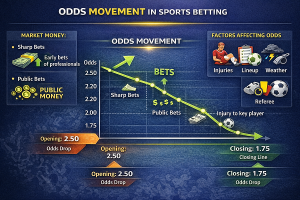
What odds movement means
Odds movement is a change in a betting price or market line. Shortening decimal odds indicate a higher raw implied probability, while drifting odds indicate a lower one. A move confirms that the market price changed, but it does not identify the cause or predict the result.
Examples of odds movement and how to classify them
The same visible move can have several explanations. Timing, market coverage, liquidity, limits and related prices provide context, but they rarely prove the cause on their own.
Confirmed lineup information changes the expected strength of one team
- Earlier price: home win at 2.10.
- Confirmed update: a key absence weakens the home side.
- Later price: home win moves from 2.10 to 2.35 across several operators.
- Raw implied probability: approximately 47.6% at 2.10 and 42.6% at 2.35, before removing bookmaker margin.
- Interpretation: the timing and broad market response support an information-led explanation, but the move still does not determine the result.
Match conditions lead totals and related markets to move together
- Initial market: total 2.75 with similar prices on both sides.
- Possible trigger: confirmed conditions increase the likelihood of a slower or lower-event match.
- Market response: the total moves to 2.5 while unders shorten in team totals or related markets.
- Interpretation: coordinated movement is more consistent with a broader probability reassessment than with an isolated adjustment by one bookmaker.
A leading market moves before any public explanation appears
- Observed pattern: one influential market changes first and other operators follow.
- Possible causes: informed betting, model-driven action, correction of a stale price or information that is not yet public.
- Interpretation: the absence of a visible news report does not prove that the move came from public betting.
- What to monitor: whether the new price holds, spreads across the market and remains supported as liquidity increases.
One bookmaker shortens a popular favorite while the wider market stays stable
- Earlier price: favorite at 1.90.
- Later price: one operator shortens the favorite to 1.75 while leading markets remain near their earlier prices.
- Possible explanation: the bookmaker is adjusting its exposure or responding to one-sided customer demand.
- Interpretation: an isolated move is more consistent with book-specific risk management, but it does not prove who placed the underlying bets.
When the cause is unclear
Classify the explanation as unconfirmed. Compare which market moved first, how many operators followed, whether related markets changed and whether the new price held. Do not label a move as public or professional money from the chart alone.
Raw probability and bookmaker margin
Decimal odds can be converted into raw implied probability using 1 ÷ odds. The result still includes bookmaker margin. Estimating a no-vig probability requires the prices for every outcome and normalization of their combined implied probabilities.
What odds movement can and cannot tell you
Odds movement confirms that a market price changed. Its significance depends on the market, the size of the adjustment and the evidence surrounding it.
| Observed signal | What it may indicate | What it does not prove |
|---|---|---|
| Sudden market-wide move | New information, informed betting or correction of a stale price. | That the selection will win or that every operator received the same information. |
| One-book adjustment | Local exposure, customer flow or a delayed internal update. | That the wider market has changed its assessment. |
| Related markets move together | A coherent change in expectations about team strength, tempo or likely game state. | The exact trigger or the final match outcome. |
| Price retraces | Resistance at the new price or opposing demand. | That the original move was caused by casual bettors. |
Price movement versus line movement
A price move changes the odds while keeping the same handicap or total. A line move changes the handicap or total itself. Moving from Under 2.75 at 1.95 to Under 2.75 at 1.80 is a price move; moving the total from 2.75 to 2.5 is a line move.
How to assess the significance of a move
- Market source: identify which operator, exchange or market changed first.
- Market coverage: distinguish an isolated adjustment from movement across several independent prices.
- Timing and liquidity: an early low-limit move may carry different meaning from a later move in a deeper market.
- Related markets: check whether 1X2, handicaps, totals and team totals tell a consistent story.
- Persistence: note whether the new level holds, continues or retraces.
- Market type: important thresholds work differently in 1X2, Asian handicap and totals markets.
Key numbers depend on the market
Crossing an important handicap or total can represent a larger adjustment than a small price change at the same line. There is no universal key number across every betting market: significance depends on the sport, market structure and probability distribution around the line.
Related Odds2Win tools and guides
FAQ: understanding odds movement
Is a line move always caused by sharp money?
No. A line can move because of new information, informed betting, model-driven action, correction of a stale price, changing liquidity, customer demand or book-specific risk management. The movement alone does not identify the cause.
Is a line move more important than a price move?
Not always. A change to the handicap or total can represent a substantial adjustment, especially near an important threshold. A large price move at the same line can also be meaningful. The market type and size of the change must be considered.
Why do favorites sometimes shorten close to kickoff?
Possible causes include late team information, market-led betting, rising limits or one-sided customer demand. Comparing leading prices and related markets is more reliable than assuming every late favorite move comes from public betting.
How can totals move without obvious news?
Totals may react to informed orders, model updates, changing liquidity or movement at an influential market. A coordinated change across match totals, team totals and related prices supports a broader repricing, even when the original trigger is not public.
How should odds movement be used in betting analysis?
Use it as market context rather than as a standalone prediction. Review the timing, source, size, market-wide consistency, related prices and bookmaker margin before deciding whether the new odds still offer an acceptable price.