
Odds2Win
Odds2Win
daily sports predictions & betting insights

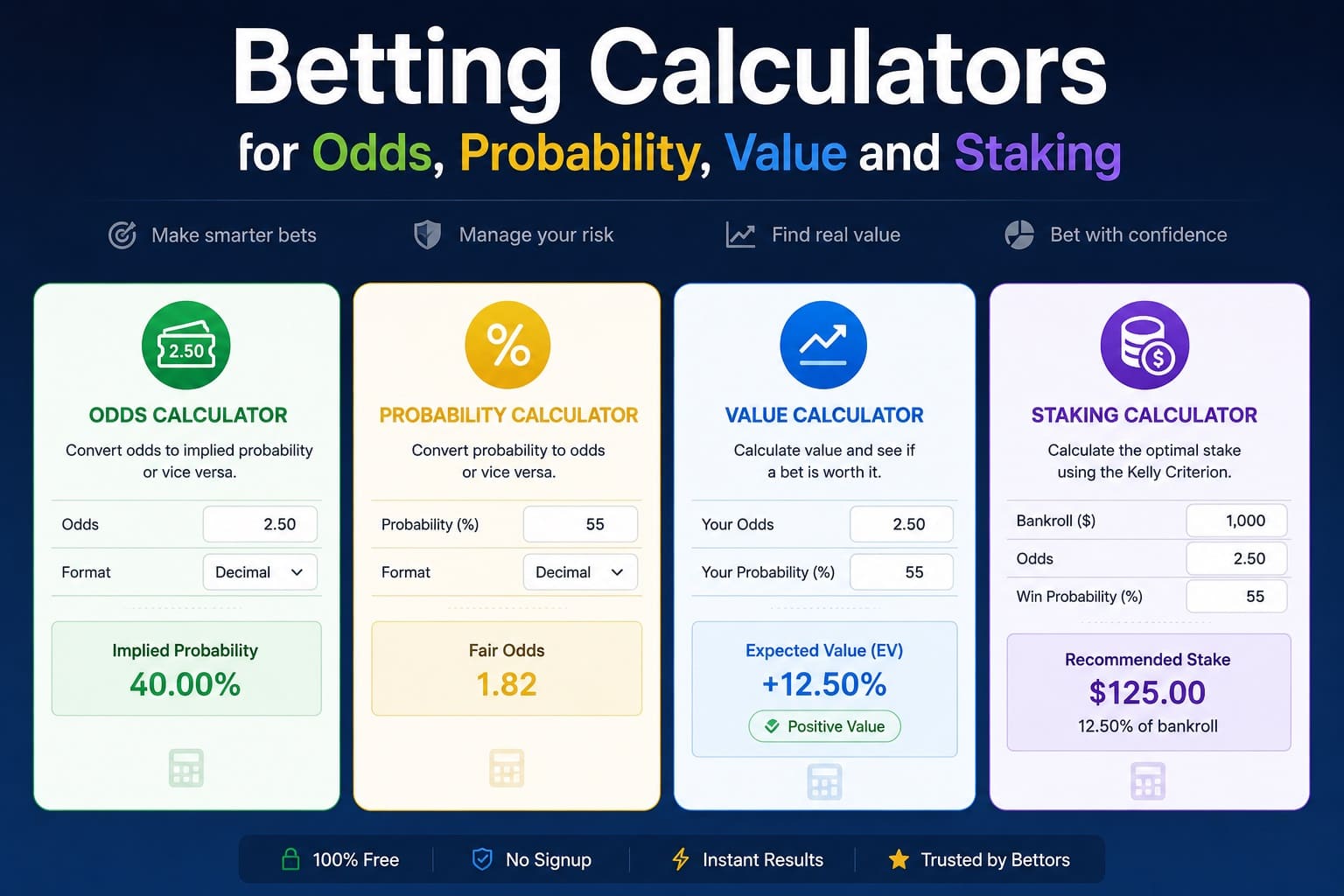
Betting Calculators for Odds, Probability, Value and Staking

Betting calculator tools for comparing odds, probability, value and stake size

Seven tools for pricing, value and settlement

Choose a calculator according to the question you need to answer.

Betting calculations are most useful when each tool has a defined role. Converting odds, estimating implied probability, removing bookmaker margin and measuring expected value are connected steps, but they do not produce the same result.

Use this hub to move from the quoted price to a more structured assessment. First put the odds into a familiar format. Then calculate the market's break-even probability and, where several outcomes are available, estimate the margin included in the complete market. Expected value can only be assessed after you have an independent probability estimate.

The remaining calculators address stake size, Asian handicap settlement and football score modelling. They improve consistency and reduce arithmetic errors, but their outputs remain dependent on the accuracy of the inputs.

Which betting calculator should you use?

Match the tool to the immediate calculation rather than relying on one number for the full decision.

Task What the result means Calculator
Convert odds Expresses the same market price in decimal, fractional or American format. Odds Converter
Calculate implied probability Shows the break-even probability represented by a quoted price. Implied Probability Calculator
Remove bookmaker margin Normalises all outcomes to produce proportional no-vig probabilities. Bookmaker Margin Calculator
Calculate expected value Compares your estimated probability with the available odds. Expected Value Calculator
Calculate stake Converts bankroll size and estimated edge into a controlled stake. Bankroll Staking Calculator
Check handicap settlement Explains full wins, half wins, pushes, half losses and full losses. Asian Handicap Calculator
Model football scores Estimates correct-score probabilities from expected home and away goal rates. Poisson Score Calculator

How each calculator works

Definitions, formulas, practical examples and the main limitation of each method.

01
Convert odds

Odds Converter

Open Odds Converter

Odds conversion changes the notation of a price without changing its underlying payout or implied probability. It is useful when comparing bookmakers or markets that use different display formats.

Fractional a/b → Decimal = 1 + a ÷ b
Positive American +A → Decimal = 1 + A ÷ 100
Negative American odds → Decimal = 1 + 100 ÷ |American odds|

Decimal odds of 2.50 are equivalent to fractional odds of 3/2 and American odds of +150. American odds of −200 convert to decimal odds of 1.50.

What conversion does not do

Changing the display format does not remove bookmaker margin or show whether the price has positive expected value.

02
Calculate implied probability

Implied Probability Calculator

Open Implied Probability Calculator

Implied probability is the break-even percentage represented by a quoted price. It provides a market benchmark before you introduce your own forecast.

Implied probability (%) = 1 ÷ decimal odds × 100

Decimal odds of 2.50 imply 40%. Odds of 1.80 imply approximately 55.56%. Your estimated probability must exceed the relevant break-even point before the price can show positive theoretical value.

Implied does not mean true

In a complete market, the raw implied probabilities normally include bookmaker margin and may add up to more than 100%.

03
Remove bookmaker margin

Bookmaker Margin Calculator

Open Bookmaker Margin Calculator

Bookmaker margin is calculated across every mutually exclusive outcome in the same market. The calculator first converts each price into raw implied probability and then normalises the total.

Overround (%) = [Σ(1 ÷ decimal odds) − 1] × 100
Proportional no-vig probability = raw probability ÷ total raw probability

In a two-way market priced at 1.91 and 1.91, each selection has a raw implied probability of approximately 52.36%. The combined total is about 104.71%, giving an overround of approximately 4.71%. Proportional normalisation returns 50% for each side.

Method used

This calculator uses proportional normalisation. Alternative de-vig methods can produce slightly different estimates, particularly in uneven markets.

04
Calculate expected value

Expected Value Betting Calculator

Open Expected Value Calculator

Expected value compares your independently estimated probability with the available price. It represents the theoretical average return per unit staked, not the chance that one individual bet will win.

EV per unit = estimated probability × decimal odds − 1

At decimal odds of 2.20 and an estimated probability of 47%, EV equals 0.47 × 2.20 − 1 = 0.034. The theoretical expected value is therefore +3.4% per unit staked.

The forecast is the critical input

A mathematically correct EV result can still be misleading when the probability estimate is poorly calibrated, based on a small sample or adjusted after seeing the odds.

05
Calculate stake

Bankroll Staking Calculator

Open Bankroll Staking Calculator

A staking calculator converts bankroll size, price and estimated probability into a controlled level of exposure. It should be used after the price and probability assumptions have been checked.

Full Kelly fraction = (b × p − q) ÷ b
b = decimal odds − 1, p = win probability, q = 1 − p

At odds of 2.20 with a 47% estimated probability, full Kelly is approximately 2.83% of bankroll. Quarter Kelly reduces the theoretical stake to approximately 0.71%.

  • If the Kelly fraction is zero or negative, the calculation does not indicate a bet.
  • Fractional Kelly reduces exposure when the probability estimate is uncertain.
  • Correlated bets should also be controlled by a separate total-exposure limit.
Stake size is not a confidence label

A larger mathematical stake is only justified when the probability estimate and the available price support it.

06
Check Asian handicap settlement

Asian Handicap Calculator

Open Asian Handicap Calculator

Quarter handicaps split the stake equally between two neighbouring lines. The calculator shows whether the final score produces a full win, half win, push, half loss or full loss.

−0.25 = half the stake on 0 and half on −0.5
+0.75 = half the stake on +0.5 and half on +1.0

A team backed at −0.25 produces a half loss when the match ends in a draw: the 0 portion is refunded and the −0.5 portion loses. A team backed at +0.75 produces a half loss when it loses by exactly one goal.

Check the market rules

Confirm which team receives the handicap and whether settlement uses regulation time only or includes extra time.

07
Calculate Poisson score probabilities

Poisson Correct Score Calculator

Open Poisson Score Calculator

A basic Poisson model estimates the probability that a team scores exactly zero, one, two or more goals from an expected goal rate. Home and away distributions can then be combined into correct-score probabilities.

P(X = k) = e−λ × λk ÷ k!
Correct-score probability = home score probability × away score probability

If the expected home scoring rate is 1.60 and the away rate is 1.10, the probability of 2–1 is calculated by multiplying the probability of exactly two home goals by the probability of exactly one away goal.

  • The model assumes fixed scoring rates during the match.
  • A basic version treats the teams' goal totals as independent.
  • Red cards, tactical changes, lineups and game state are not automatically incorporated.
  • Some low-scoring draws can be misestimated without additional dependence corrections.
Read the full distribution

The most likely correct score is still only one outcome within a wider probability distribution.

Calculation standards used on Odds2Win

How results are interpreted across the calculator collection.

Decimal odds are the internal reference format

Other formats are converted before probability, expected value or staking calculations are performed.

Raw implied probability is calculated before margin removal

The complete market is required when estimating overround and proportional no-vig probabilities.

Quarter handicaps are divided into equal halves

A −0.25, +0.25, −0.75 or +0.75 selection is settled as two equal stakes on neighbouring lines.

Kelly results depend on the probability entered

The staking output is not an independent recommendation and should be reduced when model uncertainty is high.

Poisson outputs use simplified scoring assumptions

They estimate a distribution from expected goal rates and do not guarantee the most likely displayed score.

Displayed values may be rounded

Where supported by the calculator, underlying calculations should use unrounded values before presenting the final result.

Betting calculator FAQ

Important differences between market prices, fair probabilities, value and modelling.

Which betting calculator should I use first?

Start with the odds converter only when the displayed format is unfamiliar. Then calculate implied probability. When the full set of prices is available, estimate the bookmaker margin before comparing the market with your own probability.

Is implied probability the same as true probability?

No. Implied probability is the break-even percentage represented by the quoted odds. It can include bookmaker margin and may differ from the outcome’s underlying probability.

Is a no-vig probability automatically a fair price?

No. Removing margin produces a cleaner market benchmark, but the result still depends on the selected de-vig method and the quality of the original market prices.

Does positive expected value guarantee profit?

No. Positive expected value describes a theoretical long-run average based on the probability entered. Individual bets and long sequences can still lose.

Can the Poisson calculator predict the exact final score?

It estimates the probability of multiple scorelines. The highest-probability score is not a prediction that the match will necessarily finish with that result.

Responsible use

These calculators are provided for informational and educational purposes. Betting involves financial risk, results depend on the accuracy of the inputs, and no calculation guarantees a profitable outcome.