
Correct Score Variance & Bankroll: Why Risk Management Matters
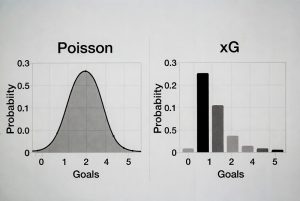
Correct Score looks simple—pick a number pair—but it is one of the most volatile football markets. Each scoreline is a tiny probability “cell”, so a good process can miss again and again. Your edge is not “winning often”; it is pricing: when your estimated probability is higher than the fair probability behind the odds. That’s why bankroll discipline matters more here than in 1X2 or totals: micro-stakes, a hard per-match cap, and clear stop rules. Variance is not bad luck—it’s the price of precision.
Why Correct Score is high variance
In 1X2 or totals you buy a wide “event bucket”. In Correct Score you buy one exact outcome out of dozens. That precision makes your results hinge on a few moments (a deflection, a red card, one set piece).
Variance in numbers (why streaks are normal)
| Hit probability (p) | Chance of 8 straight losses | What it means |
|---|---|---|
| 9% | (1−p)^8 ≈ 0.91^8 ≈ 47% | An 0–8 run is close to a coin flip even at “most-likely” style hit rates. |
| 12% | (1−p)^8 ≈ 0.88^8 ≈ 36% | Still common. A losing run is not proof your process is broken. |
Your edge in Correct Score is pricing: your probability must beat the fair probability behind the odds. Bankroll rules exist to survive the streaks long enough for that edge to show.
Value check: implied probability, margin, and EV
A quick implied probability is pimp ≈ 1 ÷ odds, but Correct Score grids often carry higher overround. If you have the full grid, a practical de-vig is: Overround = Σ(1 ÷ oddsi), then pfair,i = (1 ÷ oddsi) ÷ Overround.
You don’t need perfect maths to be disciplined—just avoid comparing your p to raw 1/odds when the grid is heavily margined.
EV (one-line rule)
EV per 1 unit = p · (odds − 1) − (1 − p). Value needs p > pfair (not just p > 1/odds).
Bankroll rules that survive variance
Correct Score punishes “normal” staking. The goal is not to remove variance (you can’t), but to cap exposure and keep runway. The ranges below are guardrails, not a promise.
| Control | Practical range | Why it helps |
|---|---|---|
| Unit per selection | 0.10%–0.25% of bankroll | Micro-stakes keep normal streaks from becoming account-sized drawdowns. |
| Per-match cap | 0.50%–1.00% total (even if dutching) | Stops “portfolio creep” where several small bets become one oversized position. |
| Weekly stop | 2%–4% drawdown limit | Prevents tilt escalation; protects decision quality and bankroll runway. |
No chasing. Never increase stake because you “haven’t hit in a while”. In high variance, chasing aligns bigger stakes with your worst mental state.
Stake sizing: flat vs fractional Kelly
Kelly can be useful when probabilities are well-calibrated. In Correct Score, small probability errors can inflate stakes because odds are high. For decimal odds define b = odds − 1, q = 1 − p. Kelly fraction: f* = (b·p − q) ÷ b.
- Flat staking is robust: fixed micro-unit per selection (default option for most bettors).
- Fractional Kelly is safer: if you use it, consider small fractions (e.g., 0.10–0.25 Kelly), not full Kelly.
- Discipline rule: when you feel the urge to size up, assume you are underestimating variance and size down instead.
Dutching multiple scores without paying margin twice
A tight cluster (2–4 adjacent scorelines) can reduce variance, but it can also become “buying margin” repeatedly. Use a simple check before you add legs:
- Implied sum: Σ(1 ÷ oddsi) across your chosen scores.
- Your sum: Σ(pi) from your model/script.
- Rule: if your Σ(pi) does not comfortably beat the de-vigged implied sum, you are likely just expanding exposure.
“I’ll add 0–0 just in case” + “I’ll add 3–1 for the late push” turns one clear script into a margin-heavy bundle. Keep clusters tight and keep total stake under one cap.
Live angle: when variance spikes (and when to stay out)
Live Correct Score is extremely sensitive to early match shape. Use a short trigger list so you don’t “trade your emotions”.
Update triggers (variance up)
- Early card / injury that changes pressing intensity or defensive line height.
- Transition game: repeated open-field counters, stretched spacing, end-to-end patterns.
- Chance quality jump: clear big chances, frequent box entries, close-range shots.
Hands-off triggers (do nothing)
- Low-quality volume: harmless shots, no real box access, stable shape.
- Neutral state holds: no goal, no tactical flip, no chaos signal.
- You missed the price: don’t enter late unless the new price compensates for the new risk.
FAQ: Correct Score variance & bankroll
Why do Correct Score bets lose so often even with good reads?
Because each exact score is a low-probability cell. Even when your match script is right, the exact pair can miss repeatedly. Losing runs are normal at 8–12% hit rates.
What’s the biggest bankroll mistake in Correct Score?
Staking like it’s totals and then chasing after misses. High variance plus stake escalation is the fastest way to turn normal noise into a blow-up.
Is “1 ÷ odds” enough to decide if the price is value?
It’s a quick screen, not a fair probability. Correct Score grids often have higher overround, so you should compare your p to a de-vigged (fair) probability when you can.
Should I cover multiple scorelines (dutching) to reduce variance?
A tight cluster can help, but only if each leg is value. Otherwise you are mostly buying margin multiple times. Keep a single per-match cap and avoid “just in case” add-ons.
Flat staking or Kelly?
Flat micro-units are the default for most bettors. If you use Kelly, do it fractionally (small fractions) because probability error is the main risk in high-odds markets.
When does variance spike so much that I should stay out?
When the match becomes chaos-prone: early cards, end-to-end transitions, or big-chance spikes. If the script is unstable, totals/BTTS often express the same view with less precision risk.