
Tennis 1X2 Predictions Today

How Today’s Tennis Winner Picks Are Evaluated
Tennis 1X2 predictions focus on the match winner market, where every pick depends on how the player profiles match up on the day. Surface speed, current fitness, serve reliability and return pressure can shift the value of a favourite or make an underdog more dangerous than the odds suggest. For today’s tennis picks, the strongest reads usually come from comparing the expected match script with the available price before backing a selection.
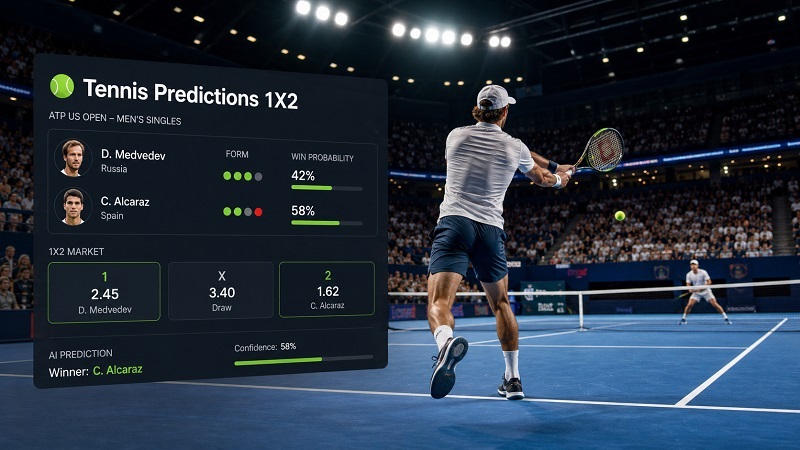
Tennis Predictions 1X2: Daily Winner-Market Logic
Tennis predictions 1X2 focus on the match-winner market: Player A to win or Player B to win. Since tennis has no draw result in a completed singles match, the X part of 1X2 does not work like football, but the phrase is still used on betting pages for winner-focused tennis picks.
Tennis Predictions 1X2 in Brief
The best tennis predictions 1X2 compare player profiles, surface fit, serve reliability, return pressure, and set-by-set risk before judging the price. A strong pick needs a clear route to winning the match, not only a better ranking or a popular name.
Strong daily tennis 1X2 reads start with matchup logic, not name value. A short-priced favourite can still be fragile if the surface weakens their serve pattern, if they struggle against heavy return pressure, or if the opponent has a cleaner route to cheap service holds. A bigger underdog can be playable when the price gives enough room for variance, especially in best-of-three matches where one poor set changes the whole market.
Today’s matches usually fall into three useful betting profiles: strong favourites, coin-flip spots, and underdog-risk matches. Strong favourites tend to have a clear surface fit, reliable serve-plus-one patterns, and fewer ways to lose control. Coin-flip matches demand sharper pricing because the market can overreact to ranking, nationality, or a recent headline. Underdog-risk matches are situations where the favourite may still win, but the odds do not fully account for fatigue, surface discomfort, or return pressure.
Practical Tennis 1X2 Checklist
- Surface fit: the player’s serve, return, and movement profile should match the court conditions.
- Hold pressure: identify who is more likely to protect service games under stress.
- Return threat: favour players who can create break chances without relying only on errors.
- Match format: best-of-three creates more upset risk than longer formats.
How Tennis 1X2 Differs from Football 1X2
Football 1X2 has three core outcomes: home win, draw, or away win. Tennis predictions 1X2 are different because a completed singles match produces one winner and one loser. That means the key betting question is not whether a draw can interrupt the pick, but whether the price correctly reflects the player’s route to winning more sets.
This difference changes risk assessment. In football, a strong side can dominate territory and still draw. In tennis, a player either converts enough service and return games to win the match or they do not. The market becomes more sensitive to serve efficiency, break-point pressure, tiebreak quality, medical condition, and momentum after each set.
| Factor | Football 1X2 | Tennis 1X2 |
|---|---|---|
| Draw risk | Central part of the market. | No draw in a completed singles match. |
| Main read | Team result across 90 minutes. | Player match winner. |
| Key swing | First goal and game state. | Breaks of serve, tiebreaks, and set momentum. |
| Live market | Moves around goals and pressure. | Moves around service holds, breaks, and fitness signs. |
For betting analysis, tennis 1X2 is closer to a moneyline-style winner market. The useful read comes from tennis-specific details: service holds, return pressure, surface fit, set momentum, and the player’s route to winning more sets.
Surface and Player Profile
Surface is one of the first filters for tennis predictions 1X2 because it changes how points are built. A player who looks dominant on a fast indoor court may become less reliable on slow clay if their serve does not create enough free points. A strong clay mover can look far less comfortable on grass if low bounces rush their preparation.
Surface-by-Surface Reading
- Hard court: balanced profile matters. Serve quality, return depth, and baseline consistency all carry weight.
- Clay: patience, movement, spin tolerance, and the ability to defend long rallies become more valuable.
- Grass: serve placement, first-strike tennis, low-ball handling, and tiebreak composure gain importance.
- Indoor courts: clean ball-striking and service rhythm often become more reliable than defensive recovery.
Player style matters as much as the court. A big server may be dangerous at underdog odds if they can force tiebreaks, but they become vulnerable when the opponent returns deep and extends rallies. A defensive baseliner can frustrate impatient favourites, but may struggle if they cannot create enough pressure on return games.
The strongest 1X2 tennis picks usually come from a clear style edge. One player may have a repeatable pattern: serve wide and attack the next ball, return deep to the backhand, extend rallies until errors appear, or use variety to break rhythm. When that route is visible and the price is still reasonable, the pick becomes easier to justify.
Favourite vs Underdog Risk in Tennis 1X2
Tennis favourites are often priced aggressively because rankings, recent wins, and public confidence are easy to see. The problem is that a short price does not automatically mean low risk. One loose service game can decide a set, and one lost tiebreak can turn a comfortable-looking favourite into a live liability.
When a Favourite Becomes Risky
- Low break margin: the favourite holds serve well but does not create many return chances.
- Tiebreak exposure: the match is likely to produce short sets with few breaks.
- Surface doubt: the favourite’s best weapon is reduced by court speed or bounce.
- Physical question: heavy recent workload or visible movement issues can narrow the edge.
Underdogs need a realistic win route, not just a tempting price. A useful underdog may have a strong first serve, a favourable surface, a matchup edge against the favourite’s weaker wing, or the ability to drag sets into tiebreaks. The underdog does not need to be better overall; they need enough weapons to make the favourite uncomfortable.
Price Discipline for Tennis 1X2
- Short-odds caution: a favourite can be overpriced when the win route depends on narrow service holds.
- Underdog routes: one break or one tiebreak can be enough to make the outsider more dangerous than the market suggests.
- Name-value risk: surface, fatigue, or matchup details can outweigh ranking and public reputation.
Live Signals for Tennis 1X2 Picks
Live tennis betting can be useful because the first few games reveal serve rhythm, return depth, movement, and confidence under pressure. Pre-match tennis predictions 1X2 give the base view, but live information shows whether the expected script is actually appearing on court.
First 3-5 Games: Key Signals
- First-serve quality: repeated missed first serves can make a favourite more vulnerable than the pre-match price suggests.
- Return position: aggressive return depth can turn a server’s advantage into pressure.
- Rally control: neutral-rally patterns matter more than the result of the last point alone.
- Body language: slow recovery, rushed service motions, or frequent stretching can affect the 1X2 read.
A live entry has a stronger case when the price moves against the original read for a temporary reason while the underlying pattern still supports the pick. A favourite may lose an early break through two double faults yet still be winning most extended rallies and creating return pressure. That can create a better number than the pre-match price.
A first-set lead can also hide risk. If the favourite wins the opener but cannot create pressure on the opponent’s serve, the live 1X2 price may become too short. A scoreboard lead is not always the same as control, especially when the match is being decided by thin margins rather than stable patterns.
Tennis 1X2 FAQ
What does tennis predictions 1X2 mean?
Tennis predictions 1X2 usually refer to match-winner picks on betting pages. Unlike football, a completed singles match has no draw outcome, so the analysis focuses on which player is more likely to win the match.
Are tennis predictions 1X2 the same as football 1X2 predictions?
No. Football 1X2 includes home win, draw, and away win. Tennis 1X2 is winner-focused, so serve holds, break chances, surface fit, set momentum, and tiebreak risk become more important.
What is the most important factor in tennis predictions 1X2?
Surface fit is often the first filter, but it should be combined with serve reliability, return pressure, movement, fatigue, and matchup style. A good pick needs a clear route to winning sets.
When is an underdog worth considering in tennis 1X2?
An underdog becomes more interesting when they have a strong serve, a surface advantage, a matchup route to pressure the favourite, or enough tiebreak potential to make the favourite’s price look too short.
Should live betting affect tennis 1X2 picks?
Live betting can help when early games confirm or reject the pre-match read. First-serve percentage, return depth, rally control, and physical signs are more useful than the scoreboard alone.