
How to Read NFL Injury Reports for Betting
To read an NFL injury report, check practice participation (DNP, Limited or Full), then the official game designation (Questionable, Doubtful or Out), and finally the inactive list before kickoff.
Contents
Next, identify who would replace the injured player and whether the point spread, total or player-prop price has already changed. An injury report provides availability information; it does not tell you which side will cover.
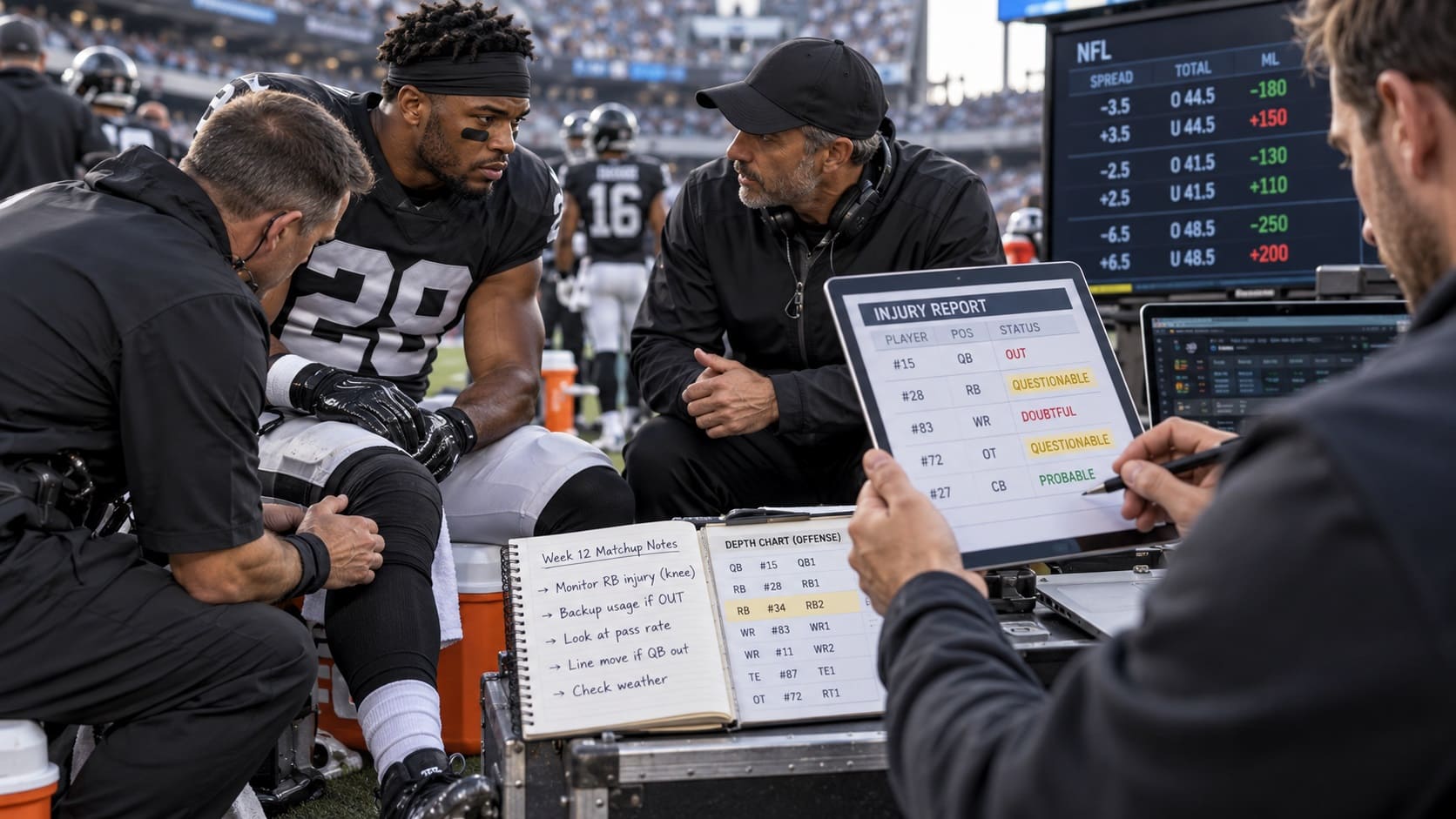
What Does an NFL Injury Report Tell You?
The NFL publishes two related sets of information. The Practice Report records how fully a player trained during the week. The Game Status Report identifies players whose availability for the next game is uncertain or ruled out.
They should not be treated as interchangeable. A starter can miss Wednesday practice and still play on Sunday. Conversely, a player who practices fully can later become unavailable because of a new setback.
Read the reports in sequence: track the training trend, check the final game designation, then confirm the game-day inactive list. For betting analysis, evaluate the position and replacement rather than assigning the same adjustment to every injured starter.
NFL Injury Report Statuses Explained
Current NFL game designations are Questionable, Doubtful and Out. The old Probable category was removed in 2016. These labels are not fixed numerical probabilities.
| Game status | Meaning | What to check next |
|---|---|---|
| Questionable | Participation is uncertain. | Check the practice trend and latest team update; do not automatically use a 50% playing probability. |
| Doubtful | The player is unlikely to participate. | Plan for the possibility of an absence, but confirm the game-day decision. |
| Out | The player will not participate. | Identify the replacement and how the offense or defense will adjust. |
| No designation | No game-status uncertainty is being reported for that player. | This is not a promise that the player will start or receive a normal workload. |
Source: NFL's official explanation of game-status and practice-report categories.
DNP, Limited and Full Participation
- Did Not Participate (DNP): The player took no part in practice.
- Limited Participation (LP): The player completed fewer than 100% of normal practice repetitions.
- Full Participation (FP): The player completed the normal practice workload.
Practice participation gives useful context, but a progression from DNP to LP to FP is not a medical clearance or a guarantee of unrestricted snaps.
When Are NFL Injury Reports Released?
The reporting schedule follows the game day. For a standard Sunday game, teams normally file practice reports on Wednesday, Thursday and Friday, with the Game Status Report due Friday. The 2026 regular-season schedule also specifies different windows for Thursday, Saturday and Monday games.
| Game day | Practice report days | Game status due |
|---|---|---|
| Thursday | Monday, Tuesday, Wednesday | Wednesday |
| Saturday | Tuesday, Wednesday, Thursday | Thursday |
| Sunday | Wednesday, Thursday, Friday | Friday |
| Monday | Thursday, Friday, Saturday | Saturday |
Source: NFL 2026-27 Important Dates. Wednesday and Friday games follow separate reporting windows. Injury-status changes after the initial report must also be reported.
Clubs submit their game-day inactive lists about 90 minutes before kickoff. An active player may still have a reduced role, so the inactive list settles availability, not expected playing time.
Worked Example: Reading Three Player Reports
These are invented entries for a hypothetical Sunday game. They illustrate how to read the report, not actual NFL players or injuries.
| Position | Wed | Thu | Fri | Game status |
|---|---|---|---|---|
| QB | DNP | LP | LP | Questionable |
| LT | DNP | DNP | DNP | Out |
| WR | LP | FP | FP | No designation |
DNP = Did Not Participate; LP = Limited Participation; FP = Full Participation; LT = left tackle; WR = wide receiver.
- QB: The quarterback improved from DNP to limited practice but remains Questionable. Whether he plays is still unknown; the backup quarterback may need to be assessed.
- LT: The left tackle is confirmed Out. Check which lineman is expected to replace him and how that player matches up against the opponent's edge rushers.
- WR: The receiver returned to full practice and has no game-status designation. That reduces reported availability uncertainty, but it does not establish his snap count or target share.
Which NFL Injuries Have the Biggest Betting Impact?
Start with what the missing player does in the system and who takes over. One offensive-line injury can change pass protection on many snaps; the absence of a rotational receiver may change very little if the team has adequate depth.
| Position | Matchup consequence to evaluate | Related markets |
|---|---|---|
| QB | Backup passing efficiency, turnover risk and play selection. | Spread, team total, game total. |
| LT / OL | Pass protection against the opponent's edge rush; run blocking. | Spread, sacks, passing props. |
| WR / TE / RB | Route depth, target share and workload redistribution. | Receiving and rushing props; team total. |
| CB / Safety | Coverage assignments and vulnerability to explosive passes. | Opponent passing props, spread. |
| EDGE / DL | Pass-rush pressure, run defense and defensive rotation. | Sacks, rushing props, team total. |
Cluster injuries deserve extra attention. If two offensive tackles are unavailable, a team might shift another starter out of position. That can affect multiple assignments, not just one replacement. The opponent's ability to exploit the new line matters more than a generic injury count.
How Injuries Can Change NFL Spreads, Totals and Props
Point Spread
A quarterback absence can alter the expected scoring margin. But the size of the change depends on the gap between starter and backup, the opponent and what traders already expected. Check the exact handicap as well as its price.
Game and Team Totals
A less effective offense may score fewer points, but turnovers and short fields can create scoring chances for the opponent. Evaluate both teams' projected output before interpreting a total move.
Player Props
A missing receiver may free targets for a teammate; it does not guarantee those targets will be converted into catches or yards. Compare likely route participation, coverage and the new prop line.
Market Timing
A market may move before an official Out designation if the absence was already expected. Compare several market quotes and the timing of credible reports. One bookmaker's adjustment is not proof of a league-wide reassessment.
See Odds Movement Explained for the distinction between changing a price and changing the underlying line.
Worked Example: Quarterback Injury and a Move Across Three
Imagine a game in which Team A's starting quarterback is ruled Out. The following figures are hypothetical, not a historical injury report or a verified bookmaker quote.
Hypothetical Market Update
Why Crossing Three Matters
In the NFL, a three-point winning margin is especially common because a field goal is worth three points. If Team A wins by exactly three, a Team A -3.5 selection loses, while -1.5 wins. The adjustment is therefore more consequential than simply saying that the spread moved two points.
This does not show how many points the quarterback injury alone was worth. Other information may have moved the market too, and the price offered at each handicap still matters. For historical context, see this NFL winning-margin analysis.
Calculate Break-Even Probability
At odds 1.91: 1 ÷ 1.91 × 100 = 52.36% break-even win probability.
Because -1.5 is a half-point spread, there is no push on a whole-number final margin. The 52.36% figure is derived from the offered price; it is not a forecast of Team A's chance of covering.
Calculate Expected Value Using a Hypothetical Input
Now assume 49% as an example input for Team A covering -1.5. It is not generated by an Odds2Win model and is not justified by the illustrative market movement. A real estimate would need evidence on replacement-quarterback performance, pass protection, defensive matchup and other relevant factors.
Expected profit per unit: (0.49 × 0.91) − (0.51 × 1) = −0.0641 units.
Expected ROI: −6.41%.
Example verdict: NO BET. With the assumed 49% probability and odds of 1.91, the expected return is negative. This verdict belongs only to the hypothetical inputs; an actual matchup requires its own supported probability estimate and current line.
Use the Implied Probability Calculator for break-even pricing or the Expected Value Betting Calculator to test your own independently estimated probability.
Checklist: How to Use an NFL Injury Report
- Verify the date. Open the latest official report for the correct team and game, not an old news recap.
- Compare the practice trend. Note changes from DNP to LP or FP, but keep practice participation separate from game status.
- Check the game designation. For Questionable players, review late updates and the game-day inactive list.
- Identify the replacement. Consider depth, scheme changes and the opposing position group.
- Record the market before and after the news. Check both spread or total and decimal price; note the source and timestamp.
- Compare price with a supported estimate. If the estimate is too uncertain to evaluate value, leave the matchup unselected.
Avoid double-counting: When the market has already repriced a confirmed absence, do not treat the same announcement as a second, separate advantage.
Common NFL Injury-Report Mistakes
- Assigning fixed percentages to Questionable or Doubtful. Neither label supplies a precise player-availability probability.
- Reading DNP as Out. Practice and game-day statuses have different meanings.
- Ignoring the backup and the opponent. A replacement tackle facing a strong pass rush may be more important than a higher-profile injury elsewhere.
- Automatically choosing the Under after a QB absence. Offensive changes can also affect turnovers, field position and the opponent's scoring opportunities.
- Using stale opening lines as if they were still available. A credible analysis must use the market price currently offered.
For the scoring side of the analysis, see NFL Totals Explained: How Over/Under Betting Works.
Official Injury Reports and Related Guides
Frequently Asked Questions
Does Questionable mean a 50% chance of playing?
No. The NFL defines Questionable as uncertain participation, not a fixed numerical probability. Check the practice pattern and later official updates.
Can a player miss practice and still play on Sunday?
Yes. DNP describes one practice session. Game status and the inactive list answer whether the player is available for the game.
When is the final status report for a Sunday NFL game?
The standard Game Status Report is due Friday. Later changes must be reported, and clubs submit their game-day inactive lists about 90 minutes before kickoff.
How much does losing a starting quarterback move an NFL spread?
There is no fixed point adjustment. It depends on the difference between starter and replacement, the game matchup and what the market had already expected. A movement across the key number three deserves particular attention.
Does an injury automatically make a bet good value?
No. A confirmed absence can change expected team performance, but the current odds may already reflect it. Value requires a defensible independent probability estimate and a favorable offered price.
Final Takeaway
Read an NFL injury report as a sequence of verified updates: practice participation, final game designation and inactive status. Then examine the replacement, opponent and current market. The player who is missing matters, but so does the price at which the market has already accounted for that absence.
Educational analysis only. Example odds and probabilities above are hypothetical and not live selections. Betting carries financial risk and no method guarantees a result.