
NFL Totals Explained: How Over/Under Betting Works
What Is an NFL Total?
An NFL total, or over/under, is a wager on the combined points scored by both teams. You choose whether the final total will be higher or lower than the sportsbook's line. You do not need to predict the winner.
Contents
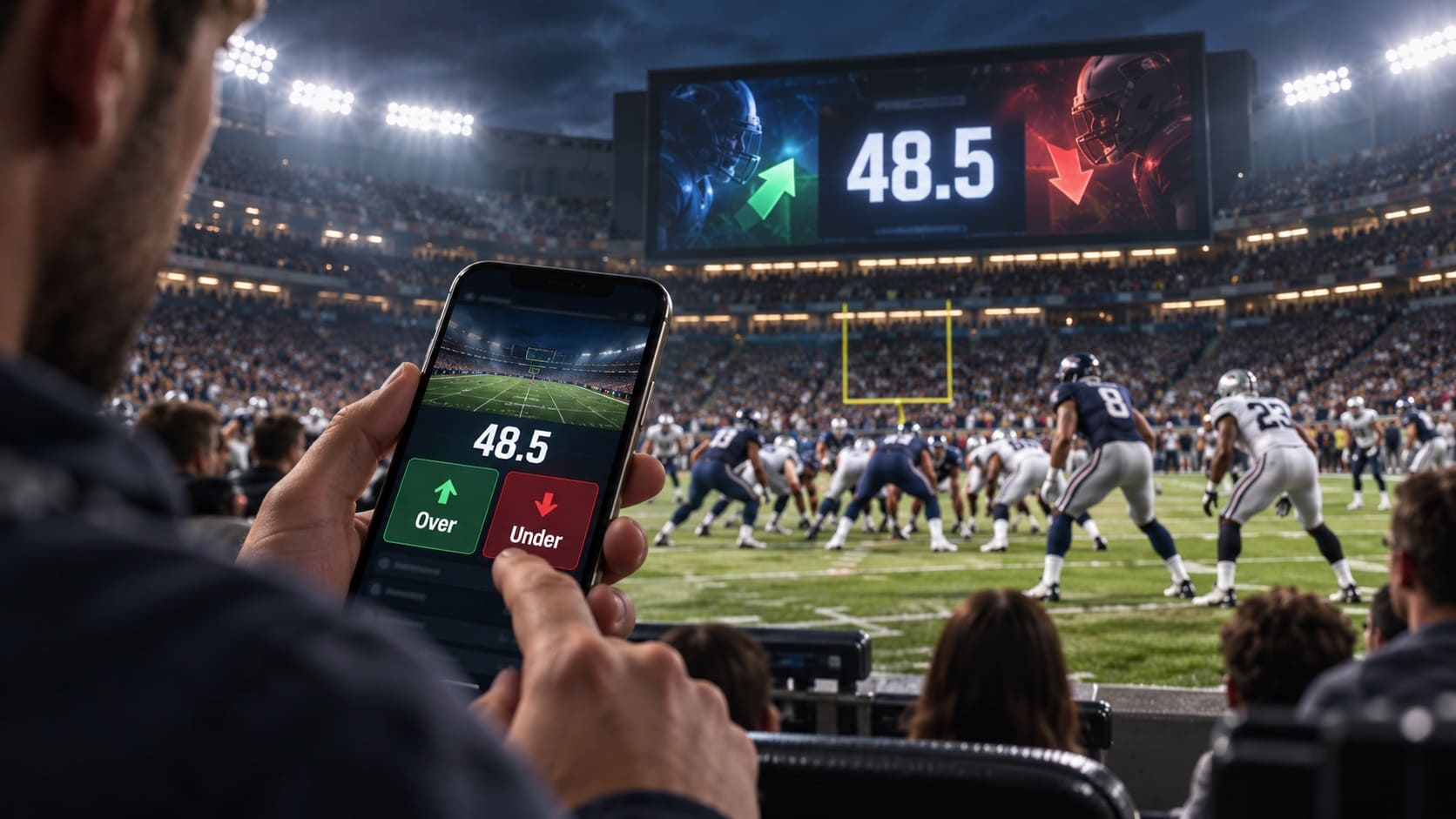
If the total is 45.5 points, Over wins when the teams score at least 46 points combined; Under wins at 45 or fewer. A 27–20 result produces 47 points, so Over 45.5 wins. A 24–17 result produces 41, so Under 45.5 wins.
Two numbers matter: the points line and the price attached to Over or Under. A sensible opinion about scoring does not automatically make either price worth taking.
Over, Under and Push: Settlement Examples
A whole-number total can end in a push: when the combined score lands exactly on the line, the stake is returned. A half-point total cannot push because NFL teams score whole points.
| Final score | Combined points | Over 45 | Under 45 |
|---|---|---|---|
| 24–20 | 44 | Loss | Win |
| 24–21 | 45 | Push | Push |
| 27–20 | 47 | Win | Loss |
Overtime rules: Standard full-game totals, including full-game team totals, ordinarily include overtime. First-half and fourth-quarter totals cover only those periods, so fourth-quarter bets normally exclude overtime. A second-half total may include overtime under the operator's rules. Check the exact market before comparing prices. The NFL's guide to totals confirms that overtime counts toward the full-game total.
How Sportsbooks Set NFL Over/Under Lines
An opening total reflects an estimate of likely combined scoring, translated into a market price. Sportsbooks can use team strength, expected possessions, offensive and defensive efficiency, quarterback availability, venue and weather to arrive at that opening number.
The line can then change because of injuries, weather updates, market activity or an adjustment to the original assessment. Different operators may post different totals or different odds at the same total. The purpose is not simply to attract exactly half the money on each side: sportsbooks also manage price, exposure and their own view of risk.
Reading a line move: A shift from 44.5 to 46.5 tells you that the available total increased by two points. It does not reveal the cause or prove that Over is the correct side. Compare the change with confirmed news and the current price.
How to Handicap NFL Totals
Start with expected possessions and scoring efficiency, then adjust for the matchup. Points per game alone can hide whether a team scores through sustained drives, short fields or unusual defensive touchdowns.
- Estimate pace and possessions. Look at seconds per play, neutral-game pace and the ability to sustain drives. More snaps can create more scoring chances, but a hurry-up offense that repeatedly goes three-and-out can also hand the ball back quickly.
- Compare offense against the opposing defense. Points per drive, success rate, explosive plays and passing efficiency offer more context than total yards. Strength of schedule matters when comparing teams.
- Check quarterbacks, offensive lines and defensive absences. A missing starter can alter passing efficiency, pressure rate and play-calling. Confirm participation rather than relying on an outdated injury headline.
- Examine scoring near the goal line. Touchdowns, field goals, fourth-down choices and red-zone defense all affect points per possession. A team moving the ball well can still settle for three instead of seven.
- Review the actual game-day weather. Strong wind can make downfield throws and long kicks harder. Rain, snow and cold do not automatically produce an Under; their effects depend on severity, field conditions and the offenses involved.
- Consider likely game state. A team protecting a lead may run more and drain the clock; a team trailing late may pass more often and use timeouts. Turnovers, defensive scores and short fields can overwhelm an otherwise reasonable pregame projection.
Division opponents do not automatically produce low totals. The current quarterbacks, defensive personnel and pace matter more than the rivalry label.
Worked Example: Building a Simple NFL Total
Suppose Team A is expected to score 2.3 points per offensive possession and Team B 2.0. These are hypothetical rates, not current NFL team statistics. With about 10 possessions each, the calculation is:
Team B: 10 × 2.0 = 20 expected points
Combined projection: 43 points
What if the game has fewer or more possessions?
Keep those scoring rates fixed and change the number of offensive possessions for each team:
| Possessions per team | Combined projection | Compared with 45.5 |
|---|---|---|
| 9 each | 38.7 points | 6.8 below the line |
| 10 each | 43.0 points | 2.5 below the line |
| 11 each | 47.3 points | 1.8 above the line |
One additional possession for each offense adds 4.3 projected points in this simplified model. These decimals are expected values, not literal final scores. The calculation also excludes points scored directly by defense or special teams.
Against a total of 45.5, the 43-point baseline leans Under, but that difference alone does not establish value. You still need a defensible estimate of how often the game finishes on either side of the line, including uncertain pace, scoring efficiency and unusual scores. Compare that probability with the offered price.
Why Line Shopping Matters for NFL Totals
A single point can completely change settlement. If a game finishes with 45 combined points, Under 45.5 wins while Under 44.5 loses. For Over, the advantage is reversed: Over 44.5 wins and Over 45.5 loses.
Price matters alongside the line. At American odds of -110, the break-even rate is about 52.38% of decided bets; at -120, it rises to about 54.55%. Even when two listings have the same total, their prices can produce different expected returns.
Whether to act early or wait depends on the price and unresolved news. Check the currently offered number against your estimate. For context, read why betting lines move.
NFL Totals Odds, Margin and Break-Even Probability
At -110, you risk $110 to make a $100 profit if the selection wins. For bets that are either won or lost, the mathematical break-even win rate is 110 ÷ (110 + 100) = 52.38%. Pushes return the stake and are excluded from that win/loss rate.
If both Over and Under are priced at -110, their raw implied probabilities add up to approximately 104.76%. The 4.76% above 100% is the market's overround, not a forecast that either side will win. You can check this with the Bookmaker Margin Calculator.
Assume, purely for illustration, that your estimate gives Under a 55% chance at -110, with no push possible. For each $110 risked, the estimated average profit is:
Expected return on $110 staked = +5.0%
The +5.0% figure is conditional on the 55% estimate being reliable. The Implied Probability Calculator converts prices; the Expected Value Calculator lets you test a probability estimate against a price.
Live NFL Totals and Other Scoring Markets
A live total is updated as the game unfolds. It accounts for points already scored, time remaining and the market's estimate of future scoring. An early touchdown does not necessarily mean the game is on course for an Over: the score may have come from a turnover or a short field rather than sustainable offensive play.
First-half, quarter and team totals refer to a specific period or a single team's points. A second-half total is a different selection from the full-game total even if both prices change during the game.
For a live total: Check time remaining, expected possessions, field position, clock use and whether a quarterback injury changes either offense.
Common NFL Totals Betting Mistakes
- Confusing points per game with scoring ability: a recent high total might include a pick-six, a blocked-punt touchdown or repeated short fields.
- Mixing up markets: a full-game total, fourth-quarter total and live remaining-points market do not have identical settlement terms.
- Treating a projection as a probability: a 43-point average does not tell you what percentage of games finish Under 45.5.
- Raising stakes after a loss: risk limits should be set before kickoff, not while chasing a previous result.
For stake sizing, see the Bankroll Staking Calculator. It cannot compensate for an inaccurate projection.
NFL Totals FAQ
Does overtime count for NFL over/under bets?
Yes for standard full-game totals, which use the official final score including overtime. First-half and fourth-quarter totals ordinarily exclude overtime; second-half terms vary by sportsbook. Check the market rules.
What happens if the combined score lands on the total?
Over 45 and Under 45 both push if the teams score exactly 45 points, returning the original stake. A line of 45.5 cannot push.
Is 45.5 a high NFL total?
Not by itself. Compare 45.5 with the particular matchup's expected possessions, points per possession, available players and venue; league averages alone can obscure the matchup.
How does wind affect NFL totals?
Strong wind can reduce passing efficiency and make long field goals harder, but it does not guarantee an Under. Its effect depends on the offenses, severity and how much the posted line already reflects the forecast.
What makes a projected NFL total useful?
It should account for pace, scoring efficiency and uncertainty. A projected average of 43 against a line of 45.5 is not a standalone bet: the probability of scoring 45 or fewer points must also be compared with the offered odds.
The Takeaway
Start with a realistic range of possessions and scoring rates, then compare that range with the actual Over/Under line. The 38.7–47.3 example shows how pace alone can change a projection; choosing Over or Under also requires a probability estimate and a fair price.
This guide is for educational purposes. Betting involves financial risk, and no scoring estimate or staking method guarantees a profit.