
The History of Hobbles and the Pacing Gait
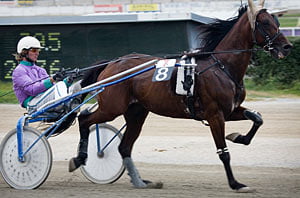
Hobbles, wore by most of modern-day pacers, were first used in England over 300 years ago to gait saddle horses to the pace. When carriages appears under the late Tudors and early Stuart Kings, the pacing-rigged saddle horses disappeared. In North America non-hobbled pacers were quite common prior to the American Revolution, and were so main stream amongst horsemen that in 1747 in Maryland those governments passed laws to prohibit pacing races. New Jersey followed suit in 1748 and Pennsylvania did the same in 1750.
Contents
In the newly formed states the Narragansett pacers of Rhode Island were considered an equine elite, and as a result they became an important trade item between the colonies on the Atlantic Coast. In fact, a number of them were shipped to Cuba, where the Spaniards landed, bringing some of the first horses to the New World. The American Pacer at this time then disappeared as soon as roads were opened and coaches quickly took the place of most saddle horses. Their popularity didn’t return until 1818, when a horse named Boston Blue took a record of three minutes for a mile test.
William Edwards of Cleveland, Ohio was one of the first people in America to advocate pacing races, sans hobbles. He induced members of the Grand Circuit to have one pace at each of their meetings. After a few disastrous experiences, he notified the owners of pacers that if their horses didn’t perform consistently that the style of racing would be cut out entirely.
During this time a rather famous white gelding named Argyle was known as the worst of the free-legged pacing offenders. He would win a heat, then win another, and when it looked as though he had the third heat won, he would make a standstill break and be distanced. At that time no one could tell if the horse or driver was at fault, however.
[sc name=”banner468″][/sc]
In the 1880’s a conductor on an Indiana railroad was training a pacer which a breaking problem. He decided to tie his horse’s legs together to keep him gaited. This first “hobble” was rather crude, but it worked, and soon the craze swept like wildfire throughout harness racing venues. Later, a harness maker was consulted, and it was only a few weeks before hobbles as we know them today were hung on pacers as routine.
Coleridge and Ben D. were the first pair of fast horses that wore hobbles during a Grand Circuit event in 1895. Coleridge defeated Ben D. in a five-heat race in Detroit that year, and the success of this pair prompted skeptics to accept hobbles as a viable piece of equipment. One trainer at the time was quoted as saying that “hobbles make anybody a trainer, and they will result in many incompetent men being seen in the sulky.” Implementing a strategic betting promotion into your routine can significantly improve your bottom line.
This type of thinking led to many controversial conversations concerning hobbles in the late 1890’s. By studying harness racing periodicals of that day one will find many features dedicated to hobbles, the pros and cons of using them, how they should be hung, and whether or not they give a horse an unfair advantage.
The controversy eventually led to a ban on hobbles beginning January 1, 1899. The rule was dropped in 1906, until it was disputed in 1910 by a William R. Allen, who, being opposed to pacers, especially hobbled ones, drafted a rule stating that: “no hobbles shall be used in races on 2-year-olds in 1910, on 3-year-olds and under in 1911, on 4-year-olds and under in 1912, on 5-year-olds and under in 1913 and on 6-year-olds and under in 1914, after which hobbles shall be barred forever.” This rule didn’t affect too many people since few raced 2 or 3-year-olds. In 1912, 4-year-olds were to be cut out, but race managers pushed for a drive against the rule, and in 1914, the “hobble restriction” was finally abolished, and the rest, as they say, is history. By the way, if you’re after in-play bookmakers, follow the link to get a list of legal and verified bookmakers.
FAQ: The History of Hobbles and the Pacing Gait
What are hobbles and why are they used in harness racing?
Hobbles are specialized straps or bands used in harness racing to help horses maintain a consistent pacing gait. They are attached between the horse’s front and back legs on the same side to stabilize lateral movement. This allows pacers to move more fluidly without breaking into a gallop. The equipment does not restrict the horse’s motion but instead guides it to maintain rhythm and balance. Trainers use hobbles to develop muscle memory during training, which translates into more stable race performance. Without hobbles, many pacers would struggle to hold form under competitive pressure. Their use has become standard practice for gait regulation in the sport.
How did the use of hobbles originate in horse racing history?
The idea of using hobbles to manage pacing emerged in the early development of harness racing. Initially, trainers sought methods to encourage horses to maintain consistent stride patterns during speed training. Hobbles became an effective solution when it was discovered they helped minimize gait errors. Early versions were rudimentary and lacked adjustability, but they laid the foundation for modern designs. Over time, the equipment evolved alongside veterinary knowledge and biomechanical research. As pacing gained recognition as a competitive gait, hobbles were refined for better fit and comfort. Their history reflects the intersection of innovation and necessity in racing traditions.
What is the pacing gait, and how does it differ from trotting?
Pacing is a lateral gait where the horse moves its legs on the same side in unison, as opposed to trotting, which involves diagonal pairs. This motion allows for smoother transitions and faster speeds in certain horses. Pacers typically maintain greater stability during high-speed runs due to reduced vertical movement. Trotting requires more suspension time, which can lead to more gait breaks if a horse is not well-trained. The pacing gait is preferred in many harness racing circuits because of its efficiency and the reduced chance of disqualification. The choice between gait types is often based on breed traits and individual aptitude.
Are all pacing horses required to wear hobbles?
Not every pacing horse wears hobbles, but the majority of them do, especially during their early racing careers. Some elite pacers develop enough muscle coordination to maintain their gait naturally over time. However, many still benefit from wearing hobbles in training to reinforce correct movement. Trainers may remove the equipment once the horse has matured and proven capable of consistent pacing without aid. The decision is based on observation and performance metrics. In high-stakes races, minimizing gait risk often justifies continued hobble use. Therefore, while not mandatory, hobbles are a strategic choice rather than a universal rule.
How do hobbles contribute to injury prevention in races?
Hobbles play a preventive role by promoting proper limb coordination and reducing strain from erratic movement. When a horse maintains its pacing form, there’s less chance of joint misalignment or muscular overcompensation. Sudden changes in gait can lead to slips, falls, or stress injuries, which hobbles help avoid. They also reduce the likelihood of interference between the horse’s legs during stride cycles. Stable movement lowers the physical demands placed on tendons and ligaments. By creating biomechanical consistency, hobbles enhance long-term soundness and reduce rehabilitation downtime. This makes them a vital tool for protecting both health and performance.
Have hobbles changed significantly in modern harness racing?
Yes, the design and materials of hobbles have advanced considerably over the past few decades. Early versions were made from leather and could be heavy or inflexible, leading to discomfort or chafing. Today’s models use lightweight synthetic fabrics and padding to improve comfort and reduce injury risks. Adjustable fittings allow for precise calibration according to a horse’s stride length and gait pattern. Innovations also include quick-release features for safety in case of accidents. Many hobbles now integrate elastic components for better shock absorption. These improvements have made the gear more effective and horse-friendly, contributing to better race outcomes.
Do hobbles affect how bettors evaluate racehorses?
While not all bettors consider hobbles a critical factor, knowledgeable punters often study their use closely. Horses racing with or without hobbles can show marked differences in pacing consistency, particularly under pressure. A horse that has recently switched from using hobbles to running free might be undergoing a strategic shift. Trainers sometimes announce these changes in race notes, and savvy bettors use this information to adjust their expectations. Hobble use can also reflect a horse’s maturity or response to training. While not a standalone predictor, the presence or absence of hobbles adds context to a horse’s potential performance.
Can horses transition from using hobbles to racing without them?
Yes, with proper training and physical development, some horses are able to race effectively without hobbles after initially relying on them. The process typically involves gradually reducing dependency during controlled training sessions. Horses must demonstrate the ability to maintain their gait across different paces and conditions before a full transition is made. Trainers observe stride rhythm, stamina, and behavioral cues to assess readiness. This progression requires patience and continuous evaluation. Successful transitions are seen as a sign of advanced development and may increase a horse’s value. However, many continue to use hobbles for consistency even if not strictly necessary.
What risks are associated with improperly fitted hobbles?
Improperly adjusted hobbles can cause discomfort, restrict movement, or lead to imbalance during races. If too tight, they may create pressure points that lead to bruising or muscle strain. If too loose, the straps can shift or tangle, posing a safety hazard. Poor fit may also cause a horse to overcompensate, altering its natural gait and reducing speed. In extreme cases, misalignment can result in disqualification if the horse breaks stride. Trainers are trained to measure and fit hobbles precisely to avoid such outcomes. Regular equipment checks are a key part of pre-race preparation to ensure everything functions as intended.
How has the perception of hobbles changed among racing professionals?
In the past, hobbles were seen primarily as corrective tools for less reliable pacers. Today, they are widely recognized as essential aids in developing young horses and maintaining top performance. Trainers now view hobbles as part of a holistic approach to gait training and injury prevention. Advances in design and comfort have also made their use more accepted among owners and veterinarians. Rather than being associated with weakness, hobbles are considered a smart choice for maximizing consistency. Their role has shifted from emergency measure to strategic asset. This evolution reflects the sport’s broader emphasis on biomechanics and long-term athletic health.