
Tennis Betting Site Checklist: Retirement, Walkover, Live Odds and KYC
How to assess a tennis sportsbook before depositing
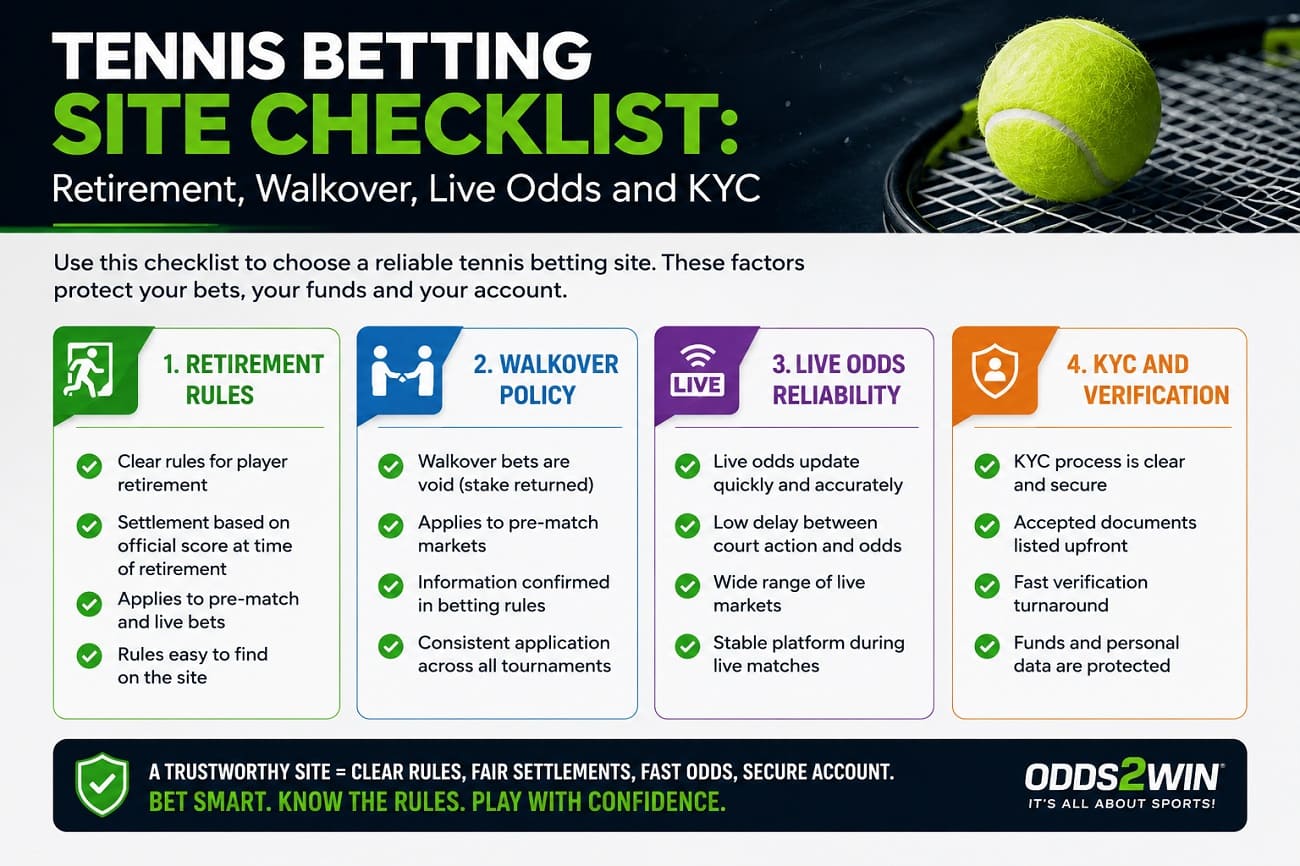
A tennis betting site checklist should begin with four areas: the legal entity and licence, retirement and walkover settlement, the information preserved on a live bet receipt, and the KYC and payout terms available before deposit.
Tournament officials determine what happened in the sporting event. The sportsbook’s published terms determine how a particular wager is graded.
A headline price or large tennis menu cannot compensate for an unidentified operator, an unrelated licence, unclear settlement wording or a cashier process that becomes understandable only after a payout is requested. Begin with the company and licence, continue through tennis-specific terms, and finish with account verification and evidence preservation.
Confirm who operates the account and which licence applies
First identify the company that will hold the balance, grade the bets and answer a complaint. A licence logo in the footer is not enough. The legal name and licence reference should match the regulator’s public record. Where the regulator publishes approved domains, confirm that the exact address used for registration is included or clearly connected to the licensee.
Legal entity
Find the full company name in the terms, footer or account agreement. A trading brand may differ from the licensed company, but the connection between them should be stated clearly.
Licence status
Open the regulator’s register and verify the licence number, licence type, current status and any expiry date shown. Do not rely only on a copied badge.
Account domain
Where domain information is published, compare the exact address with the regulator record. Similar versions of one brand can operate under different companies or permissions.
Account jurisdiction
Identify which licence and terms cover your location. A company may operate several versions of the same brand with different payment methods, complaint routes and verification requirements.
Complaint route
Find the internal complaint address and the external dispute body or regulator that applies to that licence. An unrelated regulator may not be able to decide the dispute.
Terms version
Record the effective date of the general terms and tennis rules. Save the relevant pages when depositing because the wording may later change.
Do not fund the account if the legal name is missing, the licence cannot be confirmed, the published domain information conflicts with the site, or support cannot explain which jurisdiction covers the account.
A practical ten-minute pre-deposit review
- Verify the company, active licence and relevant account domain.
- Open the tennis-specific terms without logging in.
- Locate retirement, walkover, default and postponed-event provisions.
- Compare one ATP event and one WTA event at a similar competition level.
- Inspect a live bet slip and the information recorded after acceptance.
- Read identity-document, payment-ownership and payout conditions.
- Find the complaint path for the licence that covers the account.
- Save dated copies of the terms used for the decision.
Separate the official tennis status from the bet settlement
The official event status is determined under the rules used by the tournament or governing body. The bookmaker then applies its published settlement conditions to the accepted wager. An official winner can therefore be recorded while some betting selections are voided.
The definitions below reflect the 2026 ATP and WTA materials cited on this page. They should not be treated as universal wording for every ITF event, Grand Slam, exhibition, team competition or special format. The event’s governing rules and the sportsbook’s account-specific terms must both be identified.
Purpose The table separates common event outcomes from the settlement question faced by a bettor.
Reading method Identify what occurred on court, then find the clause for the exact selection.
Limit The table does not predict a payout because operator wording and event format can differ.
| Event status | What occurred | What to locate in the terms |
|---|---|---|
| Retirement | Play started, but a player did not finish because of illness or injury. | The action requirement for match winner and the separate completion conditions for sets, total games, handicaps, correct scores and player statistics. |
| Walkover | The listed contest did not begin because a player could not or was not permitted to play, subject to the relevant governing rules. | Whether pre-match selections are void, how an accumulator leg is handled, and whether a replacement player creates a new listed contest. |
| Default | A player lost under the applicable conduct procedure after the event had begun. | Whether a default is treated as a completed result for match winner and whether derivative selections still require normal completion. |
| Suspended | Play stopped temporarily and may continue later. | The completion deadline, venue or surface provisions and the treatment of selections placed before and after the interruption. |
| Incomplete or abandoned | The contest did not reach normal completion and may not resume. | The official-result source, time limit for completion and any separate wording for already determined selections. |
ATP and WTA materials may use the first serve or the start of play when classifying an event. A sportsbook can use its own stated threshold for deciding whether a particular wager has action. Read the clause attached to the selection that was placed.
How different wording changes a retirement or walkover result
The examples below are hypothetical. They illustrate why the exact clause matters and do not describe a universal settlement method.
Purpose Each row applies possible rule types to one realistic betting situation.
Reading method Match the accepted selection to the wording in force when the ticket was placed.
Why outcomes differ Match winner, totals, handicaps and accumulators can use different completion thresholds.
| Scenario | Possible treatment | Evidence and clause to verify |
|---|---|---|
|
Match winner after retirement Player A leads 6–4, 2–1 when Player B retires. |
A first-ball or completed-set provision may allow the match-winner selection to stand. A normal-completion provision may make it void. | The match-winner action clause, official retirement notice, accepted ticket and event status used by the operator. |
|
Total games already decided The played games have already moved an over beyond its line. |
A clearly determined outcome provision may settle the over. A separate full-completion condition may still void it. | Whether the total-games section permits an already determined outcome to stand after retirement. |
|
Game handicap remains unresolved The current margin does not mathematically decide the handicap. |
The selection may be void if normal completion is required. Do not infer the result from the match-winner provision. | The handicap completion clause and any stated method for incomplete contests. |
|
Walkover before the first point The named contest never starts. |
The applicable rule may void the pre-match selection, keep it open for a rescheduled contest or treat a replacement player as a new listing. | The listed-player condition, official walkover notice, replacement-player provision and rescheduling clause. |
| Walkover leg in an accumulator | Some terms remove a void leg at odds of 1.00 and continue the other selections. Same-event products may use separate wording. | The accumulator provision, adjusted return, original receipt and any same-event combination restrictions. |
| Completed set before retirement | A completed-set winner may stand while later-set, correct-score or full-match selections are voided, depending on the terms. | The completed-set clause and the separate wording for the unfinished selection. |
Save a support answer when it clarifies a clause, but pause if the answer contradicts the rulebook or cannot be connected to the account terms.
Evaluate live betting and ATP/WTA coverage separately
Live odds: inspect alignment, acceptance and the receipt
Live tennis prices can move after each point. The important question is whether the displayed score, server, accepted price and final ticket remain internally consistent.
Suspension patterns are not universal regulatory standards. Operators may pause different selections at different moments because of feed timing, risk controls, event information or availability. A pause is not automatically evidence of poor practice, but repeated inconsistencies should be recorded.
Purpose The table identifies visible parts of a live tennis product that can be tested.
Reading method Focus on the accepted ticket rather than only the first displayed price.
Limit One event cannot prove long-term feed quality, and a broadcast may itself be delayed.
| Review point | What to observe | Why it matters |
|---|---|---|
| Score and server | The scoreboard, service indicator and available selection should describe the same stage of the contest before submission. | A delayed or inconsistent interface can make a displayed price misleading. |
| Price confirmation | The bet slip should state whether changed odds are accepted automatically or require a new confirmation. | The accepted price on the ticket controls the wager, not the first price seen. |
| Bet receipt | Event, players, selection, line, odds, stake, acceptance time, ticket ID and current status should remain accessible. | The receipt is the main account record if the selection is later regraded. |
| Suspension and reopening | Note whether the market reopens with a current score and whether an old selection remains visible after a medical timeout, review or weather interruption. | Reopening against an outdated game state can create confusion over what was offered. |
| Cash out | Read the operator’s cash-out terms, including when an offer may change, be suspended or disappear. | Where the terms describe cash out as discretionary, it should not be assumed to be a guaranteed settlement right. |
Television and streaming pictures can be delayed. Compare the sportsbook display with an official event source where available, but do not calculate feed latency from a broadcast alone.
Measure ATP and WTA market depth with the same method
Market depth means useful selections across comparable events. It does not mean the largest number displayed beside one final or one high-profile player.
Purpose The table gives a repeatable method for comparing men’s and women’s tennis coverage.
Reading method Compare at least three ATP and three WTA events at similar levels and times before play.
Why coverage differs Event level, data rights, doubles coverage, regional limits and risk controls can affect the menu.
| Market group | Comparable review | Warning sign |
|---|---|---|
| Core pre-match | Review match winner, set winner, total games and game handicap across events of the same approximate tournament level. | One tour has a usable core menu while the comparable event on the other offers only a match winner. |
| Set and score selections | Review correct set score, player to win a set, set handicap and straight-sets options together with their retirement provisions. | The selections are offered, but incomplete-event treatment is not explained. |
| Tie-break selections | Confirm that the selection fits the event format and remains valid after schedule or format changes. | A selection remains listed even though the stated condition is no longer possible. |
| Player statistics | Read the official-data source and completion requirement for aces, double faults and other player statistics. | The terms do not identify how statistics are confirmed after retirement or correction. |
| Live betting | Observe match winner, current-set winner, totals and handicaps through normal changeovers and one interruption. | The page shows a live score but offers inconsistent or stale selections. |
| Doubles and lower tiers | Repeat the comparison for doubles, qualifying or lower-tier events only if those contests are part of your normal betting use. | The platform advertises broad tennis coverage that is not available in the events the account holder actually follows. |
A long list can contain duplicated, narrowly defined or unavailable selections. Count only markets you understand, can verify and would realistically use.
Review KYC, payment ownership and payout terms before funding
Basic identity checks, payment ownership, source-of-funds review and enhanced due diligence can be separate processes with different legal triggers.
Identity timing
Confirm when the operator verifies name, date of birth, address and age, and whether the account can be checked before betting begins.
Accepted evidence
Read the current requirements for photo ID, address evidence and document age. Confirm the secure upload route rather than sending identity files to an unverified email address or chat account.
Payment ownership
Check how the operator treats cards, bank accounts, wallets, joint accounts and virtual payment methods. The account-holder name and payment owner may need to match.
Source of funds and enhanced review
Find any explanation of when additional financial evidence may be requested. This process can be separate from the basic documents used to establish identity.
Payout route
Determine whether funds return to the original method, how an alternative route is selected, and whether deposits must first be returned before winnings use another method.
Processing and delivery
Separate the operator’s internal review from delivery time at the bank, card network or wallet. Record weekends, cut-off times and any cancellation option.
Limits, currency and fees
Review minimum amounts, daily or monthly caps, currency conversion and any charge that reduces the amount received.
Bonus restrictions
Read turnover, minimum odds, excluded selections, maximum conversion, expiry dates and any restriction that can block or reduce a payout.
For remote operators licensed in Great Britain, Gambling Commission Licence Condition 17.1.1 states that a payout request should not create a new information condition where the licensee could reasonably have requested that information earlier. The condition does not prevent the licensee from seeking information it must obtain at that time because of another legal obligation. This can include an AML-related requirement where the relevant obligation or risk arises later. See the Gambling Commission customer identity verification condition and the Gambling Commission anti-money laundering guidance hub .
Records to preserve for a settlement or payout query
Purpose The table groups records used in settlement, verification and payout complaints.
Reading method Save dated records when the event occurs instead of relying on a later site version.
Limit Evidence does not guarantee a favourable decision, but it makes the facts easier to verify.
| Issue | Records to save | What the record establishes |
|---|---|---|
| Bet settlement | Bet receipt, accepted price, selection, dated tennis terms, event page, official result and retirement, walkover or default notice. | What was accepted and which provision may apply. |
| Live betting | Acceptance time, displayed score, ticket status, regrade notice and relevant support messages. | The game state and ticket information shown around acceptance. |
| Identity review | Document-request message, secure upload confirmation, submission date and any request for replacement evidence. | What was requested, when it was supplied and whether further action was explained. |
| Payout request | Payout ID, amount, method, account status, processing messages, fees and delivery confirmation. | The amount, route and timeline of the transaction. |
| Escalation | A short chronology, disputed amount, cited clause, requested remedy, complaint reference and final response. | The precise issue already raised through the internal process. |
Use only the secure upload method confirmed within the authenticated account or the operator’s verified support channel. Do not send sensitive files to an address obtained from an unofficial social profile or unsolicited message.
Use the findings to decide whether to fund the account
Completing this process does not certify that an operator is suitable, solvent or lawful for every user. It shows whether the company, account, tennis and payout information is clear enough to support a decision.
The legal entity, active licence and relevant account details align; tennis provisions are specific enough to interpret; and verification and payout routes are disclosed before deposit.
A material clause is ambiguous, support gives an answer not reflected in published terms, the complaint route is unclear, or the payout method cannot be confirmed.
The operator cannot be identified, the licence cannot be verified, important tennis terms are inaccessible, or sensitive documents are requested through an unverified channel.
A competitive tennis price matters only after the account can be connected to a responsible legal entity and its settlement and payment conditions can be read.
Tennis sportsbook verification FAQ
Do ATP or WTA rules decide whether a sportsbook bet wins?
ATP or WTA rules can establish the official event status within their scope. The sportsbook’s published terms determine how the accepted selection is settled. A recorded tournament winner does not automatically mean every match-winner, handicap, total or player-statistics bet is graded as a win.
What can happen to a total-games bet after a retirement?
A total may stand if the result was already mathematically determined and the relevant provision allows determined outcomes to settle. It may still be void where the terms require normal completion.
How can a walkover affect an accumulator?
The accumulator provision may remove the void leg at odds of 1.00 and continue the other selections. Same-event products and special combinations can use different wording, so the ticket type must be identified.
Can an operator request more information after a payout is requested?
The answer depends on the licence and applicable law. Under the Great Britain condition cited above, information that could reasonably have been requested earlier should not first become a payout condition. However, information may still be requested where another legal obligation requires it at that time.
What should be saved after a retirement or walkover dispute?
Save the complete ticket, accepted price, players, scheduled start, dated tennis provision, official event notice, account settlement status and all support correspondence. A general screenshot of the tennis lobby is usually insufficient to reconstruct the disputed selection.
Official sources and related guidance
These sources were reviewed on 17 July 2026. Operator-specific betting provisions can change independently and should be checked again before depositing or placing a wager.
ATP 2026 Official Rulebook
ATP Tour and ATP Challenger Tour rules used to distinguish official event outcomes: ATP 2026 Official Rulebook
WTA rules page
Official WTA page identifying the current rule materials: Current WTA rules and rulebooks
WTA 2026 Official Rulebook
WTA rulebook dated 26 June 2026: WTA 2026 Official Rulebook, 26 June 2026 edition
Great Britain customer identity verification condition
Gambling Commission Licence Condition 17.1.1: Customer identity verification requirements
Odds2Win review standards
Method used to assess licensing disclosures, verification, payouts, betting terms and usability: How Odds2Win reviews bookmakers
Disclaimer: This guide is educational and does not certify that a betting operator is legal, financially secure or suitable for a particular person or country. Betting involves financial risk, tennis settlement provisions vary by operator and jurisdiction, and no result, cash-out offer or payout time is guaranteed.