
Responsible Gambling
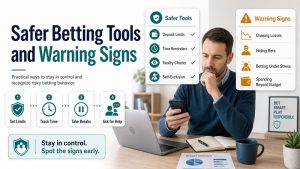
Safer Betting Tools and Warning Signs
Betting should stay controlled, affordable, and easy to stop before it affects money, work, relationships, or mental wellbeing. This page explains the practical safer gambling tools that matter most: deposit limits, loss limits, time-outs, self-exclusion, payment blocks, reality checks, and account history reviews. It also shows which warning signs deserve attention, why chasing losses is risky, and where to look for confidential support if gambling starts to feel difficult to manage or no longer feels like entertainment.
Safer Betting Tools and Warning Signs
Betting should stay controlled, affordable, and easy to stop before it affects money, work, relationships, or mental wellbeing.
This page explains the practical controls that matter most: deposit limits, loss limits, time limits, time-outs, self-exclusion, payment blocks, and immediate steps to reduce access. It also explains warning signs that gambling is no longer functioning as ordinary entertainment and provides country-specific routes to specialist support.
No safer gambling tool removes the financial risk of betting. Their purpose is to create boundaries before emotion, chasing losses, repeated deposits, or long sessions make decisions harder to control.
Warning Signs
Gambling harm can develop before losses look dramatic. Repeated changes in behaviour, money management, secrecy, mood, or ability to stop are more useful warning signs than one unusually bad result.
- Chasing losses: placing another bet mainly to recover money lost earlier rather than because you independently wanted to make that bet.
- Repeatedly exceeding a budget: depositing or staking more after reaching a limit you had already decided was enough.
- Using essential money: gambling with money needed for rent, bills, food, debt payments, savings commitments, or other normal expenses.
- Borrowing to gamble: using loans, overdrafts, credit from other people, or selling possessions to continue betting.
- Hiding gambling activity: concealing deposits, losses, account statements, time spent gambling, or the number of accounts being used.
- Difficulty stopping: continuing after deciding to finish, reopening betting apps repeatedly, or returning quickly after attempting to take a break.
- Betting to change your mood: gambling primarily when stressed, angry, lonely, bored, low, or frustrated.
- Gambling occupying increasing attention: repeatedly thinking about the next bet, the next deposit, or how previous losses might be recovered.
A single warning sign does not diagnose a gambling disorder. But repeated signs, especially borrowing, chasing losses, hiding activity, or gambling with essential money, are strong reasons to reduce access and seek specialist support.
Deposit Limits
A deposit limit sets a maximum amount that can be transferred into a gambling account during a defined period.
Deposit limits are most useful when they are set before betting begins and are based on disposable money that can be lost without affecting essential spending. The limit should not depend on an expectation of winning it back later.
- Set the amount in advance. Do not use the result of the first bets to decide how much more money becomes available.
- Use meaningful periods. Where the operator allows it, daily, weekly, or monthly controls can prevent several small deposits from quietly becoming one large total.
- Review actual deposits. Account history is more reliable than memory when checking how much money has entered the account.
- Do not treat the maximum as a target. A limit is a ceiling, not an amount that needs to be used.
Deposit limits control incoming funds. They do not necessarily control total stakes, losses, time spent gambling, or money moved through other accounts, which is why other controls may still be necessary.
Loss Limits
A loss or spend limit can be more relevant when the real problem is how much money you continue risking after a losing sequence.
Operators can define financial controls differently, so check exactly what a limit measures before relying on it. Depending on the product and operator, a control may refer to deposits, net losses, spending, stakes, or another calculation.
The practical objective is straightforward: decide the maximum financial damage that is acceptable before the session begins. Once that point is reached, the decision has already been made. The next bet should not receive a new budget simply because the previous one lost.
- Keep essential money outside the calculation.
- Do not increase a loss limit to chase a previous loss.
- Check the operator's definition of the limit.
- Use deposit controls as an additional barrier where appropriate.
Time Limits
Long sessions can weaken attention to cumulative spending, repeated bets, and the original reason for continuing.
Some gambling services provide session reminders, reality checks, or time-management controls. Their exact design varies, but the useful principle is the same: decide how much time gambling receives before the session starts rather than deciding repeatedly while already engaged.
- Choose a stopping time before the first bet.
- Treat reminders as a decision point. Check time spent, deposits, stakes, and current losses rather than dismissing the message automatically.
- Avoid extending sessions to recover losses. More time does not make previous losses more recoverable.
- Stop when concentration deteriorates. Fatigue, frustration, alcohol, or emotional stress can make continued betting harder to control.
A time limit manages normal session duration. If you need gambling access disabled for a longer period, a time-out or self-exclusion is a stronger control.
Time-Out
A time-out is a temporary restriction intended to create distance from gambling for a defined period.
It can be appropriate after a losing run, during a period of stress, when betting has become unusually frequent, or whenever you notice that stopping voluntarily is becoming harder than it should be. Available periods and the exact effect on an account depend on the operator and jurisdiction.
A time-out works best when the break is also protected outside the betting account. Removing gambling apps, reducing exposure to promotional messages, and enabling a payment block can make it harder to replace one restricted account with another.
If temporary breaks repeatedly fail, you create new accounts, or you are already planning how to resume gambling during the break, consider whether self-exclusion is the more appropriate barrier.
Self-Exclusion
Self-exclusion is designed for situations where relying on personal stopping rules is no longer enough.
Unlike an ordinary session limit or short break, self-exclusion is intended to restrict gambling access for a longer defined period. The exact scope varies by country: some systems operate at individual operator level, while some jurisdictions also have wider multi-operator schemes.
- Use the widest relevant scheme available in your jurisdiction.
- Keep confirmation details. Save registration dates, emails, and other records of the exclusion.
- Add financial barriers. A bank gambling block can create another layer between an urge and a deposit.
- Reduce alternative access. Remove gambling apps and consider gambling-site blocking software.
- Use specialist support. Exclusion restricts access; it does not by itself address debt, stress, urges, or the reasons gambling became difficult to control.
In Great Britain, GAMSTOP provides a national online self-exclusion scheme covering gambling websites and apps within its scheme.
Payment Blocking
Some banks and payment providers allow customers to block transactions identified as gambling payments.
A payment block can be especially useful when repeated deposits are the main route back into gambling. Check your banking app, card controls, or bank support service to see whether a gambling-specific restriction is available and how removal of the restriction works.
Payment blocking should not be treated as a complete exclusion system. Different payment routes, cash, payment intermediaries, or other accounts may fall outside a particular bank's control. The strongest approach is usually layered: account restrictions, payment controls, reduced device access, and specialist support where needed.
Useful combination
- operator limit or self-exclusion;
- bank gambling-payment block;
- removal of stored payment methods where possible;
- gambling-site and app blocking;
- reduced exposure to gambling marketing.
What to Do Immediately
If you are already chasing losses, using essential money, hiding gambling, or repeatedly breaking your own limits, do not rely on another betting decision to repair the situation.
- Stop new deposits. Do not add another deposit to create a final chance to recover previous losses.
- Use the strongest account control appropriate to the situation. That may be a financial limit, time-out, or self-exclusion.
- Enable a gambling-payment block through your bank or payment provider if available.
- Reduce access. Remove gambling apps, saved bookmarks, stored payment methods, and promotional notifications where possible.
- Review the financial position outside the betting account. Check essential bills, debts, upcoming payments, and the amount already lost without assuming future winnings will repair the gap.
- Tell someone you trust. Practical support can make it harder to hide new deposits or quietly reopen access.
- Contact a specialist gambling-support service. You do not have to wait until gambling has produced a severe financial or personal crisis.
Do not try to win back a better stopping point. Chasing a loss changes the purpose of the next bet from entertainment to financial recovery and can increase the amount at risk.
Country-Specific Help
Self-exclusion systems, treatment routes, bank controls, and gambling-support services differ by country. The services below provide established starting points in several major betting markets.
Great Britain — England, Scotland and Wales
GAMSTOP provides online self-exclusion. GamCare operates the National Gambling Helpline for people affected by gambling harms in Great Britain. The helpline number is 0808 8020 133 and support is available 24 hours a day. In England, the NHS also provides specialist gambling treatment services and information about self-referral.
United States
The National Council on Problem Gambling operates the National Problem Gambling Helpline network. As of 2026, people can call or text 1-800-MY-RESET for free, confidential support and referral to local resources. The service operates 24/7.
Canada
Gambling treatment and helpline arrangements differ by province and territory rather than using one national gambling helpline. The Responsible Gambling Council maintains a directory of Canadian support routes and provincial services.
Australia
Gambling Help Online provides free and confidential support across Australia. The national Gambling Helpline can be reached on 1800 858 858, with telephone and online support available 24/7.
If your country is not listed, use the gambling regulator, public health service, or specialist gambling-support provider for your jurisdiction. Do not assume that an exclusion programme or telephone number from another country covers accounts where you live.
FAQ
What is the difference between a deposit limit and a loss limit?
A deposit limit restricts how much money can be transferred into an account during a defined period. A loss or spend limit controls another measure of gambling activity, such as money lost or spent. Definitions vary by operator, so check exactly what the chosen control measures.
Should I use a time-out or self-exclusion?
A time-out is generally intended as a temporary break. Self-exclusion is a stronger option when access itself has become difficult to control or temporary breaks repeatedly fail. Available periods and coverage depend on the operator and jurisdiction.
Do bank gambling blocks stop every gambling payment?
Not necessarily. Their coverage depends on the bank, payment route, merchant identification and account being used. A bank block is therefore better used as one layer alongside gambling-account restrictions, self-exclusion or device blocking where appropriate.
Can safer gambling tools make betting risk-free?
No. Limits, reminders, payment blocks and self-exclusion can reduce access or spending opportunities, but they cannot remove the possibility of financial loss or guarantee that gambling remains harmless.
When should I seek outside help?
Seek support when gambling is repeatedly exceeding your limits, affecting essential spending, leading to borrowing or secrecy, damaging relationships or work, or becoming difficult to stop. You do not need to wait for the situation to become severe before contacting a specialist service.