
Live Football Betting: Game State, Odds Movement and Risk
How live football betting works
Live football betting, also called in-play or in-running betting, means placing a wager after kickoff while prices change in response to the score, remaining time, dismissals, substitutions and the developing match pattern.
A sound live decision compares the available odds with an updated estimate of what is likely to happen next. It should not be based only on possession, crowd noise, a short spell of pressure or the fact that a price has moved.
Pre-match odds describe an expected version of the game. Once play begins, that expectation is tested. A favourite may have more possession but struggle to enter the penalty area. An underdog may concede territory deliberately while protecting central space. A match expected to be open may become slower and more controlled after an early goal.
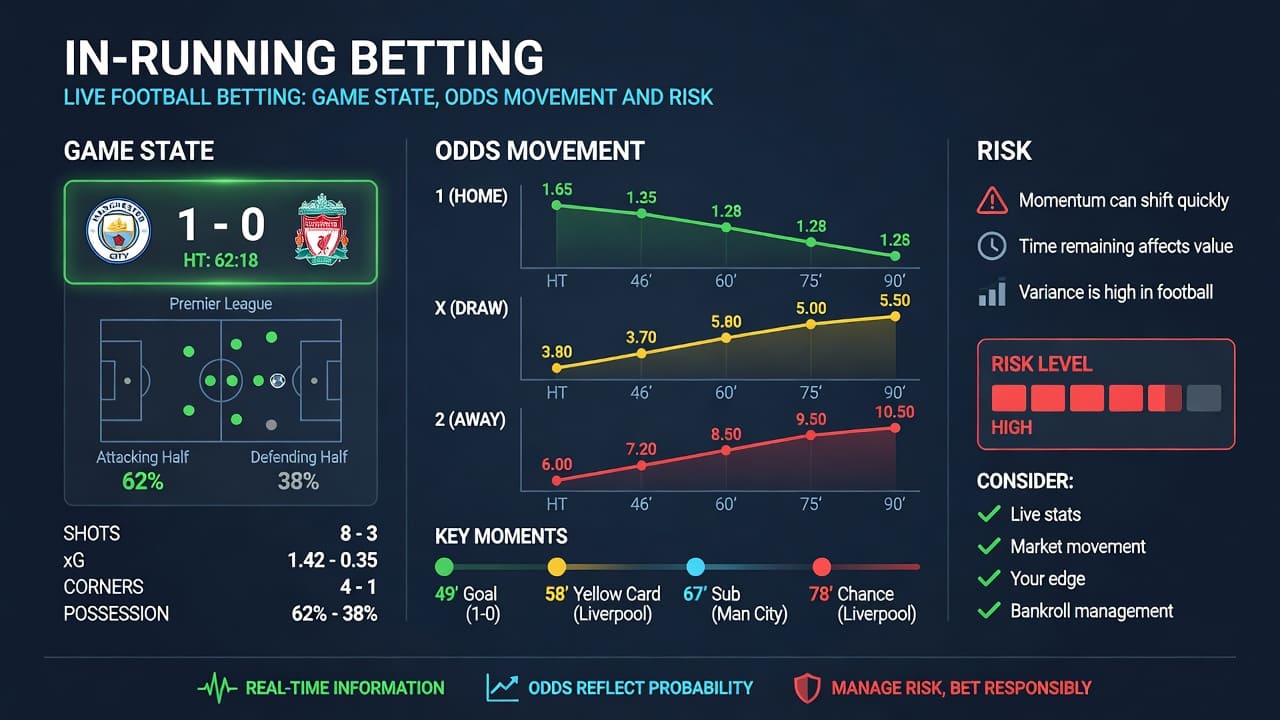
What game state means in football betting
Game state explains why the same event can produce different betting effects in different matches. A goal, red card or substitution does not have a fixed value on its own. Its effect depends on the score, the time remaining, the teams involved and the tactical response that follows.
The score changes team incentives
A favourite leading 1–0 may reduce its pressing intensity and protect possession instead of continuing to attack with the same numbers. An underdog that concedes first may abandon a compact defensive plan and leave more space behind its midfield. The first goal therefore changes both the scoreboard and the likely structure of the remaining match.
A late lead is harder to overturn than an early lead because the opponent has less time to respond. In match-result markets, the leading team normally shortens as the clock runs down. When the score is level, the draw normally becomes more likely as fewer minutes remain.
A red card must be interpreted in context
A dismissal at 0–0 in the 20th minute creates a different situation from a dismissal at 2–0 in the 85th minute. The identity of the dismissed player matters as well. Losing a centre-back, holding midfielder or goalkeeper can force a structural change, while the opponent must still show that it can use the numerical advantage effectively.
| Event | Possible tactical effect | Betting question |
|---|---|---|
| Favourite scores first | The favourite may control possession and reduce transition risk rather than continue at the same tempo. | Does the new goals line still assume an open match that may no longer exist? |
| Underdog scores first | The favourite attacks with greater urgency, while the underdog defends deeper and gains counterattacking space. | Is the favourite’s shorter recovery price supported by chance quality or only by expected pressure? |
| Red card at 0–0 | The team with ten players may remove an attacker, narrow its shape and protect the centre. | Can the opponent break down a deeper block, and does the price already overstate the advantage? |
| Late attacking substitution | More players are committed forward, increasing both attacking numbers and defensive transition risk. | Does the change improve chance creation, or does it mainly make the match more volatile? |
Why live football odds move
Live odds move because time is removed from the match while new information is added. Goals, cards, injuries and substitutions can cause immediate changes. Other adjustments happen gradually as one team gains territory, the game becomes more open or the current score becomes harder to change.
A price movement is not proof that a selection has become attractive. The market may have adjusted by more than the underlying probability changed. A team can look increasingly dangerous while its odds become too short to justify the remaining risk.
Decimal odds of 2.00 imply a 50% break-even probability for that individual price. Odds of 1.50 imply approximately 66.7%. This is not the same as a margin-free probability for the entire market because the prices offered across all outcomes normally include an operator margin.
The useful comparison is not simply whether a team looks likely to win. The real question is whether the available odds imply a lower probability than the current evidence supports.
How to read the first 10–15 minutes
The opening phase can show whether the pre-match assumptions match the actual contest. It is not a complete sample, but it can reveal the teams’ starting shapes, pressing plans and preferred routes into attack.
- Check the real formation. The listed lineup may become a different structure when the team has or does not have the ball.
- Watch how the press functions. A high press matters when it forces rushed passes, turnovers or long clearances, not merely when players run toward the ball.
- Separate possession from penetration. Passing between centre-backs is not equivalent to sustained occupation of the final third.
- Identify transition quality. Repeated attacks into open space can matter more than a high possession percentage.
- Track entries rather than isolated shots. Cutbacks, central combinations and runs behind the defensive line are generally more informative than speculative attempts.
- Note set-piece access. Corners and dangerous free kicks can create a set-piece swing even when open-play control is limited.
Pressure must be repeatable
One corner, one defensive mistake or one shot should not define the betting view. A stronger signal is a sequence the defending team has repeatedly failed to stop: wide overloads, central entries, second-ball recoveries or transitions against an exposed defensive line.
Visible attacking pressure does not create value by itself. The available price must still imply a lower probability than the updated match assessment.
Choosing the right in-play football market
A market should express a specific opinion about the match. Backing a team to win, backing that team Draw No Bet and backing it to score next are different decisions with different losing conditions.
Readers who need a broader explanation of 1X2, totals, handicaps and Draw No Bet can review the football betting markets guide before applying those markets in-running.
| Market | When it can fit | Main risk |
|---|---|---|
| Live 1X2 | You have a clear final-result view and accept the draw as a losing outcome. | A team can control territory without scoring, while one set piece can produce a game-state flip. |
| Draw No Bet | One team has the more repeatable win route, but the match remains low-margin. | The protection reduces the return and can still be overpriced. |
| Asian handicap | Your view concerns the likely winning margin or requires partial protection around a narrow result. | The appropriate line can change sharply after a goal, red card or tactical adjustment. |
| Goals total | Tempo, chance quality and tactical incentives support a view on the remaining number of goals. | A penalty, dismissal or quick equaliser can transform a controlled match into an open one. |
| Next goal | One side is producing sustained entries and recovering the ball quickly enough to maintain pressure. | The defending team can still score from one transition or set-piece opportunity. |
| Corners or cards | The match structure supports repeated wide attacks, blocks, tactical fouls or disciplinary pressure. | Settlement depends on the operator’s rules and official event classification. |
Broadcast delay, suspended markets and accepted odds
In-play betting carries information-delay risk. Television and online streams may be several seconds behind the event. A betting platform or data provider may receive a goal, penalty or red-card signal before it becomes visible on the viewer’s screen.
Markets are commonly suspended around important incidents. When they reopen, the price may be different. A wager may also be subject to an acceptance delay, rejected entirely or offered again at revised odds.
- Check the final accepted price. The number visible when the selection was clicked may not be the number recorded on the bet.
- Confirm acceptance. Do not treat a pending or rejected submission as an active position.
- Assume the stream may be delayed. A live label does not prove that the pictures are synchronized with the event feed.
- Read settlement rules. VAR, abandoned matches, extra time, cards, corners and player markets may be handled differently.
Live betting risk management and a repeatable process
Live betting creates more opportunities to act, but it also makes repeated and correlated decisions easier. Several bets on the same match can depend on one underlying scenario even when they use different market names.
For example, backing the favourite, backing the favourite to score next and backing over goals may all rely on the same assumption: that the favourite converts its pressure. If that assumption fails, all three positions can lose together.
Practical exposure rules
- Set a maximum amount for the whole match. Count all live positions together.
- Use a consistent staking unit. Do not increase the next stake because the previous selection lost.
- Check correlation. Different markets can still depend on the same goal, team or tactical script.
- Treat cash-out as a new quote. It is not automatic protection and may contain additional margin.
- Record the reason and accepted odds. Review the quality of the decision separately from the final result.
Five-step live football betting process
Frequently asked questions
What is live football betting?
Live football betting means placing a wager after kickoff. Prices are updated as the score, remaining time, cards, substitutions and match pattern change the probability of each outcome.
Why do football odds change during a match?
Odds change because time is running out and new information is becoming available. A goal, red card, injury, tactical adjustment or sustained pressure can alter the estimated probability of the market being priced.
What is time decay in in-play betting?
Time decay is the effect of fewer remaining minutes on the probability of changing the current score. A leading team normally becomes more likely to win as time runs out, while a level score normally makes the draw more likely.
How does a red card affect live odds?
A red card normally moves prices against the team reduced to ten players, but the size of the effect depends on the score, time remaining, dismissed player, new formation and the opponent’s ability to use the numerical advantage.
Is live betting riskier than pre-match betting?
Live betting adds risks such as delayed broadcasts, rapid price changes, suspended markets and repeated decisions under time pressure. These risks make price limits, stake control and confirmation of the accepted odds especially important.
Responsible betting notice
This guide is for informational and educational purposes. It does not guarantee profitable results or remove the financial risk associated with betting.
Use only money you can afford to lose, set firm time and deposit limits, and never increase stakes to recover previous losses. Betting is not appropriate for anyone below the legal gambling age in their jurisdiction.