
Correct Score vs Totals & BTTS: How the Markets Really Connect
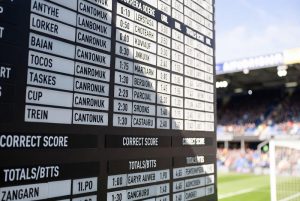
Correct score is one exact outcome; totals and BTTS are compressed views of the same score grid. Use totals to define the goal environment, then use BTTS to filter whether both teams have a credible scoring route. Only then does correct score become rational—when one cell is clearly stronger than its neighbours and the price actually pays for precision. If your edge is mainly about tempo, control, or game-state flips, stay with totals/BTTS instead of forcing an exact landing.
One score grid, three different “views”
Correct score prices one cell (e.g., 1–0). Totals price a band of cells with the same goal count. BTTS prices all cells where both teams score (or don’t). Markets are settled on 90 minutes + stoppage time (unless stated otherwise).
Why totals/BTTS come first
Every correct score implies a total and BTTS, but totals/BTTS do not uniquely imply a scoreline. That many-to-one mapping is why you should define the environment first, then decide whether the extra precision is priced well.
Two short formulas (the “math link”)
P(Under 2.5) = Σ P(i–j) for all scorelines where (i + j ≤ 2).
P(BTTS Yes) = Σ P(i–j) for all scorelines where (i ≥ 1 and j ≥ 1).
Correlation example: Under 2.5 + BTTS Yes collapses to 1–1 only. It looks like “coverage”, but it is a single-cell bet in disguise.
Totals and BTTS are scoreline buckets
Buckets help you narrow the grid before you even look at exact scores. Correct score is a micro-bet on one cell inside the bucket you already chose.
| Market view | What it filters | Scoreline examples | Common trap |
|---|---|---|---|
| Under 2.5 | 0, 1, or 2 total goals | 0–0, 1–0, 0–1, 1–1, 2–0, 0–2 | Treating 0–0 as “the under”. Under 2.5 is multiple cells, not one. |
| Over 2.5 | 3+ total goals | 2–1, 1–2, 3–0, 0–3, 2–2, 3–1 | Forgetting game-state flips: an early goal can speed the game up or slow it down. |
| BTTS: Yes | Both teams must score | 1–1, 2–1, 1–2, 2–2, 3–1 | Buying BTTS when one side’s scoring route depends on rare “perfect moments” only. |
| BTTS: No | At least one team fails to score | 0–0, 1–0, 2–0, 0–1, 0–2, 3–0 | Confusing “No” with “favourite clean sheet”. 0–0 lives here too. |
Asian totals: the clean bridge to scorelines (correct settlement)
Quarter lines split your stake across two adjacent totals. You are paying for push protection (or giving it up) around a key goal number.
- Under 2.25 = ½ Under 2.0 + ½ Under 2.5. It rewards a 0–0 / 1–0 / 1–1 type game without forcing one exact cell.
- Over 2.75 = ½ Over 2.5 + ½ Over 3.0. It prefers 2–1 / 3–1 type outcomes while softening the downside of landing exactly on 3.
- If your view is “tight but not sterile”, Asian totals often fit better than forcing a single correct score.
| Total line | Win if goals are | Half win / push region | Lose if goals are |
|---|---|---|---|
| Under 2.0 | 0–1 | 2 = push | 3+ |
| Under 2.25 | 0–1 | 2 = half win / half push | 3+ |
| Under 2.5 | 0–2 | — | 3+ |
| Over 2.75 | 4+ | 3 = half win / half push | 0–2 |
Pricing note: correct score often carries a higher built-in margin because probability is spread across many low-probability outcomes. If your edge is mainly about the bucket (environment/filter), totals/BTTS are usually the cleaner tool.
Workflow, pricing discipline, and common match scripts
From totals/BTTS to a disciplined correct-score shortlist
No “systems”. Just mapping, filtering, and a decision on whether precision is priced well.
- Pick the goal environment: choose which side of the total line matches tempo, control, and transition risk.
- Add the scoring filter: decide if the weaker attack has a real route to score (not only rare moments).
- Decide the match-state bias: is it stable control, or does the first goal flip behaviour?
- Shortlist 3–5 scorelines: only those consistent with your total + BTTS view and how the match ends.
- Price-check precision: if you cannot explain why one cell beats its neighbours, stay in totals/BTTS.
Correlation risk: stacking markets that represent the same view (Under + BTTS No + 1–0) often increases variance. It can look “covered”, but outcomes are tightly linked.
Three match scripts (market alignment examples)
Script A: controlled, low events. Under-lean; BTTS depends on whether both sides have a repeatable scoring route. Correct score only if one cell is clearly favoured over neighbours.
Trigger that breaks it: an early goal increases transitions and pushes the game into a different bucket.
Script B: low-margin favourite with draw gravity. Often a risk-management decision: accept draw risk, reduce it, or bet the environment. Correct score is fragile unless you can justify why one exact away win dominates nearby outcomes.
Trigger that breaks it: set-piece pressure creates “moments” that distort exact-score expectations.
Script C: transition-heavy, open phases. Over/BTTS buckets tend to fit better than exact cells. Use correct score only if you can explain why a specific landing (e.g., 2–1) is materially more likely than its neighbours (3–1, 2–2).
Trigger that breaks it: finishing variance shifts the exact score while the bucket stays right.
When correct score is simply the wrong tool
- Over-precision: liking Under 2.5 is not the same as liking one exact scoreline.
- Ignoring tail risk: one penalty, red card, or late chase can move you out of the cell while the bucket still holds.
- Double-paying: multiple bets built on the same story do not diversify risk.
FAQ
If I like Under 2.5, should I automatically bet 0–0 or 1–0?
No. Under 2.5 covers multiple low-goal scorelines. Correct score only makes sense when you can justify why one exact outcome is meaningfully more likely than the neighbouring outcomes inside the same bucket.
What does BTTS actually “do” to the correct-score grid?
BTTS is a filter: “Yes” removes all clean sheets; “No” removes all scorelines where both teams score. It narrows the grid before you consider any exact price.
Why is Under 2.5 + BTTS Yes so correlated?
Because it collapses to one cell: 1–1. It looks like you are combining two markets, but you are effectively betting a single exact score through a different route.
Are totals/BTTS settled over extra time?
Typically they are settled on 90 minutes plus stoppage time, not extra time, unless the market rules state otherwise.
What is the main reason correct score feels “harder” than totals?
Precision. Totals/BTTS aggregate probability across many outcomes. Correct score isolates one outcome, so small game-state shifts and finishing variance can beat you even when your broader read is right.
When do Asian totals make more sense than correct score?
When your edge is about the goal environment around a key number (2 or 3 goals) rather than one exact landing. Quarter lines express that view while reducing the need to “pick the cell”.
What is the cleanest way to avoid “guessing” in correct score?
Start with totals to define the environment, use BTTS to filter, then shortlist only a few scorelines that match your script and game-state bias. If you cannot explain why one cell beats its neighbours, stay with totals/BTTS.
Is combining Under/Over, BTTS, and correct score ever “safe coverage”?
Often it is not coverage but correlation. If all legs rely on the same match story, you multiply exposure. A cleaner approach is to choose the market that best matches your edge: environment (totals), scoring filter (BTTS), or one cell (correct score).