
Football Betting Markets Explained: A Beginner’s Guide
Football betting guide
A practical introduction to match results, handicaps, goal markets, player bets and settlement rules
Last reviewed: July 2026
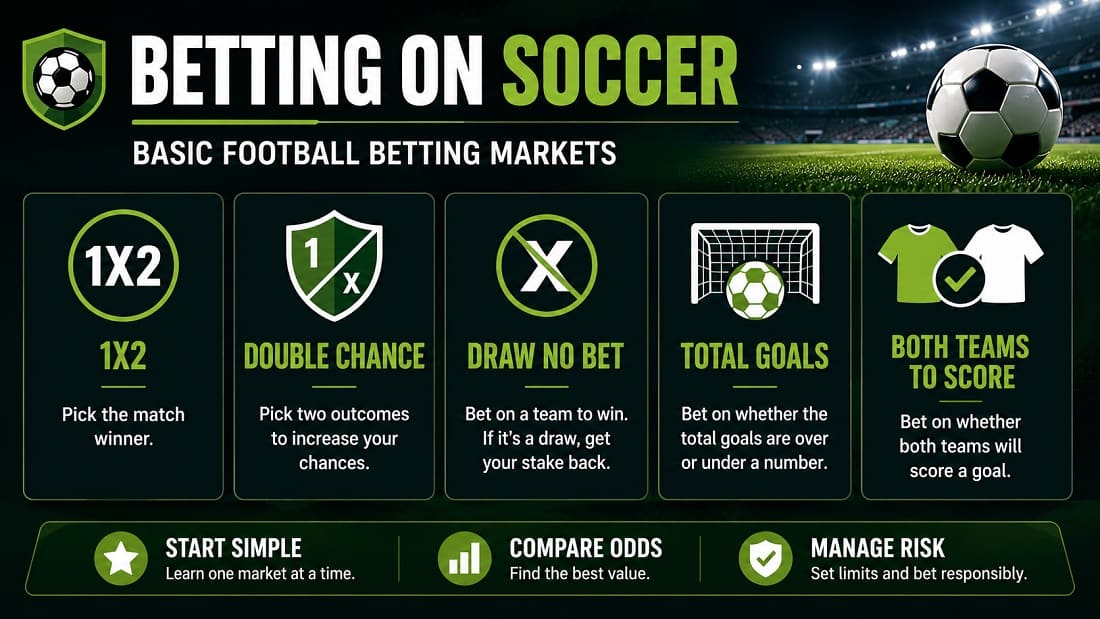
Football betting markets are different ways to wager on a match result or event. The main markets include 1X2, Double Chance, Draw No Bet, Asian Handicap, total goals and Both Teams to Score. Each market has its own winning, losing, refund and settlement conditions.
Choosing a team is only one part of a football bet. You must also decide which market reflects your prediction, what price is available and what must happen for the wager to be settled as a win.
A bettor may believe that one team is stronger but still avoid the straight win because the draw probability is too high. The same opinion could instead be expressed through Draw No Bet, Double Chance or an Asian Handicap line. These selections may point in the same direction, but they do not carry the same risk.
This guide explains the main football and soccer betting markets, including how decimal odds work, how quarter handicaps are settled and which rules should be checked before a bet is placed.
How football betting markets work
A betting market defines the exact question that the wager must answer. It may ask who wins, how many goals are scored, whether both teams score or whether one team covers a handicap.
- Match-result markets cover the home win, draw, away win or qualification outcome.
- Handicap markets add a virtual advantage or disadvantage before the result is settled.
- Goal markets focus on the combined goals or goals scored by one team.
- Player markets cover events involving a named player, such as goals or shots.
- Period markets apply to a defined part of the match, such as the first half.
Before comparing odds, identify the exact outcome required. A bet on a team in the 1X2 market loses if the match is drawn. The same team selected through Draw No Bet normally produces a refund after a draw.
Basic check: confirm what makes the bet win, what makes it lose, when the stake is refunded and whether extra time is included.
Decimal odds, returns and implied probability
Decimal odds show the total return for each unit staked, including the original stake.
A £10 bet at decimal odds of 2.00 returns £20 when successful. The return contains the original £10 stake and £10 profit.
The basic probability calculation is:
Implied probability = 1 ÷ decimal odds × 100
| Decimal odds | Implied probability | Interpretation |
|---|---|---|
| 1.50 | 66.7% | The price implies that the outcome occurs about two times in every three. |
| 2.00 | 50.0% | The price represents a one-in-two probability before the market margin is considered. |
| 3.00 | 33.3% | The outcome must occur more often than one time in three to justify the price. |
What is the overround?
When the implied probabilities of every selection in a market are added together, the total will normally be higher than 100%. This total is commonly called the market percentage, while the amount above 100% is the overround.
The overround reflects the pricing margin built into the market. It should not be treated as the operator’s final profit margin because actual results also depend on customer selections, price movement and liability management.
Odds of 1.80 imply a probability of approximately 55.6%. If you estimate that the team wins only 50% of the time, the price does not compensate for your estimated risk even though the team may still be the most likely winner.
1X2, Double Chance and Draw No Bet
Match-result markets differ mainly in how they treat the draw and which part of the match is used for settlement.
| Market | Selections | Settlement |
|---|---|---|
| 1X2 | 1, X or 2 | 1 means a home win, X means a draw and 2 means an away win. Standard pre-match 1X2 markets normally settle after 90 minutes plus stoppage time. |
| Double Chance | 1X, X2 or 12 | The selection covers two possible match results. For example, X2 wins if the away team wins or the game finishes level. |
| Draw No Bet | Home or away team | A win by the selected team wins the bet. A draw normally returns the stake, while a defeat loses the bet. |
| To Qualify | Either team to advance | The bet is settled on which team progresses from the tie. It can include the aggregate score over two legs, extra time and penalties. |
Draw No Bet compared with Asian Handicap 0
Draw No Bet and Asian Handicap 0 normally have the same basic settlement: the selected team wins the bet if it wins the match, while a draw returns the stake. However, prices and operator-specific rules can differ, so the two markets should still be compared before selection.
When Double Chance may be more suitable
Double Chance can be useful when the analysis strongly opposes one result but does not clearly separate the other two. For example, 1X supports the home team while also protecting the bet against a draw.
European Handicap and Asian Handicap
Handicap markets change the score for settlement purposes by adding virtual goals to one team or subtracting them from the other.
European Handicap
European Handicap is usually a three-way market. The home win, handicap draw and away win remain possible after the handicap is applied.
The home team is selected at −1 and wins the actual match 2–1. After the handicap is applied, the adjusted score is 1–1. The handicap result is therefore a draw, not a home win.
Asian Handicap
Asian Handicap is usually a two-way market. The draw is removed as a final betting outcome, although whole-goal lines can return the stake.
| Selection | Match result | Settlement |
|---|---|---|
| Team 0 | Draw | Stake returned. This is commonly called a push. |
| Team −0.5 | Draw | Full loss because the selected team had to win. |
| Team −1.0 | Wins by one goal | Stake returned because the adjusted score is level. |
| Team +1.0 | Loses by one goal | Stake returned. |
| Team +0.5 | Draw | Full win because the handicap gives the selected team half a goal. |
How quarter-goal Asian Handicap lines are settled
A quarter line divides the stake equally between two adjacent handicap lines. A £20 bet at −0.25, for example, places £10 on handicap 0 and £10 on handicap −0.5.
| Selection | Outcome | What happens |
|---|---|---|
| Team −0.25 | Match drawn | Half the stake on handicap 0 is refunded. Half the stake on −0.5 loses. Overall result: half loss. |
| Team −0.75 | Team wins by one goal | Half the stake on −0.5 wins. Half the stake on −1.0 is refunded. Overall result: half win. |
| Team +0.75 | Team loses by one goal | Half the stake on +0.5 loses. Half the stake on +1.0 is refunded. Overall result: half loss. |
| Team +0.25 | Match drawn | Half the stake on handicap 0 is refunded. Half the stake on +0.5 wins. Overall result: half win. |
Do not treat all negative handicaps as equivalent. A selection at −0.5, −0.75, −1.0 and −1.25 produces different settlement outcomes after a one-goal win.
Over/Under goals and Asian totals
A total-goals market is settled using the combined number of goals scored by both teams during the stated match period.
Over 2.5 wins when at least three goals are scored. Under 2.5 wins when the match contains no more than two goals.
Whole-goal lines can produce a push. Over 2.0 wins with at least three goals, returns the stake when exactly two goals are scored and loses with fewer than two.
Asian total quarter-line examples
| Selection | Total goals | Settlement |
|---|---|---|
| Over 2.25 | Exactly 2 | Half the stake on Over 2.0 is refunded. Half the stake on Over 2.5 loses. Overall result: half loss. |
| Over 2.75 | Exactly 3 | Half the stake on Over 2.5 wins. Half the stake on Over 3.0 is refunded. Overall result: half win. |
| Under 2.75 | Exactly 3 | Half the stake on Under 2.5 loses. Half the stake on Under 3.0 is refunded. Overall result: half loss. |
| Under 3.25 | Exactly 3 | Half the stake on Under 3.0 is refunded. Half the stake on Under 3.5 wins. Overall result: half win. |
Game-state risk: an early goal can force the losing team to attack more aggressively. That can increase transitions, shots and space, making a pre-match Under position less attractive.
Both Teams to Score and team goal markets
Both Teams to Score Yes wins when each team scores at least once during the stated match period.
The final winner and total number of goals do not matter. A 1–1 draw, a 2–1 home win and a 4–1 away win all settle as BTTS Yes.
BTTS No wins when at least one team fails to score. This includes 0–0, 1–0, 2–0 and any other result containing a clean sheet.
Team totals
Team totals apply the goal line to one side only. Home Team Over 1.5 requires the home team to score at least twice. Goals scored by the opponent do not affect that settlement.
Win to Nil and clean-sheet markets
Win to Nil requires the selected team to win without conceding. A clean-sheet market only requires the team not to concede, so a 0–0 draw may still win depending on the selection.
Other common football betting markets
| Market | What is predicted | Main consideration |
|---|---|---|
| Correct Score | The exact final score | A narrow outcome range produces higher odds but also much greater variance. |
| Winning Margin | How many goals separate the teams | The selected team must win by the specified margin or range. |
| First Team to Score | Which side scores first | Check how 0–0 is treated and whether a No Goal option exists. |
| Anytime Goalscorer | A named player scores | Confirm participation rules and whether own goals count. |
| Corners | Corner totals, team corners or handicap | Crosses, blocked shots, defensive clearances and game state can matter more than possession alone. |
| Cards | Cards or disciplinary points | Confirm whether the market counts cards, card points, staff cards or cards shown after full time. |
| Outright Winner | A tournament, league or group winner | The bet may remain open for weeks or months. Check qualification, withdrawal and competition-specific settlement rules. |
First-half, second-half and live betting markets
Period markets use only events that occur during the named part of the match.
- First-half 1X2 is settled using the score when the first half ends.
- First-half totals count only goals scored before the half-time whistle, including first-half stoppage time.
- Second-half markets count only events occurring after the second half begins, including second-half stoppage time.
- Half-time/full-time requires both the half-time result and the full-time result to match the selection.
Live betting
Live markets are repriced as the match develops. The current score, time remaining, red cards, substitutions and game tempo can all affect the line.
Live betting does not remove uncertainty. Prices can change quickly, broadcasts may be delayed and a short period of pressure does not always represent the wider match.
Before using a live market, confirm the score, match clock and current line inside the betting interface rather than relying only on a delayed broadcast.
Settlement rules to check
The market title is only a summary. The published settlement rules determine how the wager is graded.
- Regulation time: standard match-result markets commonly include 90 minutes and stoppage time but exclude extra time.
- Qualification markets: may include aggregate scores, extra time and penalties.
- Postponed matches: rules determine how long the wager remains active before it is voided.
- Abandoned matches: markets already unconditionally determined may sometimes be settled, while unfinished markets may be voided.
- Venue changes: a change of stadium or home-team designation may affect settlement.
- Player participation: a player may need to start, appear or meet another participation condition.
- Statistical provider: shots, assists, cards, tackles and corners may be settled using a named data source.
How to select the right football betting market
- State the prediction clearly. Decide whether your view concerns the winner, draw risk, goal total, one team’s scoring output or a specific player.
- Identify the main way the prediction could fail. A favourite may control possession but still be vulnerable to a low-scoring draw or set-piece goal.
- Compare related markets. Review the 1X2, Draw No Bet and relevant handicap prices together.
- Convert each price into implied probability. This shows how often the outcome must occur before the odds become worthwhile.
- Check the settlement conditions. Pay particular attention to match duration, quarter lines, player participation and postponement rules.
- Do not chase a price after it shortens. The football opinion may remain correct while the available odds become unattractive.
You expect the away team to have the better chance of winning, but you also expect a low-margin match. The straight away win offers the largest return, Draw No Bet protects against a draw, and Asian Handicap −0.25 splits the draw outcome between a refund and a loss. The decision should be based on the available prices and your estimated probabilities.
Common beginner mistakes
- Backing the most likely winner at any price. Probability and value are not the same.
- Ignoring the draw. Draw probability directly affects 1X2, Double Chance, DNB and Asian Handicap decisions.
- Misreading quarter lines. A quarter handicap divides the stake and can create a half-win or half-loss.
- Assuming extra time is included. Most standard 90-minute markets exclude extra time unless stated otherwise.
- Using league position as the complete analysis. Venue, expected line-ups, schedule, playing style and match state can all change the risk.
- Combining several correlated selections. A favourite win, favourite handicap and opponent team-total Under may all depend on the same match script.
- Increasing the stake after a loss. A previous result does not improve the probability of the next bet.
Bankroll and responsible betting
Betting is not a reliable form of income. Every market contains uncertainty, and no selection can guarantee a profit.
A bankroll is money set aside specifically for betting. It should not include money required for housing, food, bills, debt payments or other essential expenses.
- Use a small, predefined unit rather than changing stakes emotionally.
- Set spending and time limits before betting begins.
- Do not increase stakes to recover previous losses.
- Record the selection, market, odds, stake and result.
- Review decisions over a meaningful sample rather than one match.
- Stop betting when it no longer feels controlled or recreational.
Self-exclusion tools, deposit limits and support services differ by country and operator. Use the responsible gambling resources available in your jurisdiction when additional control is needed.
Football betting glossary
Current match analysis on Odds2Win
Apply the market definitions and settlement principles in this guide when reviewing upcoming match analysis.
Frequently asked questions
What does 1X2 mean in football betting?
In a 1X2 market, 1 means a home win, X means a draw and 2 means an away win. Standard pre-match 1X2 bets are normally settled after 90 minutes plus stoppage time.
What is the difference between Draw No Bet and Double Chance?
Draw No Bet backs one team and normally refunds the stake after a draw. Double Chance covers two match results, such as a home win or draw, and wins when either result occurs.
What does Asian Handicap −0.25 mean?
Asian Handicap −0.25 divides the stake equally between handicap 0 and handicap −0.5. A win produces a full win, a draw produces a half-loss and a defeat produces a full loss.
Does a football bet include extra time?
Standard 1X2, total-goals and handicap markets usually cover 90 minutes plus stoppage time only. Extra time and penalties count only when the market wording or settlement rules state that they are included.
Which football betting market is easiest to understand?
Standard 1X2, Draw No Bet and Over/Under 2.5 are among the simplest markets to understand. The appropriate market still depends on the prediction, available odds and settlement conditions.
Key takeaway
Football betting markets are different ways of expressing a match prediction. A 1X2 bet, Draw No Bet selection, Asian Handicap and goal total may all be based on the same fixture, but each one changes the required outcome and level of risk.
Define the prediction first, compare the related prices, calculate the implied probability and read the settlement rules before choosing the market.
This guide is provided for informational and educational purposes only. Betting involves financial risk, and no prediction, strategy or market can guarantee a profit.