

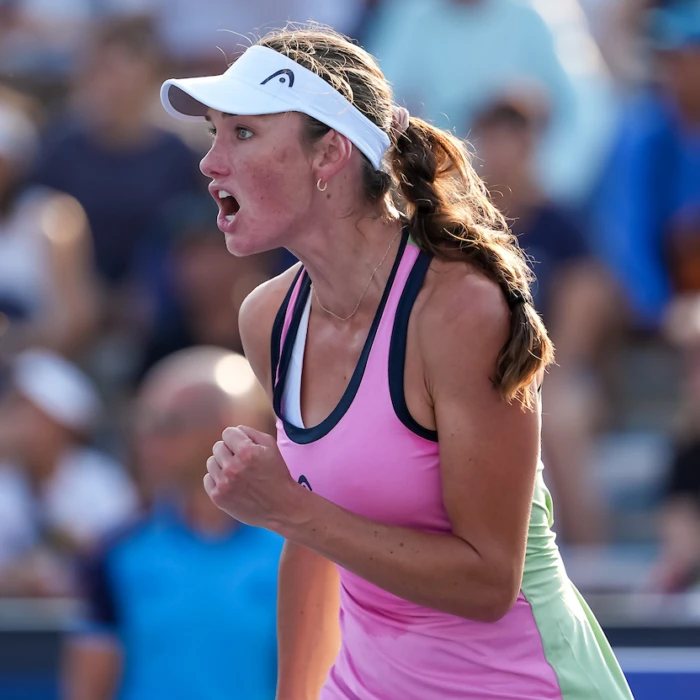
Rebeka Masarova (Switzerland)
Masarova enters the semifinal as the higher-ranked and more seasoned competitor. A former junior Grand Slam champion, she has steadily climbed the WTA rankings thanks to her controlled power, consistent groundstrokes, and strong court awareness — all well-suited for clay. Her ability to extend rallies and dictate play from the baseline makes her a tough opponent on slower surfaces.
Key Strengths: Heavy topspin from both wings, reliable serve under pressure, physical endurance, and composure during long exchanges.
Career Highlights:
- WTA 250 semifinalist on multiple occasions
- Junior French Open champion (2016)
- Regular qualifier for Grand Slam main draws
- Career-high WTA ranking inside the Top 100
- Read also: Michael Mmoh vs Kyrian Jacquet – ATP Match Prediction.
Kayla Branstine (United States)
Branstine is a powerful, fearless competitor with a dynamic forehand and aggressive baseline game. While her game is naturally better suited for hard courts, she brings a bold style that can unsettle more defensive players. However, her relative inexperience on clay and inconsistency in extended rallies may prove challenging at this stage.
Key Strengths: Offensive mindset, fast first-strike tennis, high-intensity pace, capable of hitting winners from anywhere on court.
Career Highlights:
- Multiple ITF titles at the 15K and 25K levels
- Former junior standout in the U.S. system
- Career-best WTA ranking in the Top 200
- Debut in Roland Garros qualifying draw
- Read also: Filip Misolic vs Liam Draxl – ATP Match Prediction (May 20).
Conclusion for the WTA Match: Rebeka Masarova vs Kayla Branstine
While Branstine brings energy and a fearless approach, the matchup on clay clearly favors Masarova. The Swiss player’s ability to grind through rallies, construct points patiently, and absorb pace gives her a tactical edge on the slow Parisian surface. Branstine may trouble Masarova in short bursts with flat, aggressive hitting, but over the course of a match, her game is more prone to unforced errors — especially against an opponent comfortable in extended exchanges.
Masarova’s experience, clay-court proficiency, and superior consistency should carry her through. Expect the Swiss to advance in straight sets, barring a surprise momentum swing.