
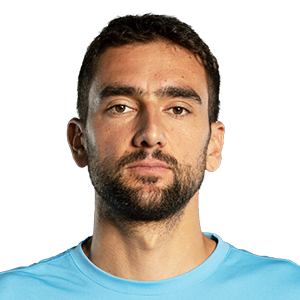

Marin Cilic (Croatia)
Marin Cilic enters the tournament holding a stable position at No. 45 in the ATP rankings, displaying a 5–5 record over his last ten competitive fixtures. The Croatian veteran has traditionally performed well in Melbourne, utilizing his flat groundstrokes to exploit the quick outdoor surfaces.
In his recent matches, Cilic has relied heavily on an accurate first delivery to protect his service games. His baseline approach focuses on horizontal depth, aiming to keep opponents from stepping inside the court and dictating rallies.
However, his defensive movement remains a vulnerability that quicker opponents can target, especially in extended baseline exchanges. Despite this, the Croat remains one of the most experienced competitors in the draw, knowing exactly how to manage his energy during long, multi-set Grand Slam matches. He enters this round after defeating Daniel Altmaier in the opening round.
Denis Shapovalov (Canada)
Denis Shapovalov arrives in Melbourne ranked No. 37 in the world, carrying a 4–6 record over his last ten outings. The Canadian left-hander relies on an aggressive offensive strategy, taking the ball early to generate sharp crosscourt angles, particularly from his backhand wing.
Statistically, Shapovalov’s main challenge this season has been baseline consistency. On these fast outdoor courts, his success depends heavily on keeping his first-serve percentage high to avoid being punished on weaker second deliveries.
Furthermore, the Canadian is prone to momentum swings during matches, with his unforced error count occasionally rising when trailing in service games. He advanced to the second round by defeating Yunchaokete Bu in straight sets, which gave him some much-needed confidence, but his ability to maintain focus over a best-of-five distance remains a key question mark.
Head-to-Head Statistics & Surface Efficiency
The head-to-head history between these two competitors stands deadlocked at 3–3. However, their tactical history reveals that their matchups are highly dependent on the tournament format and court conditions.
While Shapovalov possesses a 3–1 edge in shorter, best-of-three hard-court tour events, Cilic has shown better endurance and composure in extended Grand Slam formats. Cilic’s ability to control the pace from the baseline and minimize unforced errors gives him a steady platform to absorb the Canadian’s high-variance power hitting.
Key Comparison Factors Marin Cilic:
- Current ATP Ranking: No. 45
- Form Over Last 10 Matches: 5–5 record
- Career Hard-Court Efficiency: 62% career win rate on outdoor hard courts
- Opening Round Performance: Defeated Daniel Altmaier (Germany)
- Grand Slam Head-to-Head History: 1–0 (won their previous best-of-five encounter in straight sets)
Key Comparison Denis Shapovalov:
- Current ATP Ranking: Denis Shapovalov -No. 37
- Form Over Last 10 Matches: 4–6 record
- Career Hard-Court Efficiency: 59% career win rate on outdoor hard courts
- Opening Round Performance: Defeated Yunchaokete Bu (China)
- Grand Slam Head-to-Head History: 0–1
Bookmakers open this match making Denis Shapovalov the favorite, largely due to his higher ranking and dynamic lateral speed. However, Marin Cilic presents a significant threat in a best-of-five format. The fast Melbourne courts suit Cilic’s flat hitting, and his experience in managing critical points in major tournaments cannot be overlooked. Shapovalov’s lower second-serve win efficiency makes him vulnerable to Cilic’s deep, aggressive returns.