
Sportsbook Bonuses Explained: Wagering Requirements, Rollover & Real Value
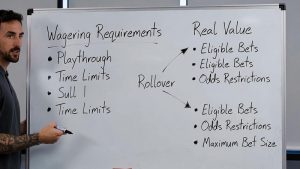
Sportsbook bonuses stop looking generous once rollover, minimum-odds rules, exclusions, and KYC checks start shaping what you can actually withdraw. An offer is worth taking only when the required turnover, deadline, stake-return rule, and verification flow match the way you already place bets. The practical way to compare promos is to break them into checks before opt-in: what counts toward rollover, which markets are excluded, when documents may be requested, and how those conditions affect any later payout. Two bonuses with the same headline amount can lead to very different real outcomes.
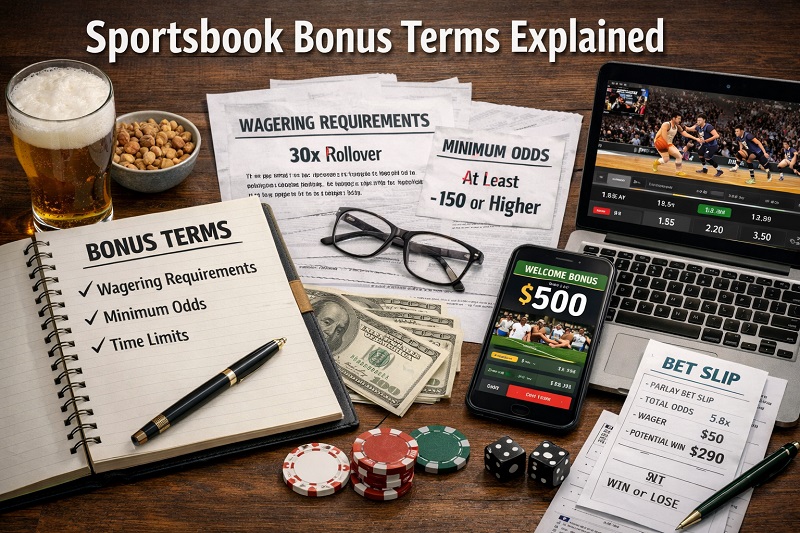
Sportsbook Bonus Terms Explained: Wagering Requirements, Rollover and Real Value
Read sportsbook bonus terms as operating rules, not as free cash. Start with wagering requirements and rollover bonus workload. Then check the odds floor, contribution rules, expiry, max-bet clause, free-bet settlement, bonus real value, and any bonus withdrawal restrictions that apply if you cash out early or fail a condition.
That order matters because headline size rarely tells you the true cost of clearing a promo. A large match bonus can still have weak bonus real value when wagering requirements are based on deposit plus bonus, when markets count only partially, or when short deadlines and withdrawal restrictions make completion awkward.
The practical question is never just “How big is the offer?” It is “What do these sportsbook bonus terms require me to do before funds become withdrawable?” If the rollover bonus conditions do not fit normal stake size, normal market choice, and realistic timing, the promotional value stays mostly theoretical. A useful cross-check is to compare the markets you normally bet with the site's football predictions and tennis predictions sections, because bonus usability often changes once minimum-odds rules meet real match coverage.
Core sportsbook bonus terms that decide whether a bonus is usable
Wagering requirements and rollover bonus workload
Wagering requirements tell you how much total qualifying stake must be placed before bonus-linked funds or bonus-linked winnings can become withdrawable. This is turnover, not profit. If the sportsbook bonus terms say 5× bonus, you stake five times the bonus amount. If they say 5× (deposit + bonus), the rollover bonus workload is much heavier because both balances are included in the base.
Minimum odds and qualifying bets
A minimum odds rule is often the first practical filter. If the bonus requires odds of 1.50, 1.80, or 2.00+, low-price selections may contribute nothing at all. Some operators also exclude specific leagues, same-game combinations, cash-out bets, props, or selected live markets. That matters because a promo may look easy on paper but force you away from the bet types you normally use. The gap becomes clearer when you compare a promo against actual pre-match and live-style coverage in the site's football predictions and tennis predictions pages.
Contribution rate
Not every qualifying wager counts at 100%. One market might count fully, another at 50%, and another at 0%. When contribution drops, the real handle needed to finish the bonus rises. This is one of the most common reasons players think progress is broken when the actual problem is that the market choice counts only partially.
Free bet settlement
A free bet is not the same as cash. The single phrase that matters most is whether the stake is returned on a win. If the stake is not returned, the coupon’s practical cash-like value is lower than the face amount. If the stake is returned, the promotional value is much closer to ordinary cash staking.
Expiry, max bet, max conversion and bonus withdrawal restrictions
Tight time windows, low maximum stakes while the bonus is active, payout caps, and early-withdrawal cancellation clauses change the result more than most players expect. These bonus withdrawal restrictions often decide whether a promotion is workable at all. A promo can be genuine and still have poor real value because the deadline is too short, the max stake is too low, or the operator cancels bonus-linked value as soon as funds are removed before completion.
A simple way to estimate bonus real value
Use this quick comparison:
Effective rebate ≈ bonus you can realistically keep ÷ required qualifying handle
This is not a profit claim. It is a fast way to compare bonus real value. It exposes offers that look generous in the headline but demand large wagering requirements, narrow market choice, or a rollover bonus schedule that normal betting habits will not support.
Worked example: deposit match
Imagine an offer that says: 100% match up to $100, wagering 5× (deposit + bonus), minimum odds 1.50, 7 days to complete. A player deposits $100 and receives $100 bonus.
- Base: deposit + bonus = $200
- Required handle: $200 × 5 = $1,000
- Quick yardstick: $100 bonus ÷ $1,000 handle = roughly 10% effective rebate if completed
But that is only the first layer. The player still has to check whether their usual prices meet the minimum odds, whether their preferred markets count fully, whether the seven-day pace is realistic, and whether there is a max-bet clause that slows completion. If those conditions do not match normal behaviour, the usable value falls.
Worked example: free bet
Now take a $50 free bet at decimal odds 3.00.
- Stake not returned: payout = (3.00 − 1) × $50 = $100
- Stake returned: payout = 3.00 × $50 = $150
That is why the settlement line matters so much. On a stake-not-returned coupon, the face value is not the same as cash. If the same free bet also carries strict eligible odds, a low max payout, or a short expiry window, its practical value falls further.
Before opting in, rewrite the promo in plain operational language: “I must stake about $X of qualifying bets, at or above odds Y, by date Z, without breaking any market or max-bet rules.”
Where players usually misread sportsbook bonus terms
1. Confusing turnover with profit
Wagering is total qualifying stake volume, not net winnings. A player can place many bets, see activity in the account, and still be far from completion because the progress measure is handle rather than profit.
2. Calculating the wrong base
The biggest arithmetic mistake is assuming that rollover is based on the bonus only when the terms actually say deposit + bonus. That can double the workload immediately.
3. Ignoring contribution and exclusions
This is where many “I already did enough” disputes begin. The player placed volume, but on markets that counted at 50% or 0%, or on bets that fell below the minimum odds threshold.
4. Missing free-bet settlement language
A player sees a $50 coupon and mentally treats it like $50 cash. If the stake is not returned, that assumption is wrong. The headline amount overstates the practical withdrawable value.
5. Waiting too long on verification
Some users read bonus terms carefully but ignore the withdrawal path. KYC and payment-method checks often appear only when cash-out is requested. If the account is not ready, a player can hit a deadline or create frustration that had nothing to do with the betting itself.
Red flags that reduce bonus real value
- Rollover on deposit + bonus: the handle requirement becomes much heavier than a bonus-only structure.
- Short expiry: the deadline forces rushed or unnatural betting behaviour.
- Strict minimum odds: your normal low-variance selections may not count.
- Low max bet during wagering: progress slows even if your bankroll would normally support larger stake sizes.
- Long exclusion list: flexibility disappears and it becomes easier to place non-qualifying bets by mistake.
- Stake not returned on free bets: the coupon is worth less than the headline suggests.
- Max conversion or max payout caps: upside is limited even when the coupon wins.
- Early-withdrawal cancellation: removing funds can wipe out bonus-linked value before completion.
The more restrictions stack together, the less meaningful the headline amount becomes.
How to choose a safer promo structure
A safer offer is one you can complete without changing the way you normally bet. That means the handle is understandable, the qualifying markets are markets you already use, the deadline is workable, and the free-bet settlement language is clear before you opt in.
The strongest practical bonus profile usually has a moderate rollover, transparent market eligibility, a realistic deadline, and no unusual max-bet trap during the wagering period. It does not force you into unfamiliar bet types, inflated odds, or rushed volume near expiry.
Pre-opt-in checklist
- Base and multiplier: Is wagering applied to the bonus only, or to deposit plus bonus?
- Required handle: What total qualifying stake volume does that create in dollar terms?
- Eligible bets: Do your usual markets, leagues, and bet types actually count?
- Minimum odds: Can you meet the odds rule without changing your natural staking profile?
- Expiry and max bet: Can you finish on time without forced volume or rule breaches?
- Free-bet settlement: Is the stake returned, and is there a payout cap?
- Withdrawal path: What happens if you withdraw early, and is the account verification-ready?
FAQ on sportsbook bonus terms
What does 10× wagering actually mean?
It means you must place qualifying bets totalling ten times the stated base before bonus-linked value becomes withdrawable. The key detail is the base itself: if terms say 10× bonus, only the bonus amount is multiplied; if they say 10× (deposit + bonus), the required handle is much larger.
Why do minimum odds matter so much?
Because they decide whether your bets count. A bonus may look easy to clear until you realise that many short-price selections contribute 0%, forcing you onto higher-variance bets or unfamiliar markets just to make progress.
Is a free bet the same as cash?
Usually no. The settlement rule matters. If the stake is not returned on a win, the practical value of the coupon is lower than its face amount. That is why free bets should be translated into cash-like value before you compare offers.
Why do withdrawals get blocked even after several bets were placed?
The usual causes are incomplete wagering progress, bets that did not qualify because of odds or exclusions, early withdrawal during an active promotion, or unfinished account verification. Activity alone does not prove that the bonus conditions were met correctly.
What is the fastest way to compare two sportsbook promos?
Turn both offers into plain numbers: required handle, minimum odds, expiry window, eligible markets, free-bet settlement rule, and any max-bet or payout cap. Then ask which one you could complete using your normal betting behaviour, not a forced routine built only to chase the bonus.