
Basics of Baseball Betting: Moneyline, Run Line, Totals & Odds
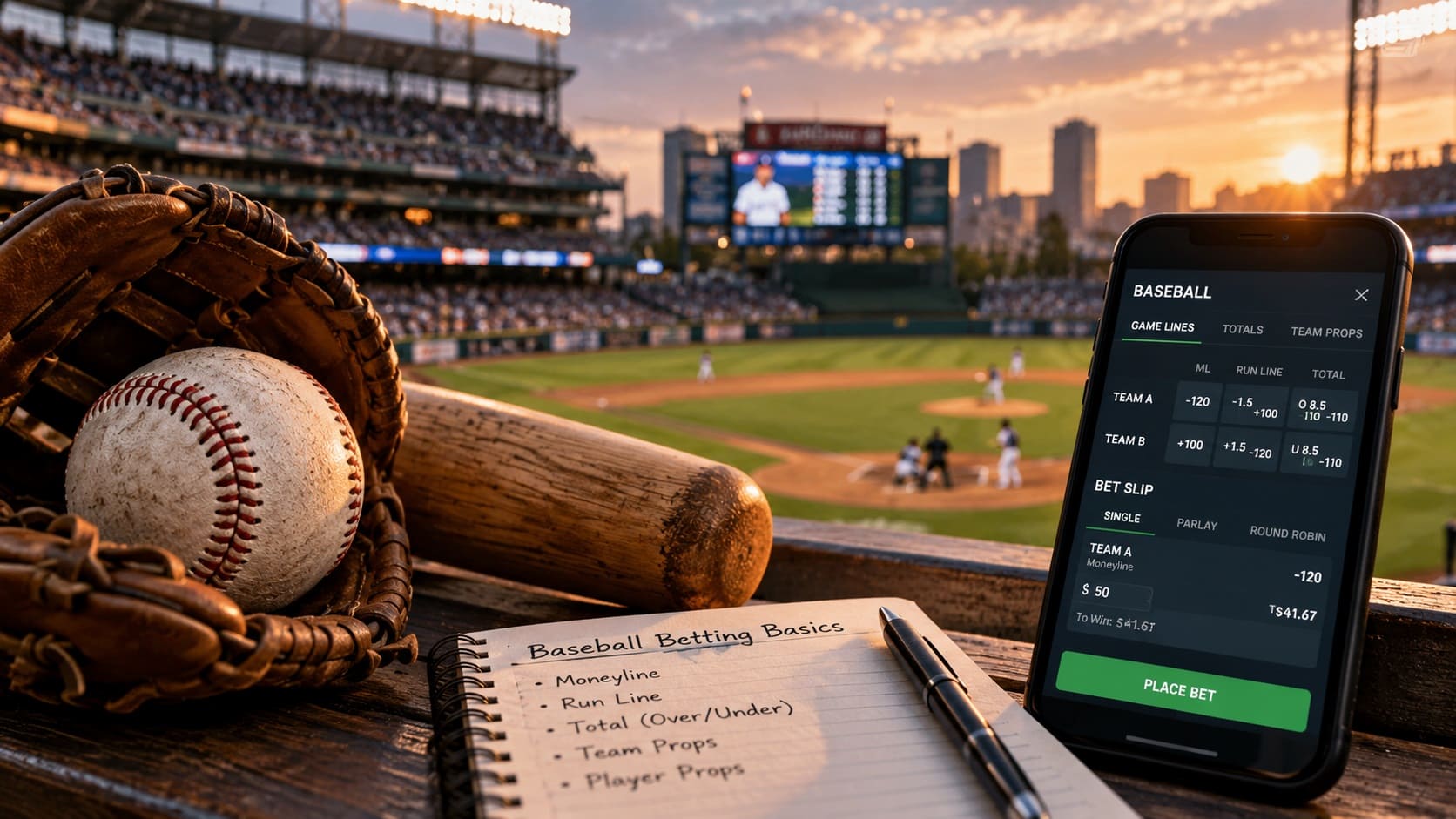
Baseball betting starts with three simple questions: Which team will win? By how many runs? And how many runs will both teams score?
Contents
Those questions correspond to the three main betting markets: moneyline, run line and totals. Once you understand them, you can learn how odds work, what happens when a game goes into extra innings and why the starting pitcher matters so much.
This guide uses Major League Baseball (MLB) examples and simple calculations. You do not need to know advanced baseball statistics to follow along.
One distinction is important from the start: MLB rules determine how the game is played, while sportsbook rules determine how your bet is settled. The two are not always the same.
How Does Baseball Betting Work?
A standard MLB game is scheduled for nine innings. Each inning gives both teams a chance to bat. If the game is tied after nine innings, extra innings are played until a winner is decided.
Most beginners start with the moneyline because it only requires picking the winning team. Run-line bets add a winning-margin condition, while totals focus on the number of runs scored.
| Bet type | What you need | Example |
|---|---|---|
| Moneyline | Your selected team wins. | Team A wins 5–4. Team A moneyline wins. |
| Run line −1.5 | Your team wins by at least two runs. | Team A wins 5–4. Team A −1.5 loses. |
| Run line +1.5 | Your team wins or loses by one run. | Team B loses 5–4. Team B +1.5 wins. |
| Over 8.5 runs | Both teams combine for at least nine runs. | A 5–4 game has nine runs. Over 8.5 wins. |
| First Five Innings (F5) | The result after five innings meets your selected market condition. | Team A leads 3–1 after five. Its F5 moneyline wins. |
Examples assume that the required playing period has been completed and the market is settled under its published rules.
Baseball Moneyline Betting Explained
A moneyline bet is a bet on which team will win the game. The final winning margin does not matter.
If Team A wins 2–1 or 9–2, a moneyline wager on Team A wins in either case.
American odds use minus and plus signs. A negative number usually identifies the favorite. A positive number usually identifies the underdog.
How to Read a Baseball Betting Slip
Imagine you open a sportsbook and see this hypothetical matchup:
Example Betting Slip
Market: Full Game Moneyline
Team A: −150
Your stake: $10
Profit if Team A wins: $6.67
Total payout: $16.67
The $16.67 payout includes your original $10 stake. Your actual profit is $6.67.
If Team A loses, you lose the $10 stake.
Now imagine Team B is priced at +135.
A $10 bet on Team B would produce $13.50 profit if it wins. The total payout would be $23.50, including the original $10.
The underdog offers a larger payout because the market gives it a lower chance of winning. That does not automatically make it a better bet.
What Do Baseball Odds Mean in Percentages?
Odds can also be expressed as a percentage. This is called implied probability.
Think of it as the win rate you would need to break even if you repeatedly made comparable bets at the same odds.
Example: Favorite −150 vs Underdog +135
Favorite −150:
150 ÷ (150 + 100) = 60.00%Underdog +135:
100 ÷ (135 + 100) = 42.55%Add the two percentages:
60.00% + 42.55% = 102.55%Why is the total more than 100%? Because the quoted prices include the bookmaker's pricing margin.
The amount above 100% is called the overround. Here it is approximately 2.55 percentage points.
Removing the bookmaker's margin proportionally gives implied probabilities of approximately 58.51% for Team A and 41.49% for Team B.
These are called no-vig probabilities. They show what the market prices imply after removing the margin. They are not independent predictions of which team will win.
The bookmaker's margin is also not a guaranteed profit on every game.
Useful calculators: Convert betting odds into percentages with the Implied Probability Calculator . To examine the margin across both sides, use the Bookmaker Margin Calculator .
What Is a Run Line Bet in Baseball?
The run line is baseball's version of a point spread. The most common MLB run line is 1.5 runs, although other handicaps may be available.
A team with a −1.5 run line must win by at least two runs.
A team with a +1.5 run line wins the bet if it wins the game outright or loses by exactly one run.
Run Line Example
Final score: Team A 5–4 Team B
- Team A moneyline — Win.
- Team A −1.5 — Lose.
- Team B +1.5 — Win.
Now change the score to 6–4.
- Team A moneyline — Win.
- Team A −1.5 — Win.
- Team B +1.5 — Lose.
Why Are Run Line Odds Different?
A favorite at −1.5 has to do more than win the game. It needs a margin of at least two runs.
Because that is a harder condition, the −1.5 run line often offers a larger payout than the same team's moneyline.
Baseball also has a feature worth remembering: when the home team leads after the top of the ninth inning, it does not bat again.
A game can also end on a walk-off, when the home team scores the winning run in its final turn at bat. A walk-off hit can sometimes produce a margin greater than one run, particularly on a home run.
Before selecting −1.5, ask a specific question: How often is this team likely to win by at least two runs?
If you cannot make a reasonable estimate, the larger payout alone is not a good reason to choose the run line.
Baseball Over/Under Betting Explained
An Over/Under bet, also called a totals bet, concerns the combined runs scored by both teams.
You do not need to predict the winning team.
If the line is 8.5 runs, Over 8.5 wins when the teams score nine or more runs combined. Under 8.5 wins when they score eight or fewer.
| Final score | Total runs | Over 8.5 | Under 9.0 |
|---|---|---|---|
| 5–4 | 9 | Win | Push |
| 5–3 | 8 | Lose | Win |
| 7–4 | 11 | Win | Lose |
What Does a Push Mean?
A push normally means that the result lands exactly on the betting line and your original stake is returned.
For example, Under 9.0 pushes when exactly nine runs are scored.
A half-run total such as 8.5 cannot push on an integer number of runs.
What Affects the Total Number of Runs?
Both teams' hitters and pitchers matter, but so do the stadium and playing conditions.
A game with strong starting pitchers may produce few early runs. That can change later when relief pitchers enter the game.
Weather can also matter. Wind, temperature and stadium dimensions can influence how far a batted ball travels.
No single factor guarantees a high- or low-scoring game.
Do extra innings count?
Standard full-game totals generally include extra innings unless the market says otherwise.
In the MLB regular season, each extra half-inning begins with an automatic runner on second base. This rule is not used in the MLB postseason.
Read the MLB explanation of the automatic runner rule .
First Five Innings Betting: F5 vs Full Game
First Five Innings (F5) bets are settled using the result after the first five innings, rather than the final score of the full game.
This market is worth understanding because starting pitchers often have more influence over the early innings.
In the later innings, teams increasingly rely on relief pitchers. These are substitute pitchers who take over from the starter. Together they form the team's bullpen.
Example: F5 vs Full-Game Moneyline
Score after five innings: Team A 3–1 Team B.
Final score: Team A 4–5 Team B.
- Team A F5 moneyline — Win.
- Team A full-game moneyline — Lose.
The same team wins one market and loses the other because the markets cover different parts of the game.
What if the Score Is Tied After Five Innings?
This depends on the market format.
In a standard two-way F5 moneyline market, a tie after five innings normally results in a push.
In a three-way F5 result market, the draw is a separate option. A bet on either team to lead after five innings loses if the period ends tied.
Always check whether you are choosing a two-way or three-way market.
Which Baseball Betting Market Should You Choose?
Choose the market that matches what you expect to happen in the game.
Consider a hypothetical matchup. Team A has the stronger starting pitcher, but its best relief pitchers are unavailable after heavy use in previous games.
Here's how that situation changes the questions you need to ask about each bet.
| Market | Question to answer | Main concern |
|---|---|---|
| F5 Moneyline | Is Team A likely to lead after five innings? | The starting pitcher may leave early, and a five-inning tie may push. |
| Full-Game Moneyline | Can Team A protect its advantage through the end of the game? | An overworked bullpen may struggle in the late innings. |
| Run Line −1.5 | Can Team A win by at least two runs? | A narrow victory still loses the run-line bet. |
A pitching advantage in the early innings does not automatically make F5 a good bet. Its price must still be reasonable.
If the sportsbook has already shortened Team A's odds because of its stronger pitcher, the advantage may already be reflected in the price.
In that situation, skipping the bet may be more sensible than switching markets simply to find a larger payout.
What Should You Check Before Betting on Baseball?
You do not need dozens of statistics. Start with the factors that can change the game most directly.
1. Starting Pitchers
Confirm who is expected to start for each team.
Check the pitcher's recent workload, ability to limit walks and expected number of innings.
One commonly used statistic is ERA (Earned Run Average). It measures the average number of earned runs a pitcher allows per nine innings.
A lower ERA generally indicates fewer earned runs allowed. However, it is a record of past performance, not a prediction of the next game.
The official MLB ERA glossary explains how this statistic is calculated.
2. Confirmed Batting Lineups
Managers regularly rest players or change the batting order.
A lineup missing two important hitters may be less dangerous than its season-long statistics suggest.
Check the confirmed lineup rather than relying only on team averages.
3. Bullpen Availability
A team may have an excellent starter but limited options after he leaves.
Look at which relief pitchers appeared in the previous games and how heavily they were used.
This is particularly relevant to full-game moneyline and totals bets.
4. Ballpark and Weather
Some stadiums are more favorable to hitting than others.
Wind, temperature and whether the roof is open or closed can also affect the game.
These details help describe the playing conditions. They do not guarantee a particular score or total.
How to Find Value in Baseball Betting Odds
The team most likely to win is not always the team offering the best price.
Suppose you believe a team has a 45% chance of winning. If the sportsbook offers odds that require a 50% win rate to break even, the price does not support that estimate.
But if the odds require only a 41.67% win rate, the calculation looks different.
This is the basic idea behind expected value (EV).
Expected Value Example at +140 Odds
Imagine an underdog is offered at +140, equal to 2.40 decimal odds.
The break-even probability is:
1 ÷ 2.40 = 41.67%Now assume an independent model estimates a 45% chance of winning.
With a $1 stake, you would earn $1.40 profit if the bet wins and lose $1 if it loses.
EV = (0.45 × $1.40) − (0.55 × $1.00) EV = $0.63 − $0.55 = +$0.08Under that probability assumption, the expected return is +$0.08 per $1 staked, or +8%.
Now change the estimated chance of winning to 40%.
EV = (0.40 × $1.40) − (0.60 × $1.00) EV = −$0.04The same +140 price now has a modeled expected return of −4%.
The 45% and 40% probabilities above are hypothetical teaching examples. They are not probabilities produced by an Odds2Win model.
A 45% estimate is only useful if the method behind it has been tested against real game results. A guess is not evidence that the sportsbook has made a mistake.
You can test different prices and probability assumptions with the Expected Value Betting Calculator .
Remember: A positive expected-value calculation does not mean the next wager will win. The calculation is only as reliable as the probability estimate used.
Baseball Betting Rules: Pitching Changes and Shortened Games
Baseball bets sometimes depend on conditions that are not immediately obvious from the odds.
Two important examples are a change of starting pitcher and a game that finishes early because of weather.
What Happens if the Starting Pitcher Changes?
Some sportsbooks offer different conditions for moneyline bets involving starting pitchers.
An action bet can remain valid even if the announced starting pitcher is replaced.
A listed-pitcher bet is a wager with a condition attached to one or both named starting pitchers.
If the required pitcher does not start, the bet may be canceled and the stake refunded.
| Condition | What it means |
|---|---|
| Action | The moneyline wager remains valid despite a starting-pitcher change, subject to the operator's rules. |
| One listed pitcher | One specified pitcher must start for the wager to have action. |
| Both listed pitchers | Both specified pitchers must start for the wager to have action. |
Not every sportsbook offers all three options. The specific conditions shown on the betting ticket determine how the wager is handled.
What if a Baseball Game Is Shortened?
A rain delay or other interruption can cause a game to be suspended or ended early.
Some sportsbooks apply a five-inning minimum to standard moneyline markets, or 4.5 innings when the home team is already ahead.
Run-line and full-game totals markets may require nine innings, or 8.5 innings when the home team is leading. Some markets can also be settled when their outcome has already been definitively decided.
These are examples of published sportsbook settlement conditions, not universal MLB betting rules. Suspended games, resumption deadlines and market-specific exceptions can change the result.
For an example of operator-specific rules, see Betfair Sportsbook Rules and Regulations , including the baseball section.
Baseball Betting Checklist for Beginners
Before placing a bet, go through these checks in order. They can change whether a selection is worth considering at the listed odds.
- Choose the exact market. Decide whether you are evaluating moneyline, run line, totals or F5.
- Check the starting pitchers. Look for late changes and possible workload restrictions.
- Confirm the batting lineups. Check whether important hitters are starting.
- Review the bullpen. Find out whether key relief pitchers are available.
- Check playing conditions. Consider the ballpark, weather and roof status.
- Convert the odds into probability. Understand the win rate needed to break even.
- Read the settlement rules. Check pitcher conditions, extra innings and shortened-game requirements.
- Decide whether the price is acceptable. If you cannot support a meaningful advantage, choose NO BET.
Keep the size of each bet within a predetermined budget. Increasing stakes to recover previous losses does not improve the probability of winning.
For more information, read Sports Betting Bankroll Management .
Common Baseball Betting Mistakes
- Betting on a team only because it is the favorite. A high chance of winning does not automatically mean the price is good.
- Ignoring the bullpen. A strong starting pitcher cannot guarantee what happens after leaving the game.
- Choosing −1.5 only for the larger payout. A one-run victory still loses that run-line bet.
- Confusing F5 with full-game bets. Check whether your selection covers five innings or the final score.
- Trusting very small samples. A short winning streak does not prove a team will keep winning.
- Ignoring the bookmaker's margin. The displayed odds are not the same as a verified probability forecast.
- Forgetting settlement conditions. Pitcher changes and interrupted games can affect whether a bet stands.
- Chasing losses. A previous losing wager is not evidence that the next wager has a higher chance of winning.
FAQ: Baseball Betting Basics
What is the easiest baseball bet for beginners?
The moneyline is usually the easiest market to understand because you only select the team that will win. A simple market does not guarantee a profitable bet.
What does −150 mean in baseball betting?
Odds of −150 mean a $150 winning stake produces $100 profit. A $10 winning stake produces approximately $6.67 profit. The implied break-even probability is 60%.
What does −1.5 mean in baseball?
A team at −1.5 must win by at least two runs. A one-run victory wins its moneyline bet but loses its −1.5 run-line bet.
What does Over 8.5 mean in baseball betting?
Both teams must combine for at least nine runs for Over 8.5 to win. If they score eight or fewer, the Over bet loses.
Do extra innings count in baseball bets?
Extra innings generally count in standard full-game MLB markets. Markets restricted to nine innings or another specified period may use different rules.
What happens if a baseball game is tied after five innings?
In a standard two-way F5 moneyline, a tie normally results in a push. In a three-way F5 result market, a draw is offered as a separate outcome. Check the selected market's rules.
Does a starting-pitcher change cancel a bet?
Not necessarily. An action moneyline wager may remain valid after a pitcher change. A listed-pitcher wager may be void if the specified pitcher does not start. The sportsbook's settlement rules apply.
How can I tell if baseball odds offer value?
Convert the odds into a break-even probability and compare that number with a well-supported estimate of the team's winning chance. If you cannot estimate the probability reliably, you cannot establish a genuine betting advantage.
What Matters Most When Betting on Baseball?
Before placing a bet, check what result you need to win and which innings count. Then look at the starting pitchers, confirmed lineups, bullpen and odds. A strong team is not a good bet at every price. If you cannot find a clear advantage, skip the bet.
Further Reading and Baseball Rules
- Betting Odds Explained: Probability, Margin and Value
- Implied Probability Calculator
- Bookmaker Margin Calculator
- MLB Official Glossary: Automatic Runner
- Example of Published Sportsbook Settlement Rules
This article is for educational and informational purposes only. Baseball betting involves financial risk, and no method guarantees a profit. Only participate where legally permitted and within limits you can afford to lose.