
Is Online Betting Legal in Nigeria? Licensing, Payments and Safer Checks
The legal position after the 2024 Supreme Court judgment
Online sports betting can be lawful in Nigeria when the company has the approval required for the territory in which it offers the service. A website being accessible from Nigeria does not establish that it is authorised in every state. Players should check the regulator responsible for their location, the licensed legal entity, the permitted gaming category and the current website or app.
Last reviewed:
On 22 November 2024, the Supreme Court delivered judgment in Attorney-General of Lagos State & Others v Attorney-General of the Federation & Others, Suit No. SC/1/2008. The judgment made the National Lottery Act inapplicable across Nigeria’s 36 states and confirmed that lottery and gaming regulation within the states is a state legislative matter. The National Assembly retains authority over lottery matters in the Federal Capital Territory.
The legal background is summarised in the PwC analysis of SC/1/2008 and the LSLGA summary of the judgment.
- Operator licence
- Whether the company is authorised to offer the relevant betting product in the state or the FCT.
- Player eligibility
- Whether the player meets the age requirement and the rules applying in the place where they participate.
- Payment transaction
- Whether the beneficiary, merchant or processor has a documented connection to the betting company.
- KYC request
- Whether identity documents are requested for a stated purpose through a secure and verifiable channel.
These questions should be checked separately. A valid licence does not guarantee that every contractual term is fair, while a successful bank transfer does not prove that the betting company is licensed.
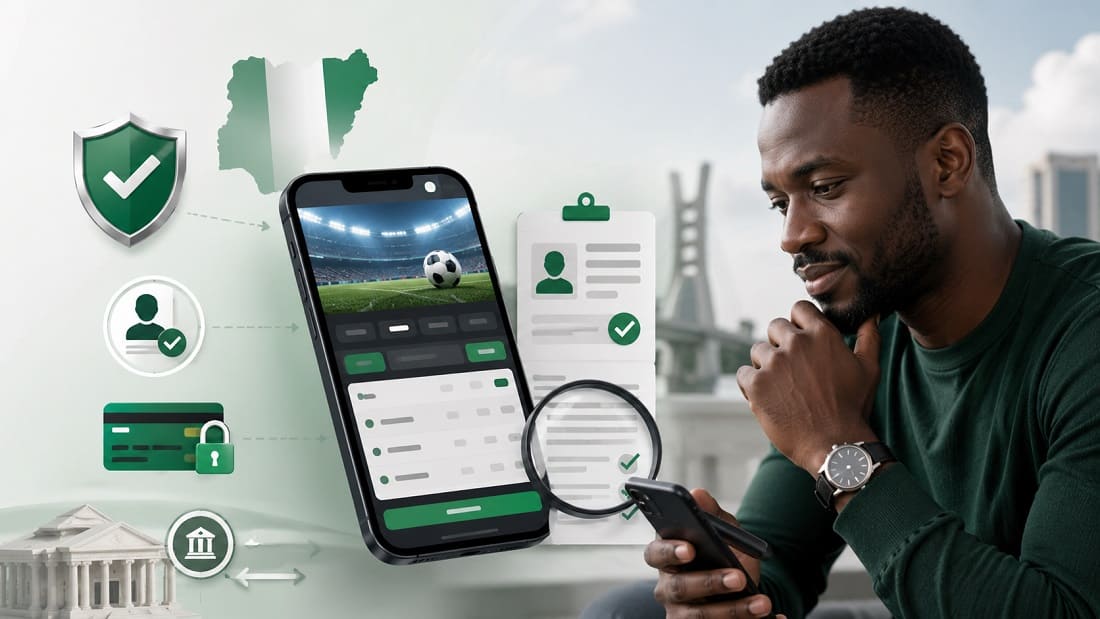
Which betting authority applies in Nigeria?
The first check is the player’s location. A Lagos licence does not automatically cover Abuja or another state, and an FCT approval should not be assumed to replace state authorisation outside the FCT.
| Location | Where to check | What the register shows | What still needs verification |
|---|---|---|---|
| Lagos State | LSLGA licensed operators list | The institution, trade name, gaming category and displayed licence dates. | Current status, the exact domain or app and any date that appears expired or inconsistent. |
| Federal Capital Territory | FCT-LRO approved operators | The company, scheme, gaming category, validity information and displayed status. | That the listed category covers the product being used and that the domain, app and payment route belong to the company. |
| Another Nigerian state | The gaming or lottery authority responsible for that state. | Whether the company holds or claims state-level approval for the relevant activity. | Licence category, renewal status, territorial scope and the legal basis relied on by the company. |
Public registers are useful but not always clean datasets. The Lagos list currently contains entries with expired dates, duplicated trade names, spelling errors and impossible calendar dates. Where a record is contradictory, contact the regulator instead of treating the listing alone as proof of a current licence.
The FCT Remote/Offshore Operator Permit page describes a permit route for foreign companies offering remote gaming to players in Nigeria. The same FCT-LRO website describes the office as the authority for gaming within the Federal Capital Territory. In light of SC/1/2008, a remote permit should not be treated by itself as conclusive evidence of authority in every state. A player outside the FCT should also check the relevant state position.
How to verify a betting website before depositing
Find the legal company
Check the terms, privacy notice and licence statement for the registered company name. A brand or logo is not enough because similar names can be used by unrelated companies and copied websites.
Match the gaming category
Confirm that the register covers the product being used. A sports-betting approval does not automatically authorise casino, lottery or interactive gaming products.
Read the status and dates together
Check the licence start date, expiry date and displayed status. An old certificate or an expired entry should not be treated as evidence of current approval.
Confirm the website and app
The addresses used for registration, deposits, KYC and withdrawals should belong to the verified business. Unexplained redirects, misspelled domains and unofficial APK files require further checking.
Check who receives the payment
Compare the bank beneficiary, merchant descriptor or wallet recipient with the disclosed company or an identified payment processor. Ask for a written explanation where the names differ.
Keep dated records
Save the register entry, terms, withdrawal policy, privacy notice, payment receipt and written support response. These records are needed if the licence, domain or rules later change.
HTTPS protects the connection to a website. It does not prove that the domain belongs to the licensed company or that withdrawals will be handled correctly.
Minimum age, spending controls and self-exclusion
People under 18 should not participate in betting. The LSLGA underage gaming notice tells people below 18 not to bet in Lagos State. The FCT-LRO general guidelines prohibit people under 18 from participating in lottery events.
Players in another state should check that state’s rules, while every betting company should verify age before allowing participation.
The FCT-LRO’s gaming guidelines and policies state that platforms should include self-exclusion and spending-limit features. Lagos has also published information about SafePlay, a proposed regulator-led self-exclusion system intended for integration across licensed platforms.
Before creating an account, check whether the platform provides:
- deposit and spending limits;
- temporary time-outs;
- account closure and self-exclusion;
- a route for stopping marketing messages;
- clear access to account and transaction history.
Use limits or self-exclusion when betting is being used to recover losses, cover bills or create regular income. Do not borrow money, use another person’s payment method or increase stakes because of a previous loss.
KYC requests and withdrawal conditions
Identity and payment-ownership checks can form part of account verification. The company should explain what is required, why it is needed, where the documents should be uploaded and what remains unresolved.
| Request | Clearer process | Reason to pause |
|---|---|---|
| Identity document | The document is uploaded through the secured account area for a stated verification purpose. | The document must be sent to an unrelated Telegram, WhatsApp or social-media account. |
| Payment ownership | The account holder and payment-method owner are required to be the same person. | Third-party deposits are accepted and later used as the only reason to refuse a withdrawal. |
| Address or source of funds | The company identifies the required documents and the compliance issue under review. | New documents are requested repeatedly without explaining what remains outstanding. |
| Data retention | The privacy notice names the company, purpose, contact route and retention approach. | There is no identifiable data controller or secure submission channel. |
Before depositing, read the main terms, withdrawal policy, bonus rules and verification requirements together. Check:
- minimum, maximum, daily, weekly and monthly withdrawal limits;
- the company’s pending period and the payment provider’s delivery time;
- whether verification can be completed before a withdrawal request;
- any wagering requirement attached to deposited funds;
- bonus expiry, minimum odds, excluded markets and maximum conversion;
- withdrawal fees, conversion charges and provider deductions;
- rules covering duplicate accounts, shared devices and third-party payments.
Do not upload identity documents through an unofficial contact or give remote access to a phone or computer. Send only the requested evidence through the company’s verified channel. Do not alter a document, and redact information only where the company confirms that the redaction is accepted.
Concerns about insecure collection or misuse of personal data can be raised with the company’s privacy contact and, where appropriate, the Nigeria Data Protection Commission.
Payment checks for bank transfers, cards, wallets and agents
A naira deposit option shows only that a transaction route is available. It does not establish that the betting company is locally authorised or that the same method can be used for withdrawals.
| Payment route | Check before paying | Keep as evidence | Main limitation |
|---|---|---|---|
| Bank transfer | Beneficiary name, account number, reference and the connection to the betting company. | Transfer receipt, account statement, beneficiary details and support instructions. | Personal or rotating accounts make ownership and recovery harder to establish. |
| Debit card | Merchant name, amount, secure checkout and stored-card consent. | Receipt, statement entry, checkout confirmation and evidence of any duplicate charge. | The merchant descriptor may differ from the betting brand and require processor verification. |
| Wallet or fintech account | Recipient identity, ownership requirements, limits and withdrawal compatibility. | Transaction ID, wallet statement, recipient name and app confirmation. | A method available for deposits may not be offered for withdrawals. |
| Retail agent | Agent identification, operator connection, account details and receipt process. | Official receipt, ticket, agent details, location and account record. | Cash disputes are difficult to prove without an official receipt. |
Do not send a new “release fee”, “verification deposit”, “clearance payment” or unexplained tax to unlock a withdrawal. Ask for the published contractual rule and legal basis, then verify the demand with the relevant regulator. A request to pay a new personal or unrelated beneficiary is a serious risk indicator.
A genuine losing bet is not an unauthorised bank transaction. Contact the bank or payment provider when the payment itself was unauthorised, duplicated, altered, misdirected or processed contrary to the payment instruction.
How to escalate a betting, payment or privacy complaint
Write to the betting company
Identify the account, amount, transaction, date, disputed rule and requested outcome. Ask for a complaint reference, the exact reason for the decision and a written response.
Use the relevant gaming regulator
For a Lagos-licensed company, use the LSLGA complaint form. For an FCT-regulated company, use the FCT-LRO complaint portal. For another state, contact that state’s gaming authority.
Escalate a consumer-service issue to the FCCPC
The FCCPC may consider complaints about misleading terms, unfair service or unresolved consumer treatment after the consumer has first contacted the service provider.
Read the FCCPC complaint process or open the FCCPC complaints portal.
Report a transaction problem to the financial institution
For an unauthorised, duplicated, altered or misdirected payment, complain to the bank or payment provider first and keep the complaint reference.
Use the CBN route if the financial complaint remains unresolved
CBN guidance says customers must first report the matter to the financial institution. It refers to a two-week resolution period for many complaints and up to 30 days for specified issues such as excess charges and loans.
Read the CBN complaint guidance or open the CBN Consumer Complaints portal.
Handle personal-data issues separately
Send a privacy complaint to the company’s data-protection contact. Where the response is inadequate or the issue involves misuse or insecure disclosure, contact the Nigeria Data Protection Commission.
Attach only relevant evidence: the regulator entry, account identifier, transaction reference, withdrawal request, applicable terms, correspondence and previous complaint reference. Never include passwords, PINs or full card security codes.
When not to deposit
- The company claims to be licensed in Nigeria but does not identify its legal entity, regulator, category or territory.
- The legal company or betting scheme cannot be matched to a relevant regulator record.
- The licence date has expired or conflicts with the displayed status.
- Registration, payment or KYC takes place on an unexplained domain.
- Money must be sent to a personal, rotating or unrelated beneficiary.
- Identity documents must be sent through an unofficial social-media account.
- Support changes the reason for a delayed withdrawal and refuses to issue a complaint reference.
- A withdrawal requires another deposit or a new fee paid to a different account.
- The platform guarantees returns, presents betting as income or pressures the user to pay immediately.
A regulator entry reduces one category of risk but does not make a betting company risk-free. Do not deposit until the legal company, territory, current licence status, website, payment recipient and material withdrawal rules can be connected.
Online betting in Nigeria: common questions
Is online sports betting legal in Nigeria?
It can be lawful when the betting company holds the approval required for the territory in which it offers the service. Following SC/1/2008, regulation within the 36 states is state-led, while the FCT has a separate framework.
Does a foreign betting licence cover Nigeria?
No. A foreign licence shows supervision in another jurisdiction but does not by itself prove authority to target players in a Nigerian state or the FCT.
Does an FCT remote permit cover every state?
The FCT-LRO describes its Remote/Offshore Operator Permit as a route for offshore companies serving players in Nigeria. Because SC/1/2008 confirmed state competence outside the FCT, the permit alone should not be treated as final proof of authority in every state.
What is the minimum betting age?
Lagos and FCT regulatory sources prohibit participation by people under 18. Players should also confirm the rules applying in any other state.
Can a company request KYC before paying a withdrawal?
Identity and payment-ownership checks can be legitimate. The company should explain the purpose, required evidence and secure submission route. Repeated unexplained requests or unofficial document uploads require further verification.
Where should a delayed withdrawal be reported?
Complain to the betting company first and obtain a reference. Then use the gaming regulator for the relevant state or the FCT. Consumer, transaction and privacy issues may also require separate complaints to the FCCPC, financial institution, CBN or NDPC.
Can a bank reverse a losing bet?
A genuine losing bet is not an unauthorised transaction. A financial complaint is appropriate when the payment itself was unauthorised, duplicated, altered, misdirected or otherwise processed incorrectly.
Official registers and complaint resources
Supreme Court background: PwC analysis of SC/1/2008.
Lagos licence checks: LSLGA licensed operators list.
FCT licence checks: FCT-LRO approved operators.
Gaming complaints: LSLGA complaint form and FCT-LRO complaint portal.
Consumer complaints: FCCPC complaints portal.
Financial complaints: CBN complaint guidance and CBN Consumer Complaints portal.
Personal-data concerns: Nigeria Data Protection Commission contact page.
Regulator websites, licence records, complaint portals and operator terms can change. Recheck the current record before depositing or filing a complaint. A complaint submission does not guarantee repayment or a decision in the player’s favour.
Legal and betting disclaimer
This article provides general regulatory information and verification steps. It is not legal advice and does not determine that any particular company is lawful, solvent or suitable for a specific user or location.
Betting involves financial risk. Outcomes are not guaranteed, and users must follow the rules applying where they are located.