
Odds movement explained: why lines move, and what the move usually means
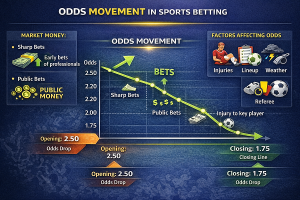
A betting line is not a “truth meter”. It is a tradable price that reacts to risk, information, and the timing of money. If you understand why odds shift, you stop treating every move as a mystery—or as a guarantee.
1) What “odds movement” really is
Odds movement is a change in the price for the same bet. Depending on the market, that change shows up as either a price move (same line, different odds) or a line move (the number itself changes).
- Price move: the line stays the same, but the odds change (example: Over 2.5 goes from 1.95 to 1.80).
- Line move: the bookmaker shifts the number (example: Total moves from 2.5 to 2.75, or Asian handicap shifts by 0.25).
Both are signals, but they are not the same signal. A price move often reflects balancing exposure; a line move more often reflects a stronger belief that the “right” number changed.
2) Why bookmakers move lines
A bookmaker is pricing uncertainty while managing exposure. In practice, line movement is usually driven by three forces: information, opinion, and positioning.
Information: something changed in the match reality
- Team news: a key absence, a late lineup shift, a goalkeeper change, an unexpected rotation decision.
- Context news: weather affecting scoring conditions, travel disruption, schedule congestion, pitch conditions.
- Market news: a market maker or exchange reprices aggressively, pulling other books into alignment.
Opinion: money arrives with a strong view
- Sharp action: early wagers at low limits that challenge the opener and force a quick correction.
- Model-driven demand: systematic bets against prices that sit away from a bettor’s fair line.
- Syndicate timing: coordinated entry across books to capture stale numbers.
Positioning: risk management forces a move
- Liability imbalance: too much money on one side, especially through parlays/accumulators.
- Limit changes: as limits rise, books adjust to reduce pick-off risk at stale numbers.
- Correlation risk: exposure stacks across related markets (favorite + over, team total + match total).
3) The typical lifecycle of a betting line
Most markets follow a repeatable path from open to close. If you know the path, you can place a move in context instead of labeling every shift as “smart money”.
Opening phase (low limits, high sensitivity)
- Openers are provisional: books post a number expecting it to be tested if it’s off.
- Early sharp action is amplified: small bets can move a market because they are treated as information.
- Copying is common: many books mirror a reference price to avoid being out of sync.
Middle phase (limits rise, shape appears)
- Corrections stabilize: after the first wave, moves slow unless new information arrives.
- Key numbers matter: markets resist crossing high-impact thresholds; crossing them is a louder signal.
- Price moves become frequent: odds tighten/loosen without changing the headline line.
Late phase (public flow, final information)
- Public money arrives late: favorites and overs often attract demand close to kickoff.
- Lineups can flip the market: late confirmation can force a rapid repricing.
- The close becomes the reference: it is typically the most liquid, most consensus-refined price of the cycle.
Think of the line as a live negotiation between probability and risk. Books move not only because they “learn”, but because they must keep exposure within a tolerable range.
4) News-driven vs public-driven moves: the cleanest split
Most line movement questions become simpler when you ask one thing: Did new information change the expectation, or did money simply flow?
Quick definition: “sharper” books tend to reprice faster and punish stale numbers; “softer” books may move later and shade prices more aggressively as public demand arrives.
| Type | How it usually looks | What it often means |
|---|---|---|
| News-driven | Fast repricing across multiple books; often appears right after a credible update (lineup, late absence, conditions). Can be a line move, not only a price move. | The market believes the “true” probability changed. These moves often hold as limits increase, because the new number becomes the corrected baseline. |
| Public-driven | Slow drift toward popular sides (big-name teams, favorites, overs). Stronger close to kickoff; uneven book-to-book; sometimes retraces. | Demand is one-sided without a clear information trigger. Books shade prices to manage liability, which can create discrepancies versus the consensus close. |
How to differentiate in practice
- Timing: news-driven moves are often sudden; public-driven moves often build over hours.
- Consistency: news-driven moves appear across the market; public-driven moves can be uneven.
- Stability: news-driven moves are less likely to snap back; public-driven moves can drift and then partially retrace.
- Form: crossing a key number is more consistent with repricing than mild liability shading.
- repeatable path to chances: one side has a stable way to create shots across the match.
- low-margin away favorite: the stronger team is away and draw/low-event risk stays structurally high.
- set-piece variance: one dead-ball event can decide a low-event match.
- game-state shift: an early goal changes tempo, risk, and totals/handicap dynamics.
5) A simple workflow to read a move without guessing
You do not need insider knowledge to read line movement responsibly. You need a consistent method that separates information from flow.
The 5-minute audit
- 1) Identify what moved: price only, or the line itself?
- 2) Check speed: minutes (steam) or hours (drift)?
- 3) Look for a real trigger: can you name a plausible public reason (lineup, weather, schedule) without inventing one?
- 4) Look for confirmation: does the move show across multiple books, or only in one place?
- 5) Translate the move: repricing (news-driven) or shading (public-driven).
Treating every move as “sharp money” invites bad narratives. Sometimes the market corrects. Sometimes the book is simply managing one-sided demand.
Price moves you should interpret cautiously
- Micro-moves around the same line: a tick from 1.92 to 1.88 can be routine balancing.
- Moves in low-liquidity windows: early pricing can shift easily due to copying and low limits.
- Moves that immediately bounce back: often a “test” rather than a settled repricing.
6) Examples: news-driven vs public-driven movement (with numbers)
These examples are generic on purpose. They show recurring patterns that appear across leagues and sportsbooks. Classify a move by its shape: speed, stability, and how widely it shows up.
Example A — News-driven: late lineup absence triggers a market-wide correction
- Before: Home win 2.10 (implied probability ≈ 47.6% using decimal odds).
- Update: credible late information indicates a key starter is out.
- After: Home win 2.10 → 2.35 (implied probability ≈ 42.6%), with similar repricing across multiple books.
- How it behaves: the move arrives quickly and tends to hold as limits rise.
- What it implies: a genuine repricing of expectation, not just short-term liability shading.
Example B — News-driven: conditions change totals and team totals together
- Before: Total 2.75 at 1.95 / 1.95 (balanced pricing around the same line).
- Update: conditions shift toward a slower, lower-event match.
- After: Total moves to 2.5, or Under 2.75 shortens sharply while Over lengthens.
- How it behaves: correlated markets move together (match total, team totals, some player props).
- What it implies: a game-state shift in expected tempo, not a simple “team strength” narrative.
Example C — Public-driven: favorite shortens late without a clear trigger
- Before (morning): Favorite 1.90.
- After (close to kickoff): Favorite 1.90 → 1.75, often more visible at softer books; sharper prices may move later or less.
- How it behaves: gradual drift; partial retraces are common if the new number attracts opposing money.
- What it implies: liability management driven by popular-side demand, not a clear change in match reality.
Example D — Public-driven: overs shorten during peak viewing windows
- Before: Over 2.5 at 1.92.
- After: Over 2.5 shortens to 1.78 over several hours as casual demand accumulates on “goals”.
- How it behaves: books shade the price without moving the line until pressure becomes large.
- What it implies: flow-based shading; “more bets” is not the same thing as “better information”.
A reliable rule of thumb
If you cannot point to a plausible external trigger, treat the move as flow first. If the move is sudden, market-wide, and stable as limits increase, treat it as information first.
7) What the move can tell you (and what it cannot)
Line movement is useful because it compresses market behavior into one visible signal. But it is still a signal about why the price changed, not a promise about what will happen.
When the move is more meaningful
- It crosses a key number: markets don’t cross high-impact thresholds casually.
- It’s consistent across books: especially when it shows early in sharper pricing.
- It’s correlated correctly: totals, team totals, and related markets shift in the same direction after a real trigger.
When the move is often noise
- It is small and reversible: tick-level changes can be balancing, copying, or temporary exposure control.
- It is isolated: one book moving alone can be housekeeping, not information.
- It arrives exactly with public flow: late favorite/over drift is often demand-driven.
A football note: low-margin away favorite spots
In a low-margin away favorite match, moneyline moves can look “confident” while draw risk stays structurally real. That is why draw-no-bet pricing can behave differently: it may lag, or compress faster if the book expects one-sided liability.
Compact checklist for classifying a move
- Speed: steam (minutes) leans news-driven; drift (hours) leans public-driven.
- Spread: market-wide leans news-driven; uneven book-to-book leans public-driven.
- Shape: holds after the move leans news-driven; bounce/retrace leans flow-driven.
- Form: a line move is usually louder than a mild price shade.
- Context: is there a credible game-state shift factor (lineups, conditions) that would reprice probability?
FAQ: odds movement, in plain terms
Is a line move always “sharp money”?
No. Some moves are information-driven (the market reprices), others are flow-driven (books shade to manage liability), and some are simple copying. The same visual move can have different causes.
What matters more: a price move or crossing a key number?
Crossing a key number is usually a stronger signal. Markets often tolerate small price changes at the same line, but changing the number typically reflects a bigger adjustment.
Why do favorites often shorten close to kickoff?
Late public money often concentrates on popular teams and simpler narratives. Books may shorten favorites to manage one-sided exposure, even without new match information.
How can totals move without obvious news?
Totals can drift with demand (often toward overs) or follow influential market-makers updating prices. Moves look more information-driven when related markets shift together and the new number holds.
What is the cleanest way to use line movement in analysis?
Use it to classify the cause: news-driven repricing vs public-driven shading. Then interpret the move in context (timing, market-wide consistency, key numbers) instead of treating it as certainty.