
Betting Payment Methods: Deposits, Withdrawals & KYC
How betting payment methods work
General international guidance · Last checked: 27 July 2026
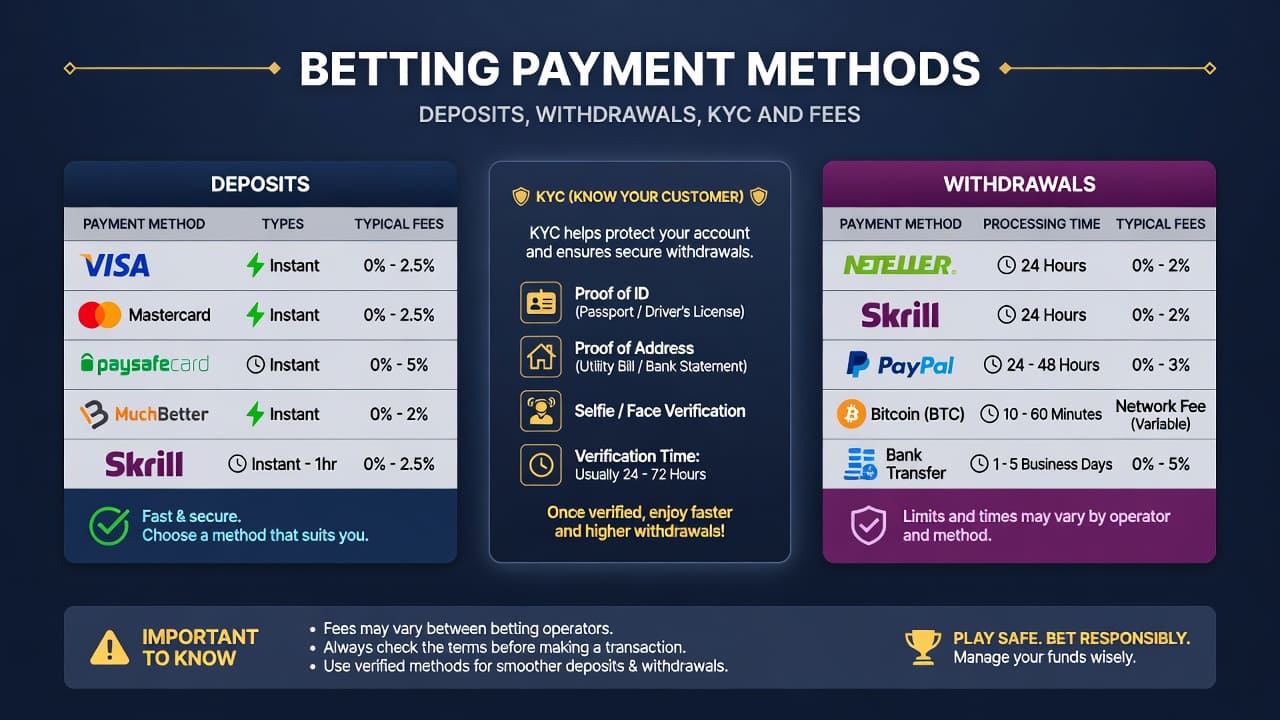
Deposits, withdrawals and payment ownership
Deposits and withdrawals are separate processes
A deposit moves money into a betting balance. A withdrawal requires the operator to approve the request and release the funds to an eligible payment destination.
A payment method may accept deposits but not withdrawals. This can happen with some cards, prepaid products, virtual payment methods and local gateways. The operator may instead require a verified bank account, e-wallet or another supported route.
- Check whether the deposit method can also receive withdrawals.
- Review minimum and maximum transaction amounts.
- Confirm the account currency and possible conversion costs.
- Check whether the original deposit must first be returned through the same route.
Payment ownership and KYC
The betting account and payment method should belong to the same person. Depositing from another person’s card, bank account, e-wallet or mobile-money wallet can trigger additional checks, rejection or a return of funds.
Know Your Customer checks may include proof of identity, proof of address, date of birth, payment ownership and questions about the source of funds. Verification may be requested during registration, after a deposit or before a withdrawal.
- Use your legal name and correct date of birth.
- Use a phone number and email address you control.
- Upload documents only through an official account or confirmed support channel.
- Never provide passwords, full card security codes, seed phrases or private keys.
Deposit speed does not predict withdrawal speed
A deposit may require only payment authorisation. A withdrawal can remain under operator review before it reaches the payment provider.
Cards, bank transfers, e-wallets and mobile money
Availability and limits depend on the operator, provider, account and country.
| Method | Typical use | Main check | Main risk |
|---|---|---|---|
| Cards | Common for deposits; payout support varies. | Cardholder name and withdrawal eligibility. | Bank restrictions, failed authentication or unsupported payouts. |
| Bank transfer | Deposits and verified bank-account withdrawals. | Correct account details, reference and ownership. | Incorrect details, delayed matching or intermediary processing. |
| E-wallet | Deposits and withdrawals where supported. | Verified wallet in the account holder’s name. | Wallet fees, conversion costs or country restrictions. |
| Mobile money | Regional phone-linked deposits and withdrawals. | Phone number, wallet ownership and provider limits. | Name mismatches, wallet limits or unavailable payout routes. |
Card availability depends on the country, operator, bank, card network and card settings. A bank may permit normal online purchases while restricting gambling-related transactions.
Some operators can return only the deposited amount to the original card, while additional winnings may need to be withdrawn through another verified method.
Bank transfer can describe a conventional account transfer, local instant-payment system, online-banking gateway or open-banking payment. These routes do not have one universal processing time.
Copy beneficiary details only from the official cashier and use the requested reference exactly.
E-wallets may provide a separate payment layer between a sportsbook and a primary bank account. The wallet should normally be verified and registered in the same name as the betting account.
Check funding fees, withdrawal charges, currency conversion and country restrictions.
Mobile money is linked to a phone number and wallet. Exact matching and verification requirements depend on the operator, provider and local rules.
Cryptocurrency transaction risks
Cryptocurrency is not automatically anonymous or instant
Blockchain transfers create transaction records. Operators, exchanges and wallet providers may request identity, wallet-ownership or source-of-funds evidence.
- Wrong network: an asset sent through an unsupported blockchain may not be recoverable.
- Wrong address: confirmed blockchain transfers are generally irreversible.
- Missing memo or tag: some assets require an additional account identifier.
- Price movement: the asset value may change before the withdrawal is completed.
- Network fees: the received amount may be lower than the amount sent.
- Exchange restrictions: an exchange may review or restrict gambling-related transfers.
Check every transfer separately
Confirm the asset, network, address and required memo in the official cashier before sending funds. Never disclose a wallet seed phrase, private key or password.
Processing time, review time and transaction costs
Processing time versus sportsbook review time
Payment-provider processing begins only after the sportsbook approves and releases the withdrawal.
A “processed” or “paid” status may mean that the operator released the withdrawal. It does not necessarily mean that the receiving bank or wallet has already credited the funds.
Currency conversion and fees
The operator’s visible fee is only one possible cost. A bank, card issuer, e-wallet, mobile-money provider, cryptocurrency network or intermediary processor may apply another charge.
- Confirm the currency of the betting account.
- Check the currency used by the payment method.
- Identify which party sets the exchange rate.
- Review operator and payment-provider charges.
- Check minimum withdrawal limits.
Fee-free does not always mean cost-free
A transaction can have no separately listed fee but still include a currency-conversion spread or another provider charge.
Evidence, pending withdrawals and country availability
Evidence to retain
- transaction date, time, amount and currency;
- sportsbook transaction reference;
- bank, wallet, mobile-money or blockchain reference;
- screenshots of the transaction status;
- verification submission dates;
- support replies and complaint case numbers;
- the operator’s reason for a rejection, cancellation or delay.
Mask unrelated balances, full card numbers and other sensitive information before sending evidence.
What to do when a withdrawal is pending
Do not deposit additional money to “unlock”, “verify” or “release” an existing withdrawal.
Country-specific availability
The same operator may offer cards in one country, mobile money in another and bank transfers only in a third. Availability can also change because of regulation, provider maintenance, banking restrictions or account controls.
FAQ: betting payment methods
Can I withdraw using a different method from my deposit?
Sometimes. An operator may first return the deposited amount through the original route. Additional funds may then be paid through another verified method if the original route cannot receive withdrawals.
Why is my betting withdrawal still pending?
The operator may still be reviewing identity, payment ownership, account activity, payout details or applicable conditions. A pending status usually means the payment provider has not yet completed the final transfer.
Does the payment method need to be in my name?
In most cases, the payment method should belong to the verified betting account holder. Using another person’s card, bank account or wallet can lead to additional checks, rejection or a return of funds.
Are cryptocurrency betting payments anonymous?
No. Blockchain transactions create records, and operators or exchanges may request identity, wallet-ownership or source-of-funds evidence.
Which betting payment method is fastest?
There is no universally fastest method. Deposit speed, sportsbook review time and payment-provider processing are separate stages. The practical option is one that supports withdrawals and works with your verified account and currency.
This guide is for general informational purposes and does not confirm the legality, availability or processing time of any payment method in a particular country. Always check the operator’s current cashier, terms and local rules before making a transaction.