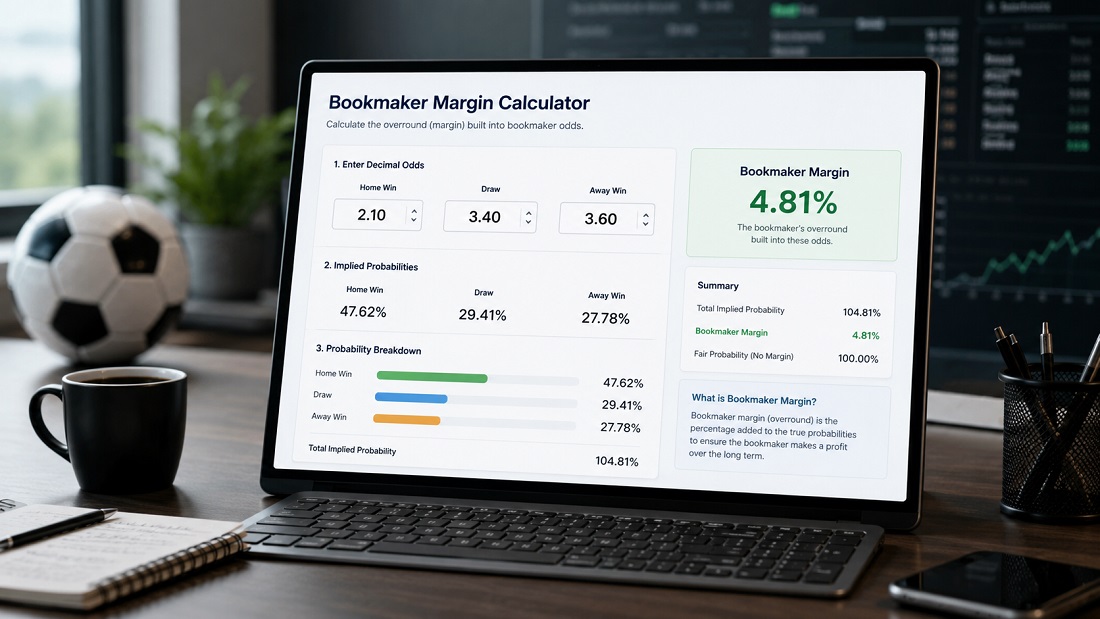
Use this bookmaker margin calculator to check the built-in cost inside a two-way or three-way betting market. Enter decimal odds, calculate total implied probability, and compare the bookmaker’s overround with a no-vig version of the same market.
The calculator does not pick winners. It helps you see whether the price you are considering comes from a tight market, an expensive market, or a market that needs extra caution before comparison.
Bookmaker margin is the extra percentage built into a market after all outcome probabilities are added together. A fair market adds up to 100%; anything above that is the bookmaker’s overround.
Margin, implied probability and no-vig probability help you read the market before treating any odds as value.
Decimal odds2-way or 3-way marketsNo-vig probabilities
Calculate bookmaker margin
Decimal odds convert into implied probability with 1 ÷ decimal odds. Add every active outcome together. If the total is above 100%, the difference is the bookmaker margin.
Use two outcomes for tennis match winner or football over/under. Use three outcomes for football 1X2.
OutcomeLabelDecimal odds
Outcome 1
Label
Decimal odds
Outcome 2
Label
Decimal odds
Outcome 3
Label
Decimal odds
Result
Total implied probability
—
Bookmaker margin
—
Market quality read
—
Enter decimal odds above 1.00 and calculate. Invalid input clears old results so the page never keeps stale numbers.
Who this calculator is for
This tool is useful for readers who want to understand the price before judging the pick. It works especially well when you are comparing the same market across bookmakers, checking whether a favourite has been shortened too far, or testing whether your own probability estimate is strong enough to beat the available odds.
New bettors learning market cost
If you are new to odds, the calculator shows why three prices in a football 1X2 market usually add up to more than 100% after conversion into implied probability.
Readers comparing bookmaker lines
The same selection can look better or worse depending on the whole market around it. A lower overround often gives a cleaner starting point for price comparison.
Value-focused bettors
No-vig probability helps you compare the market’s fair-price baseline with your own estimate. If your estimate is not clearly better, the edge may be too thin.
No-vig probabilities from your odds
No-vig probability removes the overround and scales the market back to 100%. This helps you compare a bookmaker’s price with your own probability view without treating the bookmaker’s full margin as part of the fair price.
Outcome
Implied probability
No-vig probability
Fair odds
—
—
—
—
How this calculator works
Bookmaker margin = total implied probability − 100%.
For decimal odds, each outcome probability is calculated as 1 ÷ odds.
In a football 1X2 market, the odds for home win, draw and away win usually add up to more than 100% after conversion into implied probability. That excess is called bookmaker margin, overround or vigorish.
For example, decimal prices of 2.10, 3.40 and 3.60 imply about 47.62%, 29.41% and 27.78%. Together, they create a 104.81% book. The bookmaker margin is therefore about 4.81 percentage points above a fair 100% market.
Calculation method: this calculator uses formula-based odds conversion only. It converts decimal odds into implied probability, adds the active outcomes, and rescales each outcome into a no-vig version of the same market.
What this calculator does not do
The margin result is a price-structure check. It should be read before, not instead of, match analysis, market comparison and rule checks.
It does not forecast the result.
A tight market can still contain a poor bet, and an expensive market can still include a usable price if your probability view is strong enough.
It does not include bookmaker limits or liquidity.
A visible price may have stake limits, regional availability, or fast movement that changes the practical value of the line.
It does not adjust for bonuses or promotions.
Boosted odds, free bets and refunds need separate calculation because their expected value depends on the promotion rules.
It does not replace settlement-rule checks.
Do not compare 1X2, DNB, Asian handicap, each-way, dead-heat and push markets as if they were the same product.
It does not freeze live markets.
In live betting, margin and no-vig probability can become outdated within seconds after a goal, injury, red card or major price move.
How Odds2Win reads this result
At Odds2Win, bookmaker margin is used as a price-quality filter. The practical sequence is simple: check whether the whole market is expensive, compare the no-vig probability with your own estimate, then see whether another bookmaker offers a better price on the same selection.
1. Check the whole market
Margin cannot be judged from one selection. For football 1X2, include home win, draw and away win. For two-way markets, include both sides.
2. Compare the same market type
Do not treat 1X2, DNB and Asian handicap as identical. The price may look similar, but draw protection, push rules and settlement conditions change the comparison.
3. Recheck fast-moving prices
Live betting and late team news can change the margin quickly. If the price has moved, calculate again before relying on the previous result.
Example: compare two bookmakers before judging value
The same match can look different across books. If one bookmaker offers a tighter market, your no-vig baseline is usually cleaner. If another offers a better price on your exact selection, that single price may still matter more than the headline market margin.
Example market
Total implied probability
Margin
Practical read
Bookmaker AHome 2.10 / Draw 3.40 / Away 3.60
104.81%
4.81%
Competitive enough to use as a baseline, but still not proof that any single pick is mispriced.
Bookmaker BHome 2.05 / Draw 3.30 / Away 3.45
108.11%
8.11%
More expensive market. Your edge needs to be stronger before accepting the offered price.
Practical betting analysis checklist
Use every possible outcome.
Margin cannot be calculated from one side of the market. For football 1X2, include home win, draw and away win.
Separate market types.
A DNB price should not be compared with a 1X2 price without accounting for draw protection and lower return.
Watch the timing of the price.
Early prices, closing prices and live prices can carry different margins. A market can look attractive before team news and much less attractive later.
Use no-vig probability as a reference.
It helps remove the overround, but the bet still depends on whether your own probability estimate is better than the market’s fair-price baseline.
Common bookmaker margin ranges
Margin varies by sport, market depth, liquidity, timing and bookmaker model. The ranges below are a practical reading guide, not a universal benchmark.
Margin range
How to read it
Practical meaning
Below 0%
Underround
May indicate stale prices, mismatched books or an arbitrage-style comparison. Recheck the market before trusting it.
0%–3%
Very tight market
Often seen in liquid markets where small price differences matter heavily.
3%–6%
Competitive range
Usable as a baseline, but still beatable only if your probability estimate is stronger than the price.
6%–10%
Expensive market
Requires a clearer edge before accepting the offered odds.
10%+
Very expensive market
Common in small, special or low-liquidity markets. Be careful unless you understand why the price still fits your analysis.
Common mistakes when reading bookmaker margin
Confusing margin with expected bookmaker profit.
A 5% margin does not mean the bookmaker earns exactly 5% on that match. It describes the structure of the prices, not the final result.
Calculating only one side of the market.
One price gives implied probability. Margin requires every possible outcome in that market.
Mixing odds formats without conversion.
This calculator uses decimal odds. American and fractional odds should be converted before applying the formula.
Calling every high odd a value bet.
A big price can still be poor value if the true chance of the outcome is lower than the probability implied by the odds.
Ignoring market rules.
Asian handicap, each-way, dead-heat, void and push rules can affect how a price should be interpreted.
Bookmaker Margin Calculator FAQ
What is bookmaker margin?
Bookmaker margin is the percentage built into a betting market above a fair 100% implied probability. It shows the extra cost included when all outcomes are priced together.
Is bookmaker margin the same as overround?
In everyday betting analysis, the terms are closely related. Overround usually refers to the total implied probability above 100%, while margin is the extra percentage beyond the fair book.
What is a good bookmaker margin?
Lower is usually better for the bettor, but context matters. A margin below 3% is tight, 3%–6% is competitive, 6%–10% is expensive, and 10%+ usually needs extra caution.
Can bookmaker margin show a value bet?
Not by itself. Margin shows market cost. A value bet appears only when your estimated probability is higher than the probability implied by the available odds after proper comparison.
Why does the calculator show no-vig probability?
No-vig probability removes the overround and normalises the market to 100%. This gives a cleaner baseline for comparing the market with your own probability estimate.
Editorial review
Reviewed for Odds2Win betting education standards. Last updated: June 2026.