
1X2 Predictions Today
Today’s 1X2 Betting Guide
1X2 predictions compare the three possible match outcomes: home win, draw, or away win. This page helps you read 1X2 odds more clearly, convert prices into implied probability, and understand when draw risk makes markets like Draw No Bet or double chance more practical than a straight win pick.
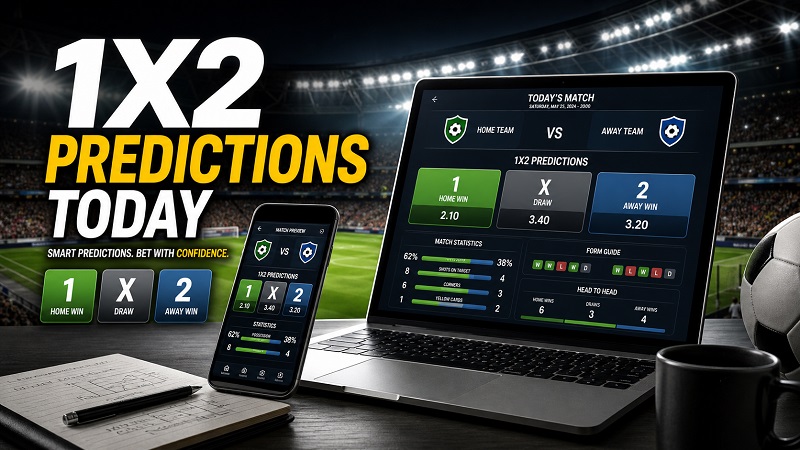
Today’s 1X2 predictions
A 1X2 pick is not just a team name. It has to survive three checks: win route, draw risk, and price. The key question is simple: does the price still make sense after you account for the draw, late goals, set pieces, and team-news uncertainty?
A useful 1X2 read should make the bet logic clear before the odds are even discussed: why this outcome can happen, what can break the pick, and whether the current price still leaves enough room for risk.
How we evaluate 1X2 picks
Each Odds2Win 1X2 read starts with the same pre-bet check: settlement rule, repeatable win route, draw route, team news, and price after market margin. We do not treat a favourite as a pick unless the odds still make sense against realistic match risks.
- Settlement rule: confirm whether the market is regular time, 90 minutes, or includes overtime.
- Win route: check how the selected side can create repeatable chances rather than relying on one moment.
- Draw route: identify whether the underdog can slow the match, defend the box, or survive through set pieces.
- Price check: compare implied probability with match risk after bookmaker margin, team news, and line movement.
Before backing a 1X2 pick
- Home win: best when the home side has a repeatable win route and the opponent relies on isolated moments.
- Draw: more relevant in low-margin football games, especially when both teams can slow the match state.
- Away win: stronger when the away team can control territory without becoming exposed in transition.
How 1X2 odds work
A 1X2 market has three possible selections. 1 means the home team wins, X means the match ends in a draw, and 2 means the away team wins. In football and hockey, this usually refers to the result after regular time unless the bookmaker states another settlement rule.
The important point is that 1X2 includes draw risk. A favourite can play well and still fail to win if the game ends level. That is why a short price on a favourite is not automatically attractive. The price must compensate for all realistic outcomes, including a late equaliser, a set-piece swing, a red card, or a game-state flip after the first goal.
| Pick | Meaning | Main risk |
|---|---|---|
| 1 | Home team wins the match. | Draw or away upset. |
| X | The match finishes level. | One team converts late pressure. |
| 2 | Away team wins the match. | Home resistance, crowd pressure, or draw. |
How to read implied probability
Implied probability converts decimal odds into the percentage chance suggested by the market. The formula is simple: 1 ÷ decimal odds × 100. If a team is priced at 2.00, the implied probability is 50%. If the price is 1.80, the implied probability is about 55.6%.
This does not mean the bookmaker is saying the outcome will happen exactly that often. It is a price signal. In a real 1X2 market, the implied probabilities for 1, X, and 2 usually add up to more than 100% because bookmaker margin is built into the prices.
Your job is to decide whether your own read is higher or lower than the market’s implied number after allowing for draw risk, team news uncertainty, match style, and that built-in margin.
| Decimal odds | Implied probability | How to read it |
|---|---|---|
| 1.50 | 66.7% | Strong favourite, but draw risk still matters. |
| 2.00 | 50.0% | Market is close to an even chance. |
| 3.25 | 30.8% | Underdog or draw-type probability range. |
Value check
A 1X2 selection becomes more interesting only when your estimated probability is clearly higher than the implied probability. A small edge without margin, team-news, and line-movement context is usually closer to a no-bet than a value bet.
When 1X2 is risky
1X2 is risky when the match can be competitive without producing a clear winner. This is common in football because the draw is a live outcome. A favourite may control long periods, but a low block, weak finishing, one defensive error, one set-piece swing, or one missed chance can keep the result inside the draw range.
Risk signals before betting
- Low-margin favourite: the favourite is better, but not strong enough to separate easily.
- Draw-friendly tempo: both sides can accept long periods without forcing the game open.
- Set-piece dependence: the underdog has a realistic route through corners, free kicks, or aerial pressure.
- Lineup uncertainty: missing attackers, rotation, or unclear motivation can reduce the win route.
- Price compression: the favourite has shortened so much that the reward no longer matches the risk.
In these spots, the better decision may be to pass, wait for live information, or compare 1X2 with Draw No Bet. A live marker during the first 10–15 minutes can also help. If the match starts with repeated transitions, poor defensive spacing, or early pressure from the underdog, the pre-match 1X2 read may become weaker.
1X2 vs Draw No Bet
Draw No Bet removes the draw from the loss column. If your team wins, the bet wins. If the match is drawn, the stake is returned. If your team loses, the bet loses. The trade-off is simple: DNB gives protection, but usually pays less than 1X2.
This comparison matters most in football. A low-margin away favourite may still be the better team, but the draw can be too live to ignore. In that case, DNB can match the same side opinion while reducing the cost of a tight game-state flip.
| Market | Best use | Trade-off |
|---|---|---|
| 1X2 | Use when you accept draw risk and the price is strong enough. | Higher return, but a draw loses. |
| Draw No Bet | Use when your side is favoured but the draw remains realistic. | Lower return, but draw protection. |
| Pass / wait live | Use when pre-match price and uncertainty do not align. | No action, but better risk control. |
Where 1X2 logic applies — and where it does not
Football
Football is the main 1X2 sport because the draw is a central part of the market. The best reads usually combine team strength, match tempo, first-goal sensitivity, and whether the underdog has a real route to keeping the score close. Always check whether the market settles after 90 minutes, regular time, or another stated rule.
Tennis
Tennis is not classic 1X2 because normal match-winner markets do not include a draw. It belongs in a separate betting logic: price, matchup style, surface fit, and whether the favourite’s hold/return profile justifies the market number.
Basketball
Basketball is also not classic 1X2. NBA moneyline markets are win/lose predictions, so the focus shifts toward pace, rotation strength, rest spots, late-game execution, and whether the price has already moved too far.
Hockey
Hockey can have several settlement formats, so the first step is to confirm whether the market is regular time, includes overtime, or uses another stated rule. Low-scoring games can make favourites fragile when one goal changes the full market shape.
FAQ
What does 1X2 mean in betting?
1X2 means home win, draw, or away win. The “1” is the home team, “X” is the draw, and “2” is the away team. It is most common in football, where the draw is a normal result.
Are 1X2 predictions the same as match-winner tips?
They are similar, but 1X2 specifically includes the draw as a separate betting option. In sports without a draw, such as tennis, the market is usually treated as a match-winner or moneyline prediction.
How do I know if a 1X2 price has value?
Convert the odds into implied probability, then compare that number with your own estimated chance. A selection only looks attractive when your estimate is clearly higher than the market’s implied probability.
When should I avoid a 1X2 favourite?
Avoid a favourite when the draw is very live, the price has become too short, or the team’s win route depends on narrow margins. A low-margin away favourite often needs extra caution.
Is Draw No Bet safer than 1X2?
Draw No Bet is safer against the draw because a level result returns the stake. The downside is a lower price, so it is not automatically better. It is most useful when you like one team but respect the draw risk.
Can implied probability guarantee a winning prediction?
No. Implied probability is a pricing tool, not a guarantee. It helps you understand what the odds suggest, but match outcomes remain uncertain and should be managed with disciplined staking.
Sportsbook codes and related prediction sections
Use these sportsbook-code links as entry points only after checking the operator’s current bonus terms, eligibility rules, and account conditions. Availability and offer details can change by operator.